VALORANT Cheater Detected Message: Does Lost RR Come Back?
Written by Valorant Village
Source-backed coverage ●
Seeing a cheater message after a VALORANT match feels like it should come with a refund receipt. It does not, at least not automatically in every case.
Riot has used a red, full-screen notification for this situation. In an official 2021 competitive ruling, Riot described players receiving “a cheater detected in their game” and called it the “Red Screen.” That is the clearest first-party description of the old message, but it is not a promise that every current client, platform or queue uses identical wording. (Riot’s competitive ruling)
Here is how to read the warning without guessing what happened to your RR.
What the message means
The useful part is the word detected. The message is a system intervention, not a verdict that you can issue from a scoreboard or a replay. Riot’s anti-cheat team says Vanguard uses prevention, automated detection and behavioral systems to act against cheating. It does not publish every detection signal or a player-facing formula for deciding when a match is invalidated. (Anti-Cheat Update // Winter 2023)
Riot has also described match terminations and player notifications as possible anti-cheat actions in its console-focused Vanguard article. That makes one distinction important: a notification tells you that Riot intervened, but it does not tell you the exact rating result for every mode or platform. (Vanguard x VALORANT)
Do not treat a clip, a screenshot or an opponent who looked suspicious as the same thing as a Riot confirmation. A player can have an unbelievable game without being caught by Vanguard. Conversely, a later action may be based on information that was not visible in the match.
What to do after you see it
First, let the client finish its own flow. If the game terminates or returns you to the menu, do not disconnect your account in a panic. Save a screenshot if you can, and note the approximate time, mode, map and match result. Those details are more useful than trying to reconstruct the whole scoreboard from memory.
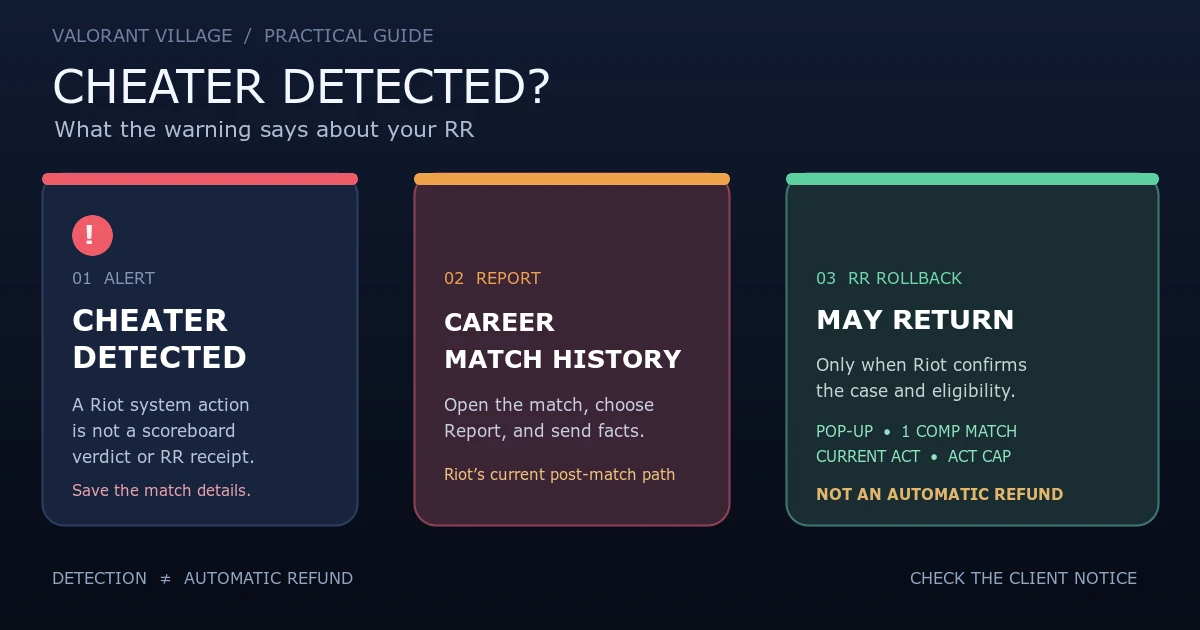
If the suspected player is still reportable, use Riot’s post-match route. Open Career, select Match History, open the relevant match, right-click the player’s name, choose Report, fill out the form and submit it. That is Riot’s current documented process, including for reports made after the match has ended. (Report Players After Game Here)
You do not need to write a detective novel. Pick the cheating category, add a short factual note if the form allows it, and include the match details you saved. Riot says reports are one part of the information used to curb bad behavior. It may send an email when a successful report leads to action, but it says those emails are limited to one per week. No email does not prove that nothing happened. (Received an Email After Reporting)
If the notice clearly identifies a cheater, do not deliberately keep queueing with that player. Riot’s older competitive ruling treated repeated re-queueing after the red notification as evidence in a specific competitive-policy case. That ruling is not a universal penalty table for every player, but avoiding the situation is the sensible move.
When Riot can restore lost RR
Riot’s most specific public rule is the Ranked Rollbacks section of Patch 10.05. It says that if you lost RR because of a match against a confirmed cheater in the last week, you may be eligible for an RR refund.
The process Riot published is quite specific:
- You receive a pop-up showing the exact RR amount.
- You complete one Competitive match to apply it.
- The refund is added to your total in that match’s End of Game summary, whether you win or lose.
- The rollback is valid only during the current Act and is subject to an Act cap.
That is a real refund path. It is also narrower than “I saw a cheater message, so my RR must come back.” Riot’s wording depends on a confirmed cheater and eligibility conditions. It does not say that every detection notice restores every player’s loss, that every terminated match has the same outcome, or that a player can calculate the amount from K/D or the final score.
There is another source of confusion. Riot’s July 2026 policy on boosting and other rank manipulation discusses RR/MMR reversions and reward reversions for confirmed abuse. Those are enforcement actions against manipulated rank, not a replacement for the Ranked Rollbacks rule. Keep the two policies separate. (Playing Fair: Anti-boosting and other smurfing countermeasures)
If the refund does not appear
Check whether an in-client rollback pop-up appeared, whether the match was Competitive, and whether you are still in the same Act. If Riot tells you to complete a match, do that before deciding the system failed. If there is no notification, do not play a game solely because an old post promised a refund.
Keep the screenshot and match details, then contact Riot Player Support if you believe your case matches the published eligibility but the rollback never appeared. Ask Riot to review the match; do not describe a manual restoration as guaranteed, because the public rule does not make that promise.
If the match also involved a disconnect or a failed vote, compare the decision with our remake, surrender and AFK rules guide. For the wider ranked-integrity context, see the current penalty and enforcement notes.
The safest reading is simple: the message means Riot has taken an anti-cheat action. Lost RR may be returned through an eligible Ranked Rollback, but the message by itself is not proof of a refund. Check the client’s notification, report through Match History, and let Riot’s confirmed case and current-Act rules decide the rating outcome.