Does Deathmatch Improve Aim? A Practice Plan With Limits
Written by Valorant Village
Source-backed coverage ●
Deathmatch can improve some aim, but “aim” is not one skill. Riot describes FFA Deathmatch as a mode built to sharpen Free For All skills, with a fast loop of live encounters. That makes it useful for a narrow question: can you perform one shooting habit when another player appears? It does not answer whether you chose the right fight, helped a teammate, or protected the Spike.
What Deathmatch can train
Riot’s FFA Deathmatch rules describe a no-team mode with no abilities, infinite money, weapon swapping, and up to 14 players. A lobby ends at 40 kills or when nine minutes expire. Respawns place you near the action, enemies are revealed after a respawn, health packs restore full health and armor for a short window, and a kill reloads your weapon.
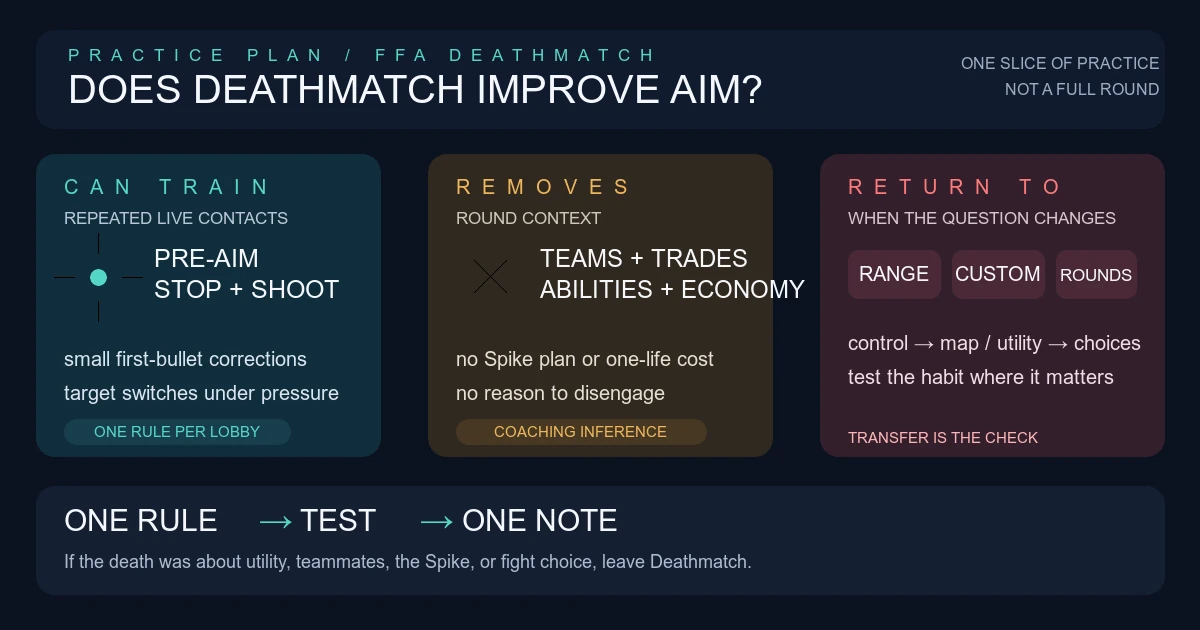
Those rules create many chances to practise pre-aiming an angle, stopping before the first bullet, making a small correction, controlling a short burst, and switching to a second target. That list is Valorant Village coaching inference from the repeated contacts, not a Riot promise that Deathmatch will raise your aim, wins, or rank. The mode can show whether a habit survives surprise and imperfect timing. It cannot tell you whether the habit produced a good round decision.
If your crosshair is the first thing going wrong, use our VALORANT Crosshair Placement guide to name the starting-position problem before you queue. A named problem is easier to test than “my aim feels bad.”
What the rules remove
This is the important limit, and it is a Valorant Village coaching inference from Riot’s rules. No teammate means no trade. No abilities means no smoke, flash, recon, or timing around a cooldown. Infinite money and weapon swapping remove buy decisions. Respawning removes the one-life cost of a reckless swing. The health packs, instant reload after a kill, and enemy reveal after respawn keep the loop moving instead of asking you to hold a round state.
Deathmatch therefore gives weak practice for playing off a teammate, delaying a hit, holding a post-plant, retaking with utility, or deciding when to disengage. A reckless peek can be a cheap repetition in FFA and a round-losing choice elsewhere. There is no Spike plan to organise around, and the mode does not ask you to make information, timing, and shooting work together.
Use one deliberate rule
Call this section coaching, not Riot instruction. Riot’s Beginner’s Guide gives the mechanical baseline: learn where enemies can come from, watch angles and corners, ask whether an ability helps the next goal, communicate, and stop moving before shooting to be more accurate. It does not prescribe a Deathmatch routine.
For one lobby, use one rule: “I will not fire until I have stopped.” Choose a familiar rifle and keep that rule from the first spawn to the final scoreboard. Do not add a second target such as a kill total, a headshot percentage, or a new sensitivity.
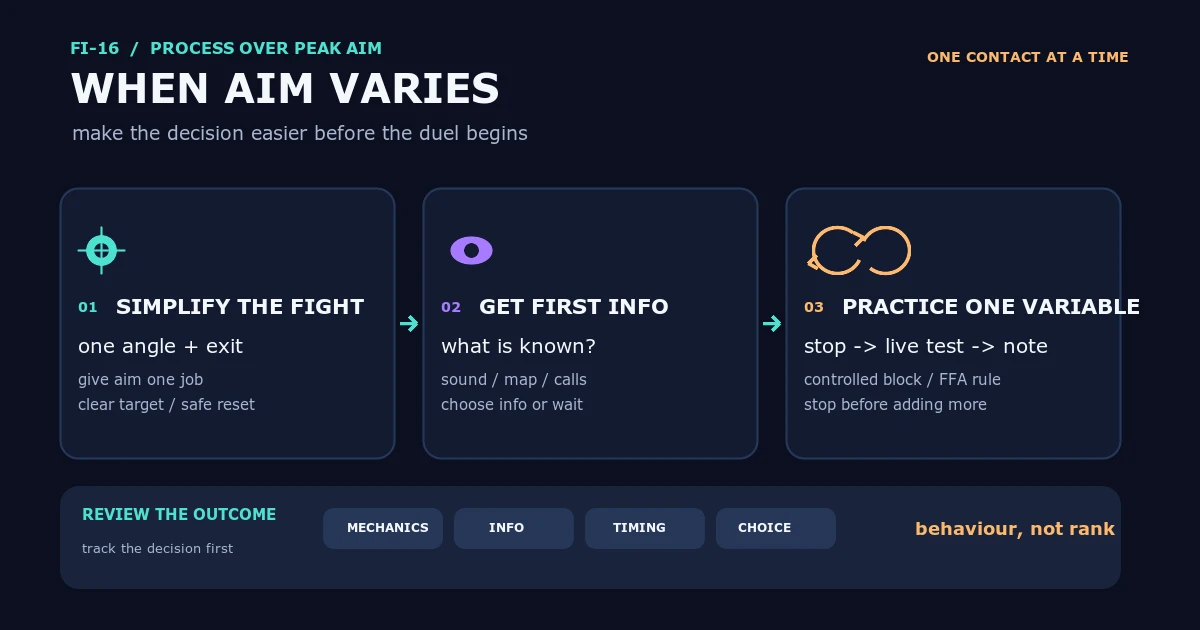
Before queueing, write the rule where you can see it. During the lobby, judge only the first burst of each fight. After a death, ask, “Did I move while firing?” If yes, record one short note and continue. If no, ask separately whether the crosshair or fight choice was the problem, but do not change the drill mid-match. The scoreboard is context, not a grade. Holding a spawn angle or sprinting toward every sound can inflate repetitions without practising the habit you chose.
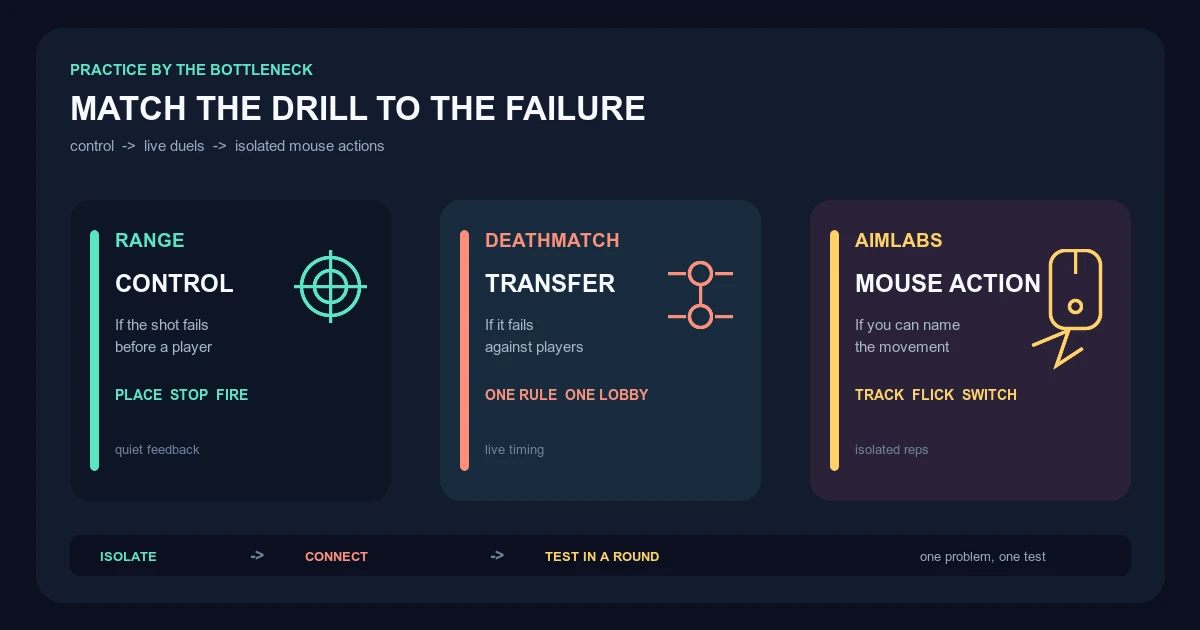
Finish with three concrete observations, such as “I fired during a strafe at close range” or “my crosshair arrived low after turning.” One short focused lobby is enough to answer a question. If you need a bounded warm-up around it, use the 20-minute VALORANT warm-up. Our Range, Deathmatch or Aimlabs guide also explains why the tool should follow the mistake, not the other way around.
When to leave Deathmatch
Return to The Range when the error appears against a still target or before another player can disrupt you. If your crosshair starts on the floor, your stop-and-shoot timing is unclear, or a burst is inconsistent, spend a few minutes repeating one rifle action with no lobby noise. The Range isolates the motion. It cannot validate decisions.
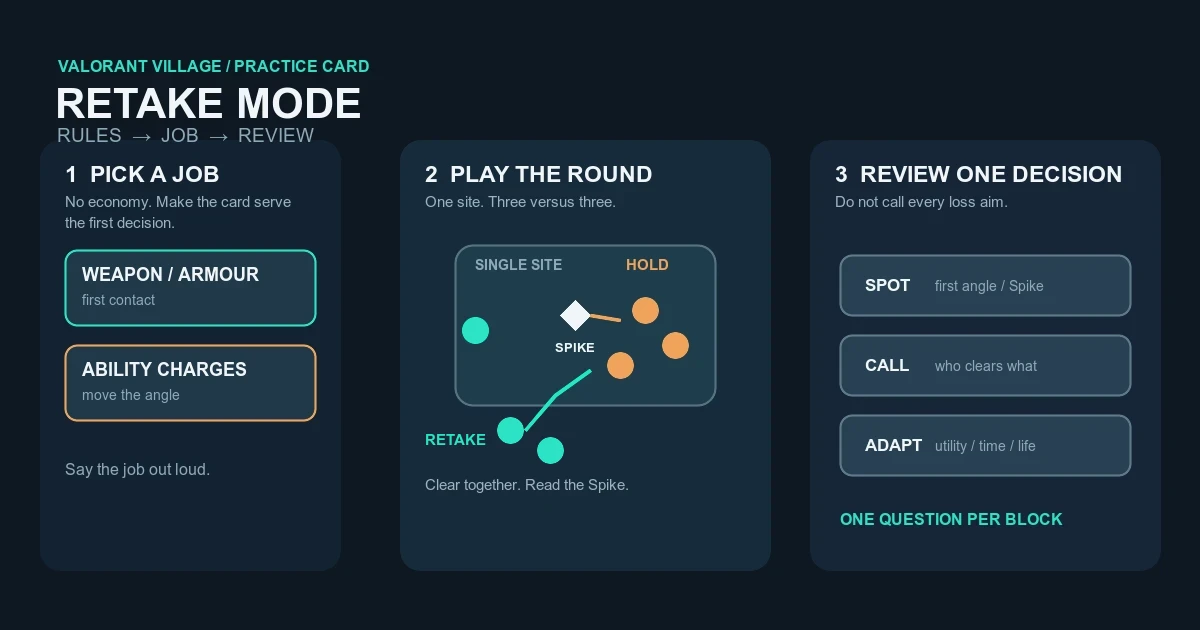
Use a custom game when the motion is fine but the map is the problem. Walk one route, clear one angle order, or rehearse the space around a plant or retake. Add the agent ability or teammate timing that Deathmatch removed. That is coaching advice, not an official Riot drill. If you cannot describe what the custom session is testing, return to The Range instead.
Use a real round when the duel only makes sense with an objective. Riot’s Beginner’s Guide says attackers plant and detonate the Spike, defenders defuse after a plant, and communication helps the team. Riot’s tac-cycle explanation describes Intel, Plan, Execute, and Repeat, with timing, abilities, and shooting inside execution. Carry the same one rule into Unrated or Competitive, but let the round decide when to fight. Do not swing a site or ignore a teammate to prove your practice point.
After the session, classify the repeated miss as mechanics, timing, information, or fight choice. If the answer is fight choice, queueing another Deathmatch is not a diagnosis. Return to the practice surface that contains the missing decision.
Sources checked
- Riot Games Support, “VALORANT Game Mode - FFA Deathmatch”, page date displayed as 2024-10-31 23:52, checked in a live browser at 2026-08-14T13:40:15Z. Used for the mode rules and Riot’s stated skill-sharpening purpose.
- Riot Games, “Beginner’s Guide”, page date displayed as 2024-08-03, checked in a live browser at 2026-08-14T13:40:40Z. Used for stopping before shooting, angle awareness, objective context, abilities, and communication.
- Riot Games, “How we balance VALORANT”, page date displayed as 2020-06-27, checked in a live browser at 2026-08-14T13:41:07Z. Used for the Intel, Plan, Execute, Repeat frame and the distinction between mechanical execution and broader round decisions.
The rule selection, limits, transfer tests, and advice about returning to The Range, a custom game, or real rounds are Valorant Village coaching inference, not a guarantee of better aim, wins, or rank.