Why VALORANT Teams Need Smokes (and How to Play Around Them)
Written by Valorant Village
Source-backed coverage ●
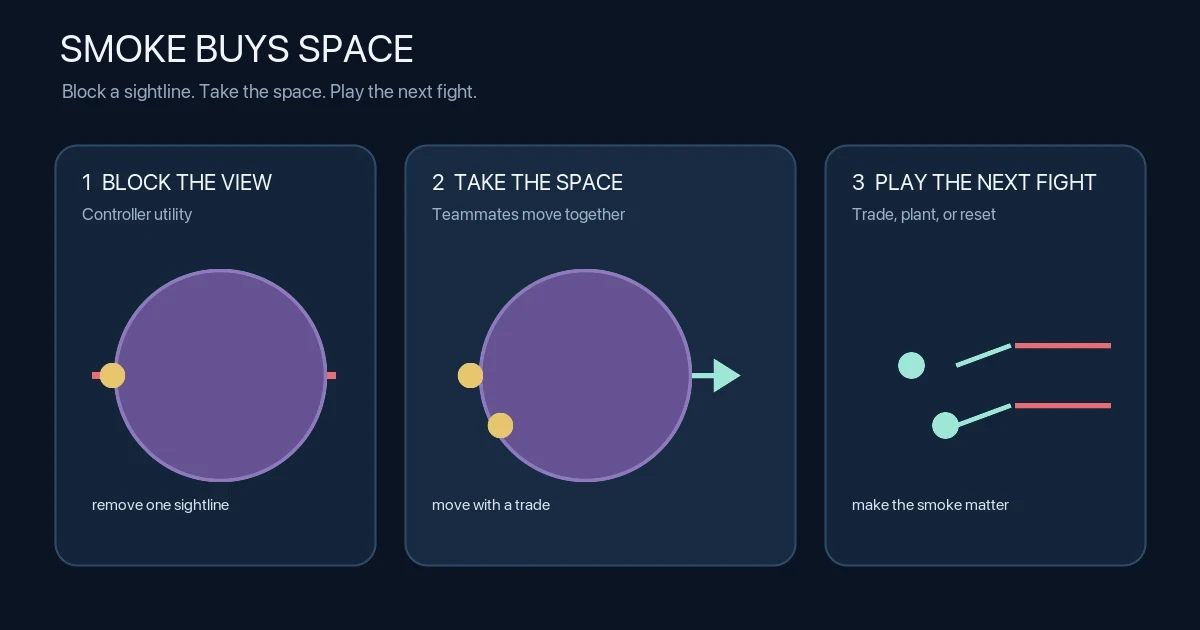
A smoke is not useful because it looks dramatic on the minimap. It is useful when the team does something with the space it hides.
That is the part many ranked rounds miss. A Controller drops a smoke, everyone waits behind it, then one player walks through alone and dies. The smoke gets blamed. Usually the missing piece was the plan after the smoke.
Why teams need smokes
Riot’s Beginner’s Guide says a team has a better chance when its agents bring different duties, and gives a Controller’s ability to smoke sight lines as a direct example of making a site easier to enter. Riot also makes clear that no single role is mandatory in every five-player team. That is a useful distinction: smokes are a way to solve a problem, not a box every composition must tick.
The problem is sight. An attacker trying to cross an open lane may be exposed to several defenders at once. A smoke can remove one of those views long enough for the team to cross, plant, regroup or force a closer fight. On defense, it can interrupt a rush, make a choke point less comfortable, or buy time for teammates to rotate. None of that guarantees a kill. It changes which fights the other team can take cleanly.
Controllers do not all do that in the same shape. Riot’s current agent pages describe Omen’s Dark Cover as a shadow sphere that blocks vision and Brimstone’s Sky Smoke as smoke clouds that block vision. Viper’s Toxic Screen is a tall wall of toxic gas, while Harbor’s High Tide creates a vision-blocking screen that slows players who cross it. The names and shapes differ, but the team question stays the same: which sightline are we removing, and what are we doing while it is gone? (Omen, Brimstone, Viper, Harbor)
The Controller’s job in a real round
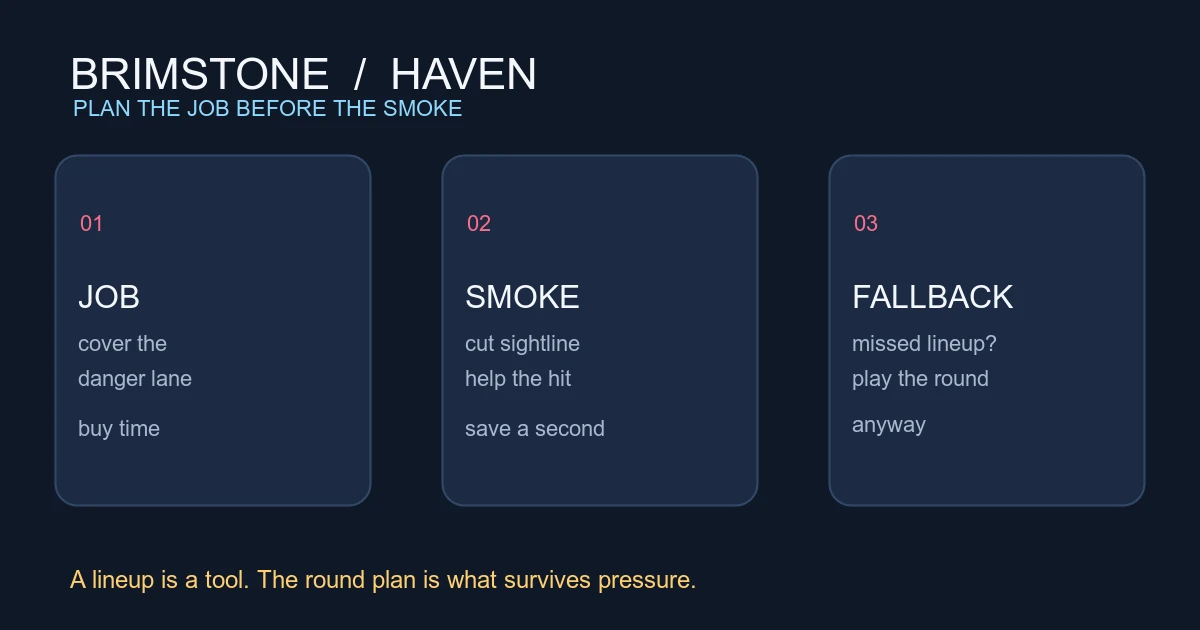
The Controller should not be expected to guess the team’s plan from silence. Before using the first smoke, make the purpose clear: “block the right side so we can cross,” “cut the retake view,” or “hide the plant while we take this space.” The call does not need a named lineup. It needs a reason.
Riot’s tac-cycle article describes every round as Intel → Plan → Execute → Repeat and calls abilities part of reducing the risk of a plan. That is a good way to judge a smoke. Intel tells you where the pressure is. The plan chooses the sightline to remove. The execute is the cross, plant, hold or fight that follows. Then the team checks what changed instead of treating the first smoke as the whole round.
A good Controller also thinks about the second decision. Do not spend every piece of vision control on a decorative cloud at the start of the round if the team has not decided whether it is taking space. Do not save everything forever either. A smoke held until the fight is already lost is not a resource; it is a regret.
The placement should leave teammates a playable route. A smoke that blocks an enemy angle but also hides the only person who can trade you may be the wrong smoke for that moment. If the team is defending, a smoke can be a boundary that makes an entry awkward. It does not mean the Controller has to stand inside it or fight every edge. Call where the next contact is expected and let the rest of the team build around that information.
How teammates should play around the smoke
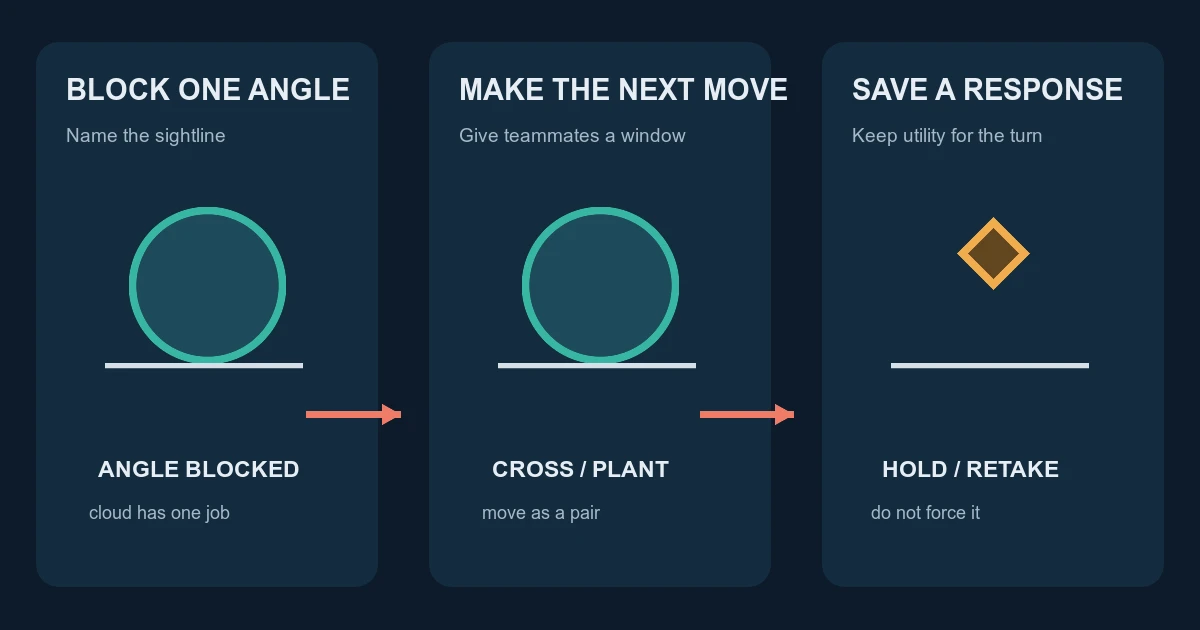
On attack, do not treat the smoke as a waiting room. Use it to move one decision forward.
- Know what it blocks. If the smoke removes one defender’s view, do not wander into a different exposed lane while staring at it. Ask which space is now safer and take that space with a teammate.
- Give the first contact an answer. The player entering first should have a trade nearby, or the team should have information or other utility that makes the entry sensible. A smoke is cover from vision, not a replacement for a second gun.
- Move with the call. “Smoke down” is incomplete. “Smoke down, cross now,” “smoke down, wait for contact,” or “smoke down, plant” tells everyone what the cloud is buying.
- Do not dry-peek the edge because it is there. Enemies often expect a player to appear at the smoke’s boundary. If nobody can trade the fight, wait, take another angle, or change the plan.
On defense, teammates need the same discipline in reverse. If a Controller cuts off a lane, do not immediately undo that work by swinging through alone. Hold the space the smoke has made difficult, listen for the push, and be ready to fight when the enemy commits or when the team has enough information to retake. A smoke can delay a hit without stopping it. That is still useful if the team uses the time to arrive together.
The smoke also needs a clear response when it lands badly. Maybe it covers the wrong sightline, arrives after the team has already given up the site, or leaves the Spike carrier on the wrong side. Do not force the original plan just to prove the smoke was not wasted. Regroup, use the remaining utility, or play the round from the space you actually own.
A quick smoke check before the fight
Ask four questions in voice or ping them as simply as possible:
- What enemy view is blocked?
- Which piece of space are we taking now?
- Who is close enough to trade the first contact?
- What is our next move if nobody fights?
Those questions work for a smoke execute, a defensive delay and a retake. They also stop the common argument from going in circles. The Controller is not there to make every duel fair. The teammates are not there to admire the smoke. Everyone is there to use the changed sightlines for one shared decision.
If nobody knows what the smoke is buying, it is probably only hiding the plan.
The call that makes the smoke useful is usually short. The comms guide gives the wording, while the beginner economy guide explains why a team may choose to spend utility on a weak buy or save it for the next round.