What Determines the VALORANT Performance Bonus? Riot's RR Factors Explained
Written by Valorant Village
Source-backed coverage ●
If a ranked match ends with a better-than-usual RR number, players often call the difference a performance bonus. The shorthand is useful, but it makes the system sound cleaner than it is. Riot’s current How Rank Rating (RR) Is Calculated page calls the relevant category Individual Performance. It is one input into your final RR, not a separate prize for topping the scoreboard.
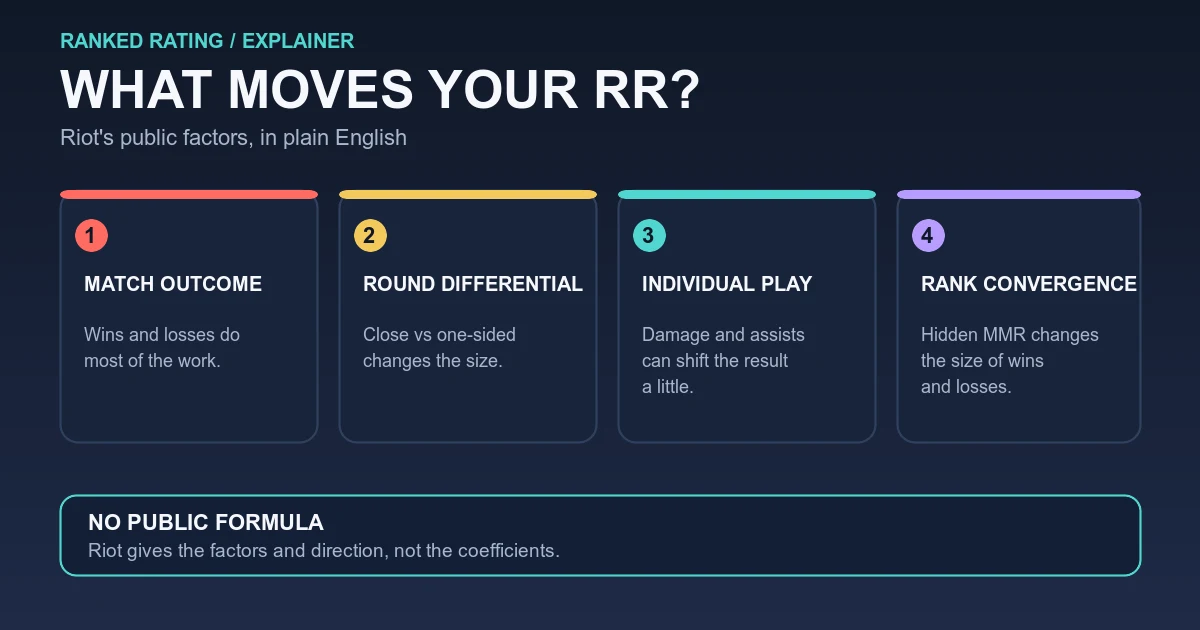
The honest short answer is this: winning matters most. Round differential changes how decisive the result was. An outstanding individual game can slightly improve a win or soften a loss. Then a hidden MMR-to-rank comparison adjusts the payout. Riot publishes those directions. It does not publish the weights, thresholds or equation you could plug your scoreboard into.
The word “bonus” is doing too much work
Riot’s Support article was updated on June 1, 2026 and lists four main factors in the RR calculation. The first is match outcome. A win gives a base amount of RR, and a loss removes a base amount. Riot says the result mostly determines RR movement and recommends working as a team to secure the victory rather than chasing a high K/D/A.
That also answers the question people usually mean when they ask about a bonus after losing: no, a good loss does not become a positive RR result. Riot says you cannot gain RR from a loss. It does say an exceptional performance in that loss can increase your hidden MMR, which may help future RR gains. That is a delayed effect, not a refund for the match you just dropped.
Riot’s four inputs
Round differential is the second piece. One-sided matches move RR more than close games. Riot’s examples are deliberately plain: a 13-2 win earns more RR than a 13-9 win, while a 3-13 defeat loses more than an 11-13 loss. The article does not say that every round has a fixed point value, so treat those examples as direction, not a calculator.
Individual performance is real, but it is the small part of the story. Riot specifically names total damage dealt and assists, not only kills. An outstanding performance can slightly increase your RR gain or cushion your RR loss. The same page says this factor has less impact than the match outcome, and even less impact for Immortal and Radiant, where winning as a team is everything.
The missing detail matters. Riot does not publish the damage threshold for “outstanding,” the value of an assist, or a conversion from combat stats to RR. It also does not promise that a plant, smoke, flash, trade, or non-damaging utility action triggers a bonus. Those plays can make a round more winnable; the public explanation simply does not assign them a direct RR value. That is a gap in the documentation, not proof that the game ignores team play.
Rank convergence explains why two players with similar-looking scoreboards can receive different numbers. Your visible rank is the badge on the ladder. Your MMR is the hidden matchmaking rating Riot uses to estimate skill. If your MMR is higher than your rank, the system gives larger gains on wins and smaller losses on defeats. If they are roughly aligned, gains and losses should be closer. If your rank is ahead of your MMR, wins pay less and losses hurt more while the system tries to pull the two back together.
The current Support page also lists five-stack penalties from 0% to 90%, depending on the rank spread inside the party. That is not a performance bonus, but it is another reason a post-match number may look smaller than your scoreboard suggests. Do not use one result to reverse-engineer your MMR.
What to aim for in a real match
Play for the round, not for a stat line. A clean kill that lets your team take site or hold a retake is useful. A late exit kill followed by a lost round is much less so. You cannot force the hidden formula to reward a particular weapon, agent or K/D, but you can stop treating the scoreboard as the whole match.
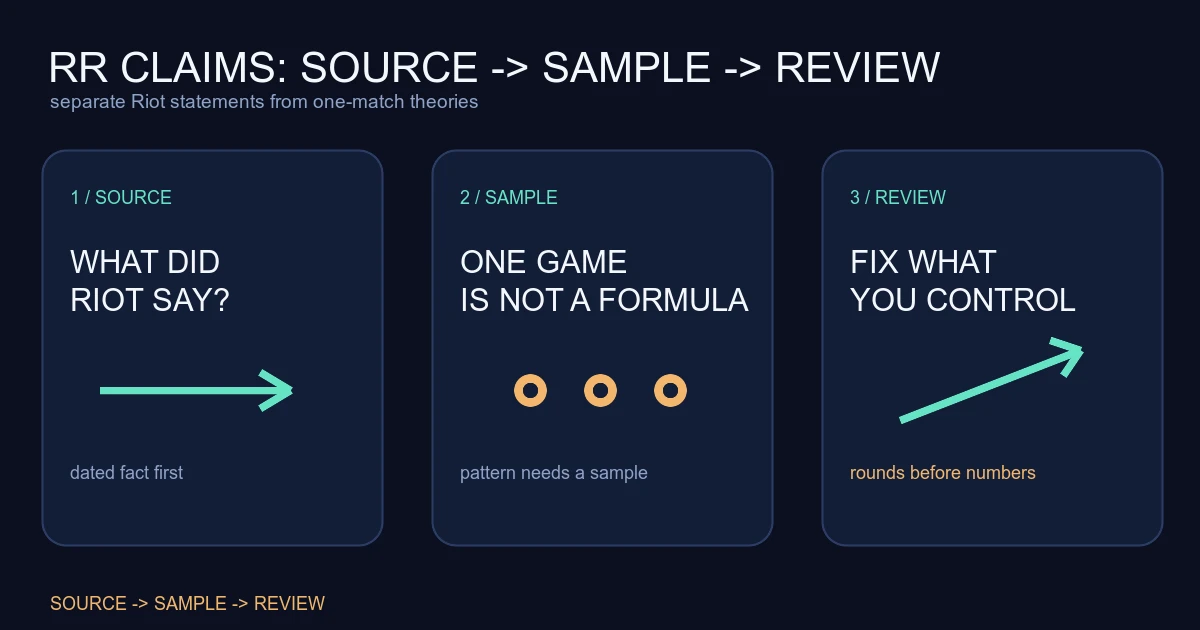
If you want to test your own pattern, keep a short note for ten or so games: result, round score, rank, RR change and the role you played. Look for repeatable mistakes rather than secret weights. Are your wins narrow because you throw 10-3 leads? Are you taking fights that add kills but give away the Spike? Those questions are more actionable than trying to infer MMR from three screenshots.
Riot also changed the surrounding system recently. Patch 13.00, published June 23, 2026, says Riot adjusted RR calculations after earlier MMR changes so consistently winning players would feel less stuck, with particular feedback requested from Immortal+ players. It gives no new public equation. Old posts that promise an exact fixed bonus should be treated as historical unless a current Riot page supports them.
The practical follow-up is the buy, not another spreadsheet. See VALORANT economy for beginners for the round-to-round decision, and how to play a man advantage for turning a good opening into a win.
So, what determines the performance bonus? Riot’s answer is broader and less magical than the phrase suggests: match outcome, round differential, individual performance and rank convergence all shape RR, with individual performance explicitly carrying less impact than the match outcome. Play to win the rounds, use your stats as feedback, and leave the secret coefficients to Riot.