How Challengers Teams Enter the Regional Play-In
Written by Valorant Village
Source-backed coverage ●
The 2026 VCT path is more open than a simple partner-league ladder. Challengers teams can reach the regional international-league competition, but the route is not identical in every territory. A fan asking “who gets into the Play-In?” needs the region, stage and qualification announcement before the answer becomes reliable.
The clearest current example is the Americas route described by VALORANT Esports in its July 2026 Path to Champions and Last Chance Qualifier guide. It shows how regional Challengers results can lead to a final contest for a VCT Americas Play-In place.
Challengers is the regional starting point
Challengers is not one global table. North America, Latin America and Brazil have their own competitions, schedules and qualification outcomes. A team first has to earn a relevant regional seed before it can be considered for the next stage.
Riot's 2026 season primer describes the broader change: Challenger teams can reach the Path to Champions and compete alongside international-league organizations. It also says regional paths differ. The 2026 Americas structure gives direct opportunities to selected regional winners, while the final place is decided through an LCQ.
That distinction is important for coverage. “A Challengers team qualified” does not automatically mean “the team won the same bracket as the team in another region.” The competition name, seed and route should appear in the article's source notes.
The Americas LCQ example
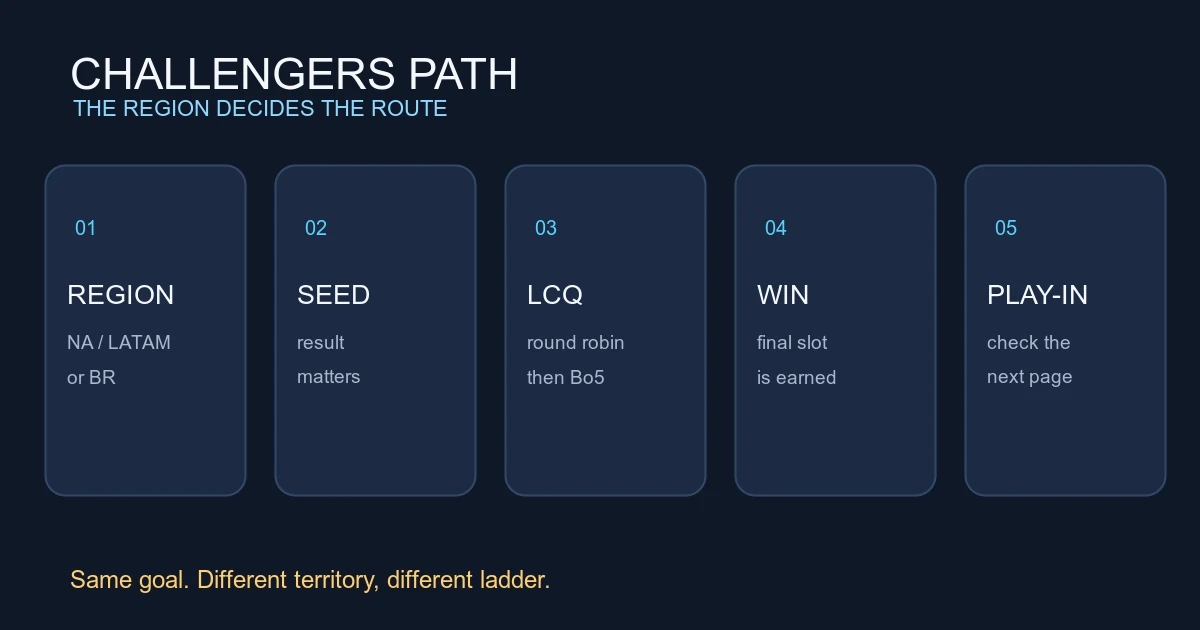
The official Americas guide says the Last Chance Qualifier brings together the Seed 2 team from Latin America, North America and Brazil. Those three teams play a round robin, so each team has a match against the other two. The third-place team is eliminated at the end of that stage.
The top two then move into a best-of-five LCQ Grand Final. The winner takes the final available place in the VCT Americas Play-Ins. In the source's 2026 schedule, the round robin begins on July 28 and the Grand Final follows on July 29. Those dates belong to that published event and should be refreshed when a later season changes the calendar.
The format creates two useful viewing questions. First, can a team recover after a poor opening match when the round robin leaves little room for error? Second, does the best-of-five final reward a deeper preparation pool than the shorter series before it? The official article confirms the structure. The tactical interpretation is Valorant Village analysis, not a Riot claim.
The route also explains why a regional runner-up can remain relevant. Finishing second is not the same as qualifying directly, but in this Americas example it can produce the Seed 2 that enters the LCQ. The path is a ladder with different rungs, not one binary winner-or-eliminated switch.
Why the route changes by territory
The VCT 2026 season primer lists different arrangements for the four territories. Americas uses regional slots and an LCQ. EMEA uses Challengers results and points to determine its top four seeds. Pacific uses direct regional slots plus a separate LCQ involving teams from several subregions. CN has its own details and may publish updates separately.
The practical lesson is to start with the region's official season page. Do not copy an Americas LCQ into Pacific coverage. Do not assume a Stage 3 winner has the same destination as a second-place team. A headline can say “road to Champions” while the actual next match is a Play-In, a Stage 2 Playoff, an LCQ or a regional final.
The VCT Stage 2 watch guide gives the viewer context for the international stage. The VCT standings guide is useful when several regional teams appear close. Before writing a result, confirm which competition page owns the qualification line.
How to follow the next route
Use this checklist when a Challengers team is one series from the next level:
- Identify the territory and subregion.
- Name the stage that produced the seed: regional stage, playoff, LCQ or another event.
- Confirm whether the next destination is a Play-In, playoff or direct qualification spot.
- Check series length and bracket format before discussing pressure or preparation.
- Record the source date because the route can change between seasons.
This avoids a common coverage mistake: treating “Path to Champions” as a single bracket that every team enters in the same way. The public format may change again, and that is not a contradiction. VCT organizers can adjust the ecosystem while keeping the goal of connecting regional competition to the global event.
For viewers, the route is also a good reason to watch beyond the familiar international names. The LCQ structure makes a regional second seed meaningful, and the Play-In gives an open-ecosystem team a stage against established organizations. The interesting question is not only whether the team qualifies. It is how quickly its map pool, anti-strat work and communication hold up when the opponent has more film.
Sources checked
- Everything You Need to Know About the VALORANT Challengers Americas Path to Champions and the LCQ, published 2026-07-13 and checked 2026-08-14 UTC. Used for the Americas LCQ participants, round robin, Grand Final and Play-In place.
- ACE VALORANT Challengers NA 2026: Building the Next Generation, published 2025-12-02 and checked 2026-08-14 UTC. Used for the North American stage structure and regional route context.
- VCT 2026 Season Start: EYNTK, published 2025-12-02 and checked 2026-08-14 UTC. Used for the territory-specific approach to the 2026 Challenger path.
The format comparison and tactical questions are Valorant Village editorial interpretation. The official regional announcement remains the authority for a team's current route.