Champions Shanghai 2026: Calendar, Format and What to Check
Written by Valorant Village
Source-backed coverage ●
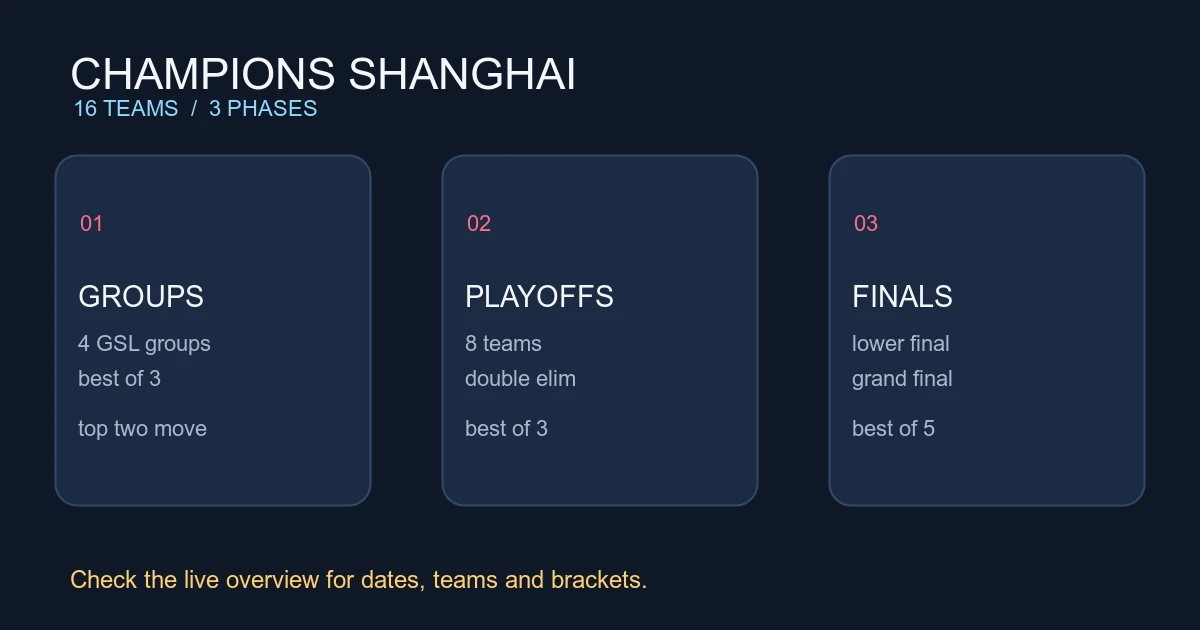
Champions Shanghai is the final global VALORANT event on the 2026 calendar. The official tournament page currently lists the event window as September to October and describes the qualification routes and bracket. It does not, at the time of this check, provide a complete day-by-day schedule or a finished list of teams.
That distinction matters. A useful event guide tells you what is confirmed, what will change as regional Stage 2 finishes and where to check before planning a watch party. It does not fill empty slots with guesses.
What the official page confirms
The Champions Shanghai overview describes a 16-team global tournament. The field comes from two routes in each territory: the top two teams from Stage 2 Playoffs and the top two Championship Point earners. The winner is crowned the 2026 VALORANT World Champion.
The 2026 season primer explains the same structure at season level. Two teams qualify through Stage 2 placement and two qualify through points. The result is a tournament with direct playoff success and season-long consistency represented in the same field.
The official page labels the current event as upcoming. That means team slots, seeding details and the day-by-day calendar should be read from the live overview as they are published. An article checked on 14 August 2026 is a snapshot, not a substitute for the event page.
Group Stage: four GSL groups
The event overview says the 16 teams will be split into four GSL groups. Each match in the Group Stage is best-of-three. The top two teams from each group advance to the playoff bracket.
For a viewer, “GSL” is a useful shorthand for a group that rewards early wins without making one opening loss an automatic elimination. The exact match order and seeding still belong to the official bracket. If you are building a prediction, note the group draw and the opening pairings before comparing teams from different groups.
The format also changes how a single series should be judged. A 2-0 win may create a cleaner route through the group, but a 2-1 win still advances the winner's record. The result tells you who moved. It does not, by itself, explain whether the losing team had a map-pool problem, a veto disadvantage or one late-round collapse.
The VCT veto guide gives a useful way to watch that context. Look at the maps chosen, the side starts and the adjustment between maps before calling the series a simple mismatch.
Playoffs: eight teams, double elimination
The eight teams that survive groups enter a double-elimination playoff bracket. The official overview says playoff matches are best-of-three, with the Lower Final and Grand Final played as best-of-five. That creates two different preparation problems: early bracket survival and the longer series at the end.
Double elimination changes the emotional shape of a loss. A team can drop into the lower bracket and still win the tournament, but the recovery path is less forgiving because every later series becomes an elimination match. A viewer should mark the bracket position alongside the score. “Lost” is not enough information without knowing which side of the bracket the team entered.
The best-of-five finals also reward adaptation across more maps. That does not guarantee that the deeper team wins. It does mean the final is a larger test of map-pool depth, timeout use and the ability to change a plan without abandoning the team's identity. The pro timeout analysis explains the decision-making angle without pretending a ranked timeout works exactly the same way.
How to follow the calendar responsibly
Keep three checks open when the event approaches:
- The official Champions Shanghai overview for the current event window, qualified teams and brackets.
- The territory announcement for the Stage 2 Playoff and Championship Points outcomes.
- The official broadcast or schedule notice for match times and regional viewing links.
Do not rely on a search snippet for the final schedule. Esports pages change as qualifiers finish, and a translated regional page may expose details before another language version does. Save the page date in your notes and update the article if a firm schedule replaces the current September-to-October window.
What this format gives viewers
Champions Shanghai has an easy headline, but the format is the real viewing guide. Groups ask whether a team can survive a small set of best-of-three matches. The double-elimination bracket asks whether it can recover from a loss. The best-of-five finals ask whether the team can keep solving problems after the opponent has time to adjust.
The qualification routes add another layer. A points qualifier may arrive with a season of evidence but a different recent form. A Stage 2 finalist may have just completed a strong regional run. Those are not interchangeable stories, and the bracket gives viewers a chance to test the difference.
Sources checked
- Champions Shanghai overview, checked 2026-08-14 UTC. Used for the September-to-October window, 16-team field, qualification routes and group/playoff format.
- VCT 2026 Season Start: EYNTK, published 2025-12-02 and checked 2026-08-14 UTC. Used for the season-level split between Stage 2 placement and Championship Points.
- VCT Americas 2026 Stage 2: Everything You Need to Know, published 2026-06-24 and checked 2026-08-14 UTC. Used for an official territory example of the final qualification race.
The viewing advice and the warning against filling missing dates are Valorant Village editorial guidance. The live tournament page is the authority for updates.