How to Read a VCT Veto Before the First Map Starts
Written by Valorant Village
Source-backed coverage ●
The veto happens before the first pistol, but it is not a mind-reading exercise. On the broadcast, you can see maps removed, maps selected and sides assigned. You cannot see the scrims, the coach's notes or the reason a team preferred one problem over another.
That distinction makes the card easier to read. Treat the rulebook as the record; treat the rest as a hypothesis.
Check the series format first
Start with BO3 or BO5. Riot's current 2026 VCT ruleset gives each format its own map-selection procedure, and it says event-specific rules can add to the global ruleset. The live 2026 League Handbook's Champions Shanghai section lists BO3 matches in the Group Stage and Playoffs, with the lower final and grand final as BO5. Other events can present a different mix, so check the specific event page or broadcast card before trying to remember an order.
The global ruleset also says the map pool has seven maps, with the full pool listed in the event-specific rules. That is one reason a veto card can look different across events. The map names may change, and the special rules for a final can change the opening bans.
Translate a standard BO3 veto
The rules use Team A and Team B. The better-seeded team decides which letter it takes. If the tournament has no predetermined seeding, that role is determined at random.
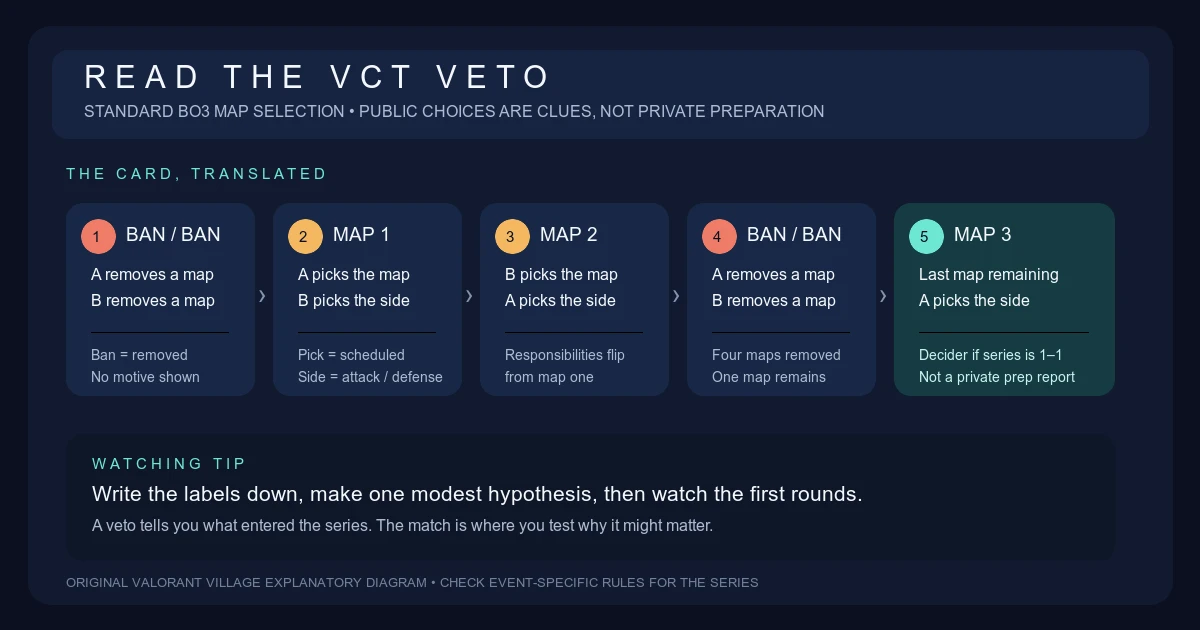
For a standard best-of-three, the order is:
- Team A bans one map.
- Team B bans one map.
- Team A picks map one. Team B picks the starting side on that map.
- Team B picks map two. Team A picks the starting side on that map.
- Team A bans one map, then Team B bans one map.
- The only map left is map three. Team A picks the starting side.
“Ban” means the map is removed from this series. “Pick” means the map is scheduled, not that the picking team has been promised a win. “Side” means attack or defense for that map. “Decider” is the usual viewer name for map three because it only decides the series if the score reaches 1-1.
The side choice is easy to miss. The team that picked map one does not pick its side in this standard BO3 sequence. The other team does. That gives the non-picker a way to choose the half it wants to start on, while the map picker gets the map it asked to play. Map two flips those responsibilities. On map three, there is no map pick left to trade, so the rules give the side choice to Team A.
BO5 has more picks, not the same card repeated
The standard best-of-five procedure starts with one ban from each team. Team A picks map one and Team B picks its side. Team B picks map two and Team A picks its side. Team A then picks map three, Team B picks its side; Team B picks map four, Team A picks its side. The last remaining map is map five, and Team B picks its side.
Notice what is missing: the second pair of bans from the BO3 sequence. A BO5 uses the larger series to let both teams pick two maps before the leftover fifth map. Riot also lists a separate procedure for a double-elimination grand final, so “the VCT veto always works like this” is too strong.
What the card lets you say
A ban gives you a constraint, not a motive. You can say that the team removed a map from the series. You cannot say it feared the map unless someone involved has actually explained that choice. The ban might remove the opponent's favourite map, protect a new setup or deal with a pool that does not suit the current roster.
A pick gives you a little more information because the team accepted responsibility for putting that map in the series. It may be a comfort map, a good matchup or simply the map that left the opponent with the least attractive alternatives. None of those explanations is visible on the card. Do not call it a free win.
Side selection is a useful second clue. If a team chooses defense, you can watch whether it wants early information, a protected setup or a slower first half. If it chooses attack, look for an opening plan that uses that choice. This is viewing advice, not a rule about which side is stronger and not a prediction of the pistol.
The decider deserves the most restraint. Both teams allowed it to remain, but that does not tell you whether they liked it, disliked the other options more or had a roster-specific reason to leave it alone. It is a public leftover, not a private preparation report.
A simple way to watch the first rounds
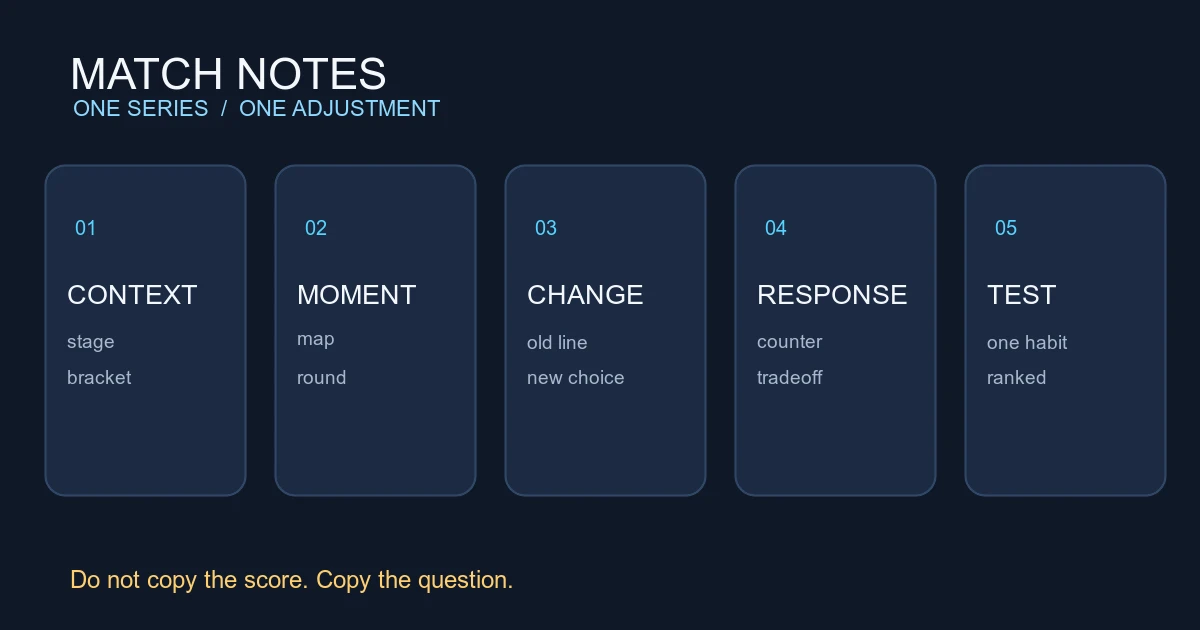
Write down the card in plain language: who banned what, who picked each map, who picked each side and what map is left. Then make one small hypothesis, such as “Team B wants to start map one on defense.” Keep it modest.
Watch the first three rounds for evidence. Does the team contest space early? Does it spend utility to secure a setup? Does it show a late hit instead of forcing the opening fight? If the rounds do not fit the hypothesis, change the hypothesis. The point is to connect the veto to visible decisions, not to defend a story you made up during the desk segment.
Do not use a lost decider to declare the veto bad. The public card cannot tell you how much preparation a team had, whether a substitute changed the plan or whether the opponent solved the map better. A good veto read stays close to the evidence: this map was removed, that map was selected, this side was chosen, and here is what the teams actually did next.
For season context, read the Stage 2 qualification guide and watch guide.
Riot sources checked
- The Library: Riot Games Competitive Operations, page title “The Library,” listed January 10, 2026; accessed 2026-08-14 12:01 UTC. The current VAL filter lists the 2026 VCT Official Competition Ruleset and identifies its December 18, 2025 last-update date.
- VALORANT Champions Tour Official Competition Ruleset: Riot Games / VALORANT Champions Tour, last updated December 18, 2025; accessed 2026-08-14 12:01 UTC. Sections 1.2 and 4.6.5–4.6.10 support the event-specific-rules caveat, seven-map pool, Team A/Team B assignment, BO3/BO5 order, side selection and remaining-map procedure.
- VALORANT Esports | League Handbook, Champions Shanghai section: Riot Games / VALORANT Esports, page date not displayed; accessed 2026-08-14 12:01 UTC. Its format summary says the Group Stage and Playoffs are BO3, while the lower final and grand final are BO5.