VCT 2027 Open Qualification Explained: What Riot Has Confirmed
Written by Valorant Village
Source-backed coverage ●
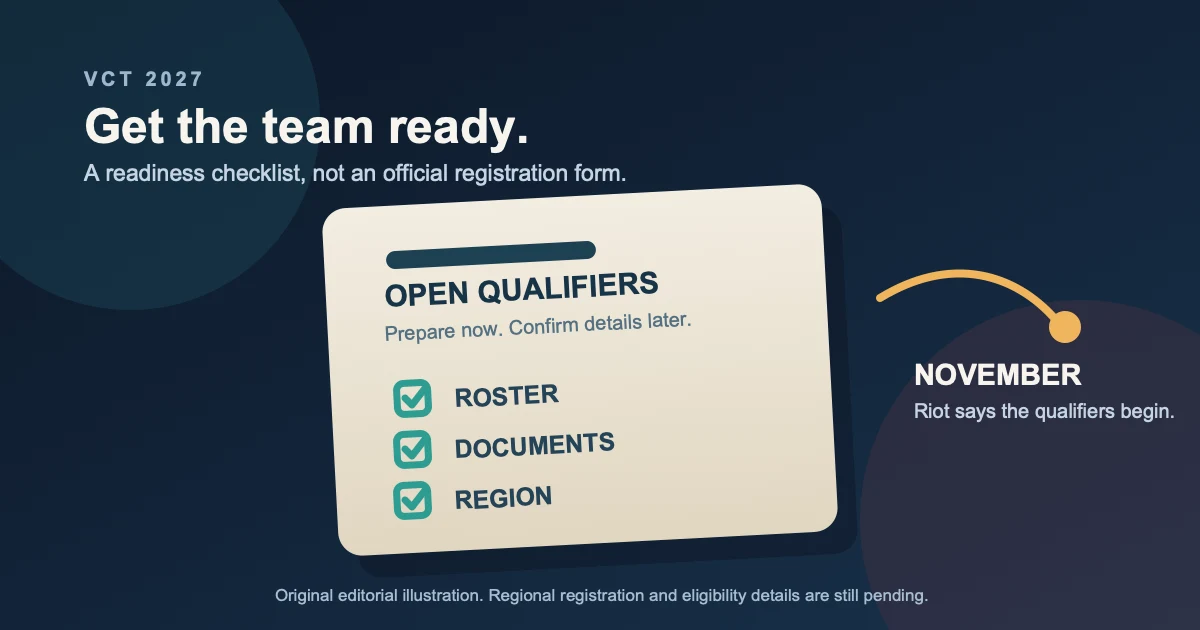
Riot is changing the VALORANT Champions Tour in 2027. Every team will have a route into the system, but not every team will start in the same place. The useful new detail is that Riot now says Kickoff Open Qualifiers begin in November. That is a preparation signal, not a registration link: the announcement does not give a registration date, a qualifier date, a bracket, or a start time. Riot's September Open Qualifiers announcement says more regional information is still coming.
For 2027, Riot says regular-season league play will give way to tournament events called Cups. Open Qualifiers will feed into that system, and the route to Masters and Champions will begin through those qualifiers. That is a real change from the old Ascension-era idea of spending a whole season chasing one promotion place. It is not a promise that any five-stack can stroll straight into Champions.
The basic route: qualify, then keep qualifying
Riot's April announcement says that Open Qualifiers will begin the path to every Masters and Champions event. It also says each territory will have two Cups per year, eight in total, replacing regular-season play and directly qualifying teams to Masters and Champions.
That gives an open team a clearer mental model than the old league table: earn a place through a qualifier, make the next event, then earn the next step. A bad result can send a team back toward Open Playoffs or Open Qualifiers. Riot's June update says teams outside the top positions at a Cup or Masters move into Open Playoffs, while teams with no previous result or a poor Open result may need to restart at Open Qualifiers. Riot's wording matters here: the path is open, not permanent.
For players, that should change the question from “how do we get promoted?” to “what result keeps us in the next event?” Results appear to have a shorter shelf life. A team needs enough consistency to keep moving instead of treating a single qualifier run as a season-long safety net.
Partners get a head start, not a blank cheque
Partner teams are still part of VCT 2027. Riot says they will receive direct seeding advantages and guaranteed base payments under a new two-year partnership cycle. Those benefits are confirmed, so it would be misleading to describe the new model as a level starting line.
But direct entry is not the same as automatic progress. In Americas, Pacific and EMEA, Riot says Kickoff will include 12 teams: eight partners and four teams from Open Qualifiers. The top three teams from each territory then qualify for Masters. After that, qualification becomes performance-based; partner teams are not automatically placed in every Cup. Riot's June breakdown is the clearest confirmation of that distinction.
So an open team does not need to become a partner to appear on a major stage. It does need to survive the same result-driven ladder once the season gets moving. Conversely, a partner's initial seed protects the beginning of its year, not every event after it.
What a team can prepare now
Riot is explicit that teams do not need to register today. Before registration opens, build a roster, make sure players have valid passports, begin necessary travel or visa preparation, and follow regional channels. The new announcement also says that, in most regions, at least three of the five players need to be from that region.
Treat that as a readiness check, not a substitute for the final rulebook. Confirm the intended five, check travel documents, and agree which regional announcement each player will watch. Riot has not attached the exact conditions to every regional event.
Riot says future regional details will include registration dates, format, eligibility, age restrictions and MMR thresholds. Until they arrive, do not guess whether a rank qualifies, how a region seeds teams, or when a roster locks.
Keep the roster together
There is one practical rule worth circling before any hypothetical roster shuffle: Riot says an open or creator-led team keeps its points and progress by retaining at least three of its five players. That roster-continuity threshold is specific enough to plan around.
It does not answer every eligibility question. Riot has not published every regional rule, transfer window or substitute condition. Still, the three-of-five rule gives teams a useful warning. Rebuilding most of a roster between events may also mean rebuilding competitive progress.
Which Open Qualifier is named for your territory?
Riot's current list names the lanes, but each information link still says additional information is coming soon. In the Americas, the listed qualifiers are North America, Latin America North, Latin America South and Brazil. In EMEA, Riot lists Europe, Turkiye and MENA. In Pacific, it lists South Korea, Japan, Thailand, Indonesia, Vietnam, Southeast Asia (the Philippines, Malaysia, Singapore and the rest of Southeast Asia), South Asia and Oceania. VCT CN has a China Open Qualifier. Use Riot's regional table as the source of record because these labels may be refined when registrations open.
That list is helpful for choosing the announcement channel to follow. It is not proof that a player may enter a different territory, that a cross-region roster will be accepted, or that every lane uses the same rules. The announced region-of-residence expectation and the unfinished eligibility details are the reason to wait before making those claims.
Sources checked
- The New VALORANT Champions Tour, published 2026-04-08 and checked 2026-08-31 UTC. Used for the tournament model, Open Qualifiers, Cups, partnership benefits and the still-pending regional details.
- No Guaranteed Paths: Inside the New VCT 2027, published 2026-06-18 and checked 2026-08-31 UTC. Used for Kickoff composition, progression, roster continuity, qualification payments and regional exceptions.
- Get Ready for VCT 2027 Open Qualifiers, published 2026-09-08 UTC and checked 2026-09-08 UTC. Used for the November Kickoff Open Qualifier timing, readiness guidance, region-of-residence statement, roster-continuity reminder and the named regional qualifier lanes.
- VALORANT Esports Schedule, checked 2026-09-08 UTC. Used only for current-season context; it does not replace the regional Open Qualifier rules.
The practical readiness checklist is Valorant Village editorial guidance. Riot has not yet published the full regional qualification rules for 2027.