Stage 2 Match Notes: One Useful Adjustment per Series
Written by Valorant Village
Source-backed coverage ●
Most match recaps stop at the score. That is enough to record who won, but it is not enough to learn from a VCT Stage 2 series. The useful part is usually smaller: one adjustment a team made, one response the opponent tried and one question a ranked player can carry into the next match.
This is the format for a recurring Stage 2 match-notes column. It is a review method, not a claim that one public series reveals a team's private playbook. Each instalment should use the official match page, state the date and select a concrete moment that viewers can check in the VOD.
Start with the event context
Before watching the maps, write down the stage and bracket position. The 2026 regional formats do not all place teams in the same situation. In Americas, the Stage 2 guide describes two groups of six, with the top two from each group moving directly to Playoffs and the remaining teams entering Play-In alongside Challengers representatives. Pacific describes a different route, with places three through six entering Play-In and the top four from that stage moving forward.
That context changes the pressure of a round. A team fighting for a direct playoff spot may value a controlled closeout. A lower-bracket team may need to take more risk. You do not need to guess a player's emotions. You only need to know what the bracket makes possible.
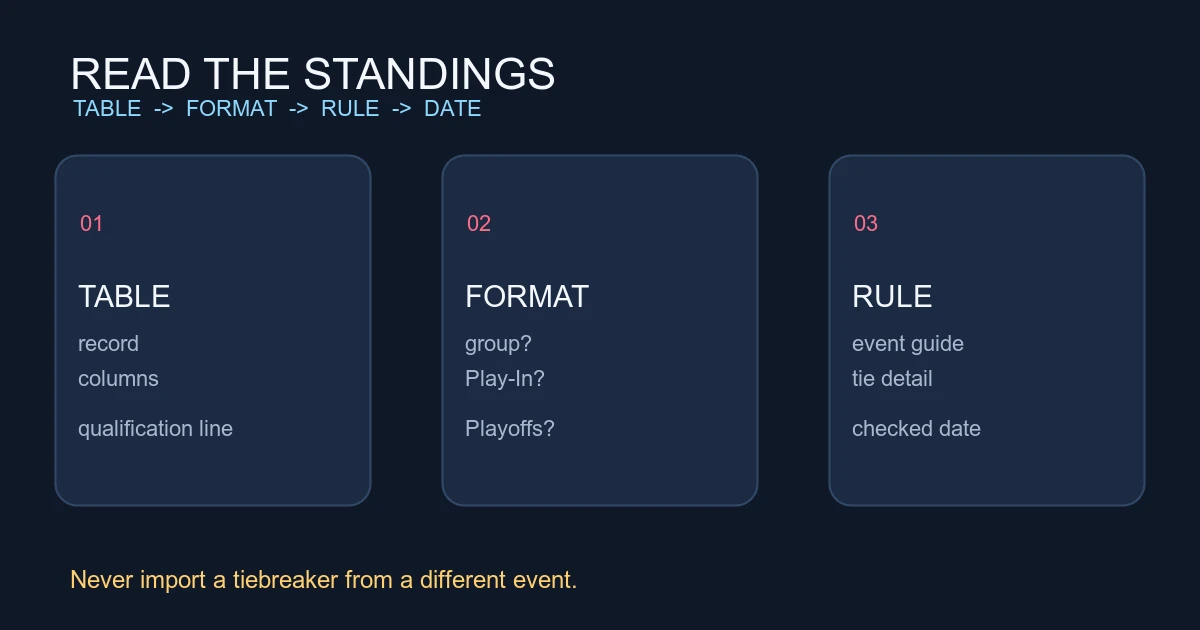
The VCT standings guide helps with this first step. The VCT watch guide is useful when you need the wider Champions qualification picture.
Pick one map and one question
Do not review an entire best-of-three as a list of every smoke, duel and timeout. Choose one map and write a question before pressing play. Examples include:
- How did the attackers create the first safe piece of space?
- What did the defenders save after losing the opening duel?
- Which utility changed the retake timing?
- Did the team repeat a default after the opponent had shown a counter?
The question keeps the notes narrow. A VCT match contains too much information for a ranked player to copy. One useful adjustment is more likely to survive the next queue than a ten-point list of “meta” habits.
Name the adjustment precisely
An adjustment should describe a decision, not a personality trait. “The team played smarter” is not a note. “After the first failed A hit, the attackers held one piece of utility for the late rotate instead of spending everything at the choke” is testable.
Use the VOD to record four timestamps: the old pattern, the opponent's response, the changed decision and the result. The result does not have to be a win. A good adjustment can create a better trade or a clearer post-plant even when the round is lost.
Then ask whether the change was planned or forced. A timeout, a player death, a missing ultimate or a low-credit buy can make a team choose a different line. That is still interesting, but it should not be written as a universal default without more examples.
Connect the note to a ranked habit
The column is most useful when it translates a pro decision into a modest ranked experiment. If the series shows a team delaying its second wave of utility, try holding one tool until the first contact rather than copying the entire composition. If the series shows a retake starting after a saved flash, practise calling the flash timing before entering.
Do not pretend the environments are identical. Professional teams have rehearsed lineups, coordinated comms and opponents who punish predictable patterns quickly. A ranked team may only have one teammate ready to trade. The lesson is the decision shape, not a claim that the exact play will work in every lobby.
The VOD review guide gives a practical stopping rule: leave the review with one habit to test. The pro timeout analysis covers another example of translating team-level decisions into a smaller ranked question.
Record what the series cannot prove
One series cannot prove that an Agent is permanently strong, that a map is solved or that a team has abandoned an old identity. It can show a choice under a particular opponent, veto, patch and bracket situation. Write those limits into the note.
This is also where official sourcing matters. Use the VALORANT Esports match page or broadcast VOD for the score and map order. Use the tournament guide for the stage format. Label your own tactical reading as analysis. If a future instalment covers another series, give it a new date rather than silently changing the old conclusion.
The column template
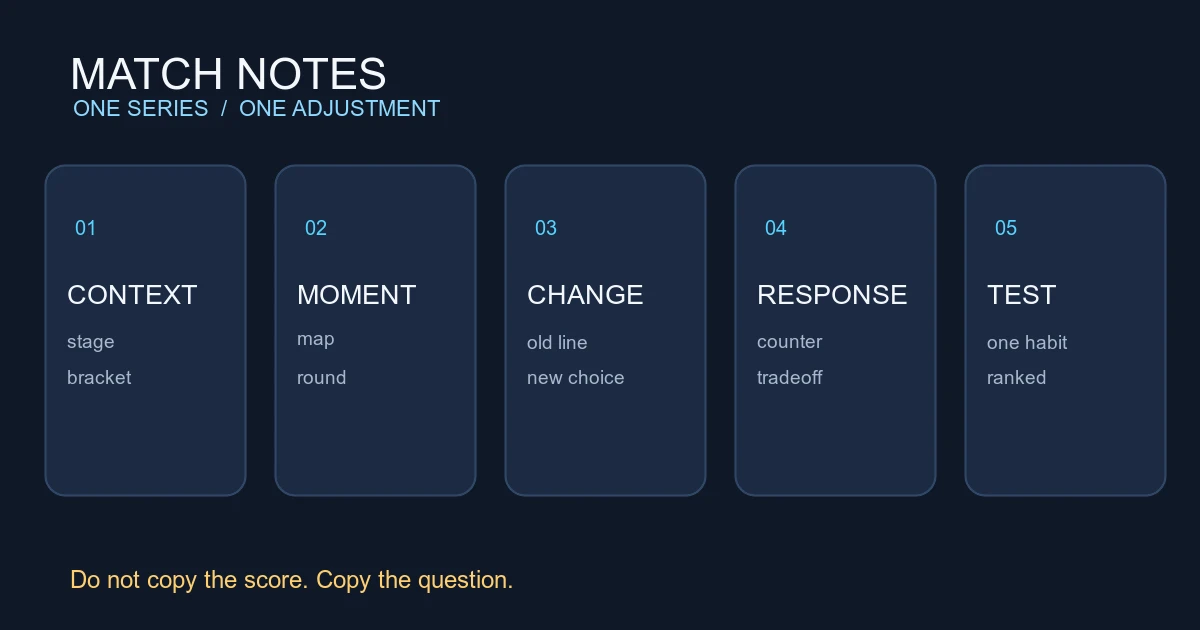
Each weekly note can use the same short structure:
- Context: event, series, patch and bracket stakes.
- Moment: map, round and timestamp.
- Adjustment: what changed from the earlier pattern.
- Response: how the opponent answered.
- Ranked test: one small habit to try.
- Limit: what the series does not prove.
That template leaves room for genuine observation. It also prevents a recap from turning into a transcript of the broadcast. The goal is not to collect every clever play. It is to notice one decision, understand the tradeoff and make the next match easier to read.
Sources checked
- VCT Americas 2026 Stage 2: Everything You Need to Know, published 2026-06-24 and checked 2026-08-14 UTC. Used for the Americas group and Play-In context.
- 2026 VCT EMEA Stage 2, published 2026-06-25 and checked 2026-08-14 UTC. Used as a second regional format reference.
- VCT Pacific Stage 2: Group Stage Ticket Sales, published 2026-06-23 and checked 2026-08-14 UTC. Used to confirm that regional Stage 2 routes differ.
The note template, tactical questions and ranked translation are Valorant Village editorial guidance. A future instalment must add its own official match source, date and VOD evidence.