Brimstone Guide: Simple Smokes, Post-Plants and Round Plans
Written by Valorant Village
Source-backed coverage ●
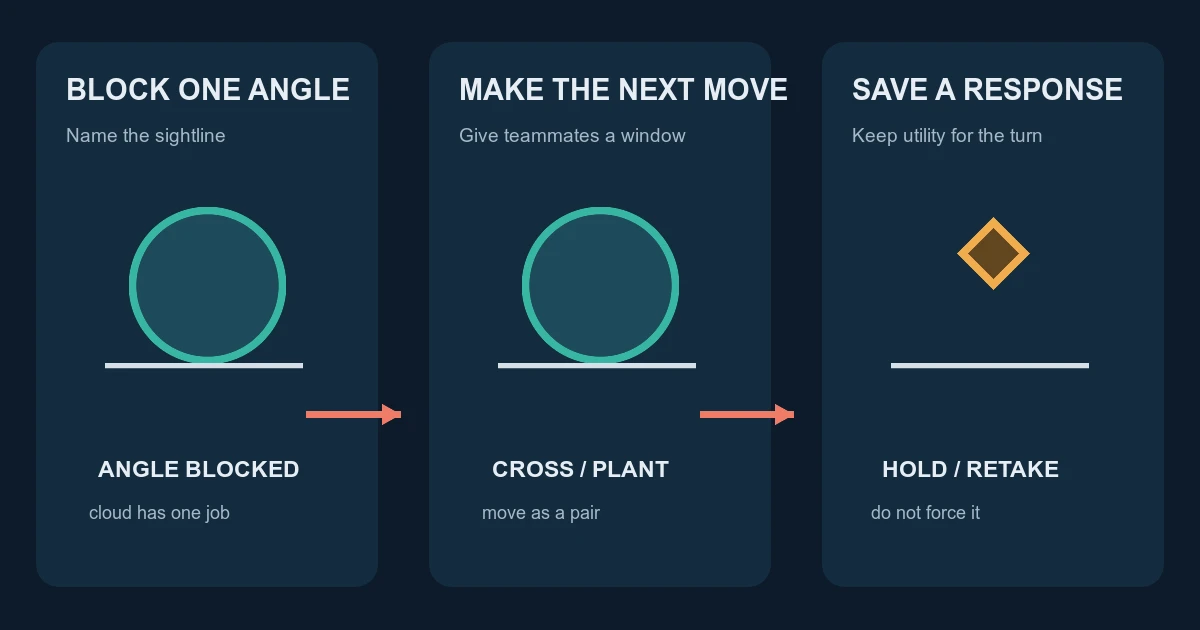
Brimstone is easy to mistake for a player who puts clouds on a site before anyone moves. That is the lowest-value version of the agent. A useful Brimstone makes one next action safer: a teammate crosses, the Spike gets planted, a defender cannot watch two angles, or a retake slows down long enough for help to arrive.
Start with the action. Then place the smoke.
What Riot currently documents
Riot lists Brimstone as a Controller. His live page says Incendiary leaves a lingering damaging fire zone; Sky Smoke places long-lasting clouds that block vision; Stim Beacon creates a field that grants RapidFire; and Orbital Strike places a lingering, high-damage strike. The descriptions are a safer reference than old clips with patch-era numbers attached.
Riot’s Beginner’s Guide gives the basic reason controllers matter: smoking sightlines enemies are watching makes it easier to enter a site. It also tells new players to check angles, ask whether an ability helps the next goal, and communicate. The round plans below are Valorant Village coaching, not Riot rules or guaranteed setups.
Give every smoke a sentence
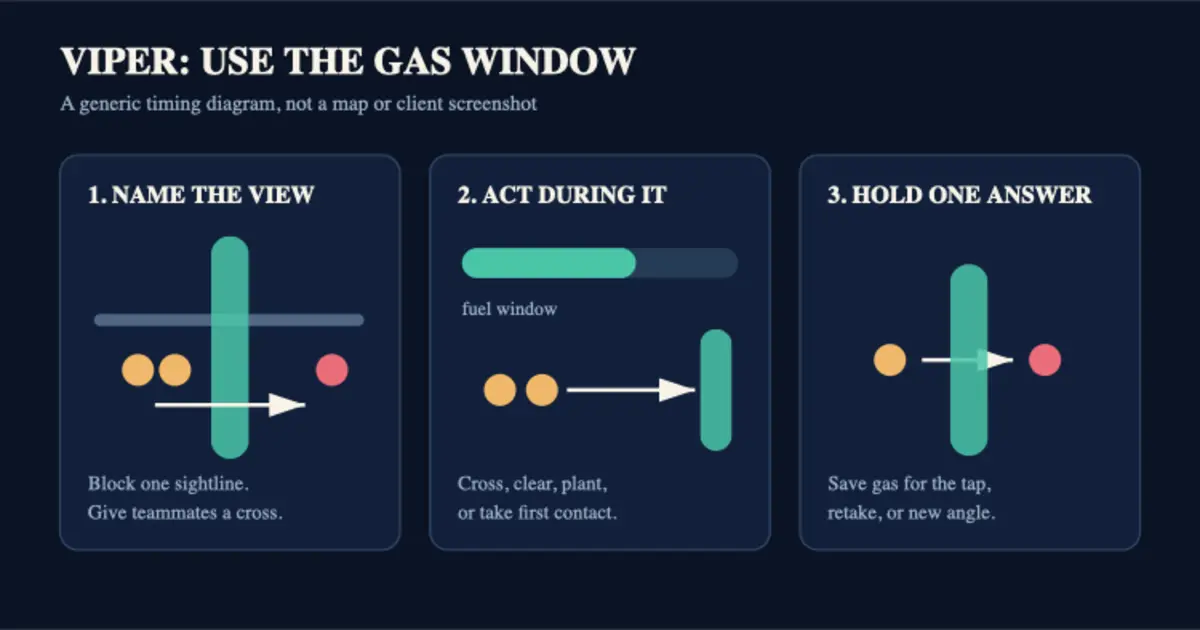
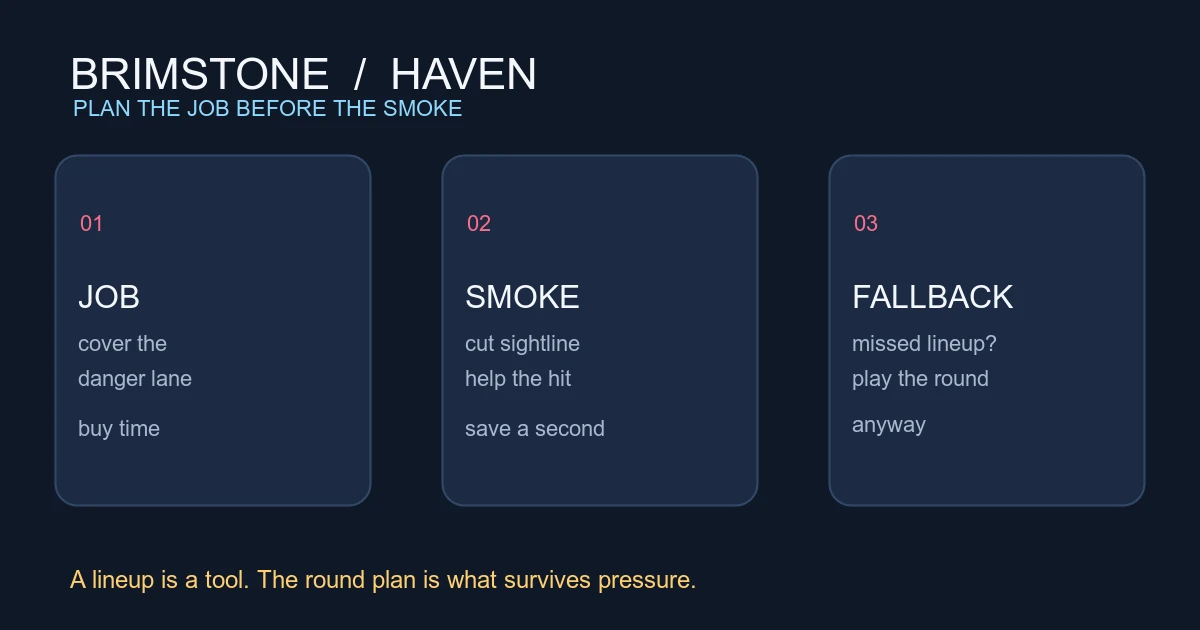
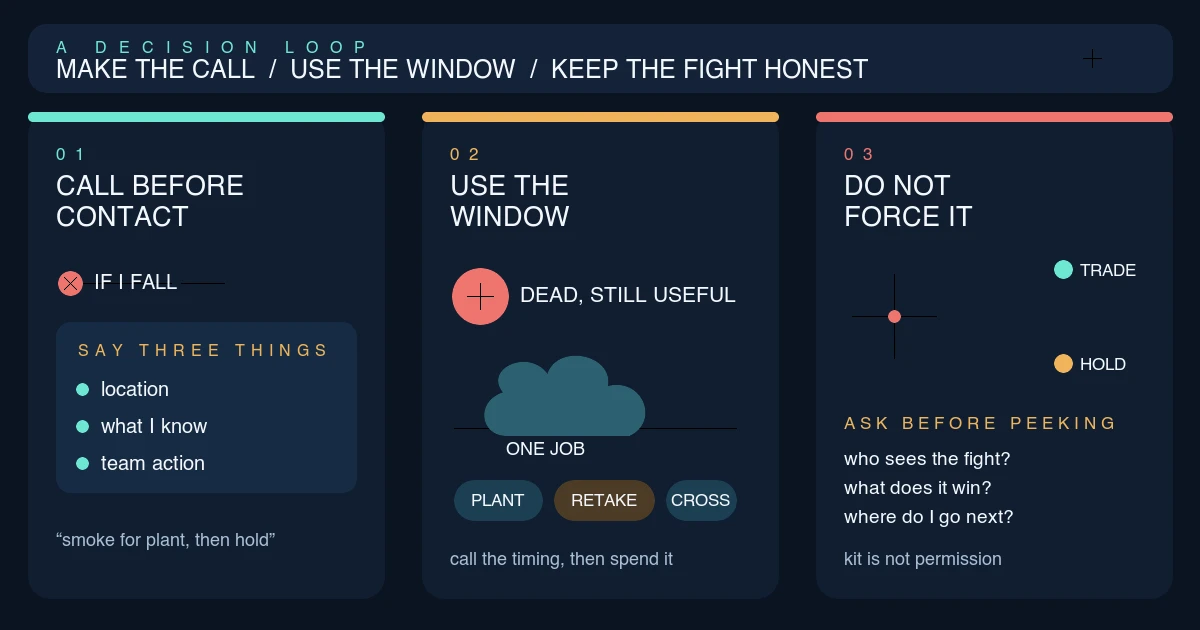
Before the barrier drops, describe each Sky Smoke in one sentence: “Block their long angle so our entry clears close,” or “Smoke the retake lane so we can plant and hold the other side.” That call names the angle, the teammate action, and the result you expect.
“Smoking site” is not enough. A site has several angles, and a smoke can make one of them harder to use while creating another close corner that still needs clearing. If the entry player does not know what remains dangerous, the cloud has not solved the team problem.
On attack, pick one job first: protect a cross, split the site into smaller fights, or hide the plant. Do not spend every smoke before anyone knows whether first contact is winnable. If an enemy is holding ground or your entry is delayed, keep one cloud for the adjustment. A late smoke that lets the Spike cross can be worth more than an early one that nobody used.
The same test works on defense. Ask what the smoke buys: time for a rotate, a safer fall-back, or a chance to isolate the first attacker. If it buys none of those, hold it. Blocking vision is useful only when a teammate can do something during the window.
Play the round in two parts
Think of the first plan as a test, not a promise. On attack, the plan might be: “Smoke the long lane, clear close with two players, then plant if the defender gives ground.” If the first player dies with no trade path, stop and name the new problem. If the defender is pushed off but the Spike carrier is elsewhere, use the space to move the objective rather than chase through a cloud.
On defense, decide where the round can bend. An early Sky Smoke can stop a fast look, but it should leave you enough utility to answer the actual hit. If your teammate sees two attackers, say what is confirmed, where the smoke lands, and whether you need help now. Our guide to useful VALORANT comms has a good baseline: fact first, then location, then the action you need.
Incendiary is strongest when it makes a known action expensive. Use it when the plant spot, choke, defuse position, or forced path is clear. Throwing it into an empty lane because it is available often leaves you without an answer when the Spike arrives somewhere else. Orbital Strike follows the same rule. Its threat is real, but it should serve a call: deny a defuse, clear a committed position, or force a player from the place your teammate can punish.
Stim Beacon needs a commitment too. Riot describes it as a field granting RapidFire, not a reason for five players to sprint into an unknown angle. Put it where a team is already taking a supported fight, holding a post-plant, or preparing a retake. The field helps a plan. It does not invent one.
Post-plant: leave yourself an answer
Once the Spike is down, the important question changes from “what can I throw?” to “what must the other team do?” Identify the defuse spot, the retake lane, and the teammate who can see the fight. Keep a smoke if it blocks the retake path, then use Incendiary or Orbital Strike only when the defuser or a forced route is known.
This is also where a man advantage disappears. A team with four players against three does not need to offer four separate duels. Smoke the lane that joins the retake, play an angle in pairs, and make the defenders spend time clearing. Our man-advantage guide explains the same reset: protect the objective and make the other side answer the next question.
Practice one map-specific version at a time. The existing Brimstone Haven guide is useful for turning smoke jobs into a repeatable Haven plan without treating a lineup as the whole round. In a custom game, name the sightline, walk the cross, then test what happens when the first idea fails. If your second action is always “throw the rest and hope,” the plan is too thin.
For the next three games, review one Brimstone round after it ends. Write down the smoke’s job, the action it enabled, and the utility you still had when the round changed. A cloud that helped a teammate cross is a success even if you did not get the kill. A perfect-looking smoke with no action behind it is just fog.
Sources checked
- Brimstone, Riot Games live agent page, checked in a Playwright browser on 2026-08-17 UTC. Used for the Controller role and current high-level ability descriptions.
- Beginner’s Guide, Riot Games, published 2024-08-03 as displayed, checked 2026-08-17 UTC. Used for controllers blocking watched sightlines and the guidance on angles, utility goals, and communication.
- Game Updates, Riot Games live index, checked 2026-08-17 UTC. Used to confirm that Patch Notes 13.02, published 2026-07-29, is the newest listed gameplay patch; no Brimstone-specific numbers from old patch notes are used.