How to Make Useful Comms in VALORANT
Written by Valorant Village
Source-backed coverage ●
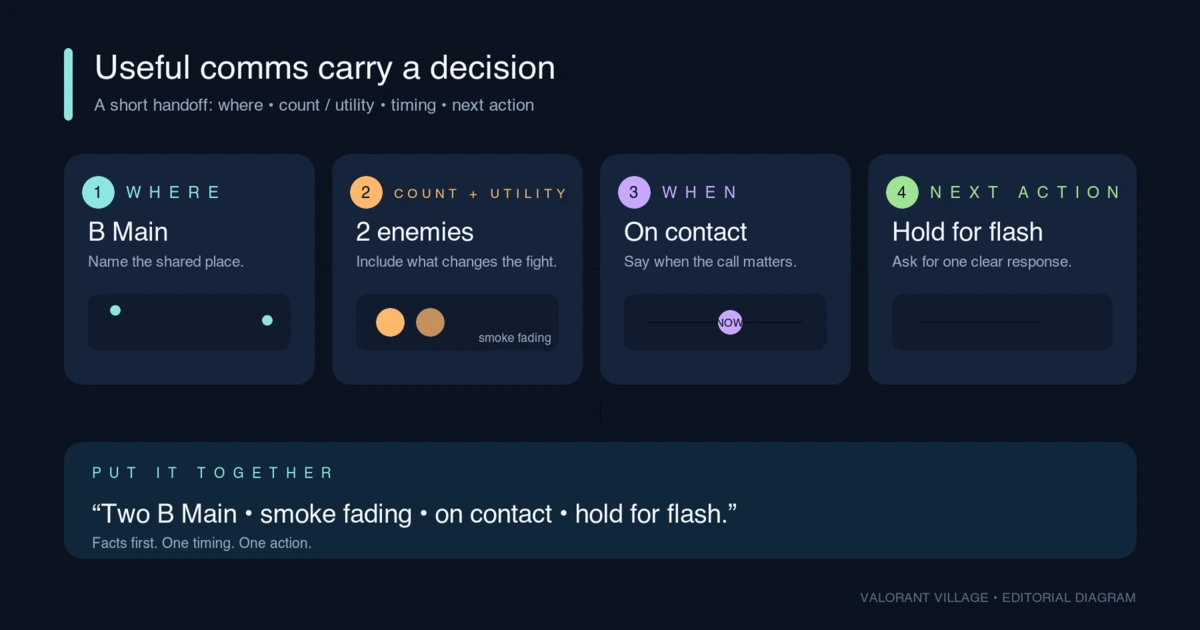
A useful comm gives a teammate something they can do before the round changes. It does not need to sound polished. It needs a place, a current picture of the enemy, a timing, and a next action.
Riot’s Beginner’s Guide calls communication a priority and specifically points players toward sharing an enemy’s location through voice chat, pings, or in-game Agent voice lines. Riot does not publish the four-part sentence below as a rule. This is a Valorant Village coaching frame built around the information a player needs to choose the next fight.
The four parts of a good call
- Location: Where is the enemy, Spike, utility, or teammate? Start with the shared map name: “B Main,” “back site,” “top mid,” or “C Link.” If the exact callout is uncertain, ping the area and describe what you can see.
- Count and utility: How many enemies are confirmed, and which ability or weapon detail changes the choice? “Two B Main, one Operator” is different from “two B Main, both rifles.” “Smoke down” or “wall breaking” can matter more than a guessed health bar. If you only heard one, say “heard one,” not “only one.”
- Timing: When does the information matter? Use “now,” “on contact,” “after the reload,” “before plant,” or a rough count such as “in five.” An event is often clearer than a vague “soon.”
- Next action: Tell teammates what you are doing or ask for one response: hold, swing, fall back, wait for a flash, rotate, play retake, or save. The action is a suggestion, not a command from Riot.
For example: “Two B Main, one dash used, smoke in five, hold for my flash.” The location arrives first. The count and changed utility follow. The timing tells teammates when to be ready. The final phrase gives them a shared action.
Riot’s How we balance VALORANT describes its “tac cycle” as Intel, Plan, Execute, Repeat. Its Intel questions include who and where the opponents are and which Agents, abilities, and guns are in play. Its Execute section calls out timing and coordination. That is a useful way to understand the framework: a comm is the handoff from what you know to what the team can do with it.
Say facts before guesses
A fact is something you saw, heard, or caused: “one A Main,” “Spike down B,” “I used both flashes,” or “the wall is breaking.” A guess can still help, but label it: “I think they are rotating from A,” or “probably one more close.” The wording gives teammates a chance to weigh the risk instead of treating your prediction as confirmed information.
The same rule applies to numbers. “Two back site” means two were seen there. “One back site, one unknown” tells the team what remains unaccounted for. “I heard one C Link, not sure if more” is a complete call when that is all you know. Do not inflate a sound cue into a full enemy count.
Update the picture when it changes. After a kill, “one dead, three seen A, Spike still B” is more useful than repeating the original “three A.” When you have no new information, stop talking. The players still alive need to hear footsteps, ability audio, and the next call.
Match the call to the round phase
Before the barrier drops, keep the plan short and add one trigger: “Default until contact, then group B,” or “I hold flank; call if they take mid.” That gives the team a starting point without reciting every possible branch.
During contact, lead with the immediate fact. “One close left.” “Two crossing now.” “Flash out, swing with me.” If the fight is bad, say so while there is still time to leave: “I’m falling back; don’t chase.” A late warning is often just a replay of a death.
After a pick, spend the advantage on a decision. On attack, the Spike and the route to site matter more than hunting a second kill. On defense, keep the important space or call the fallback. In a retake, name the first area to clear and the timing: “Play together, clear close right, tap after contact.” In a save, say what weapon you are keeping and where you will exit. These are suggested calls, not official Riot instructions.
If you die, leave one final update: location, utility, and the last known movement. “Two A Main, smoke fading, Spike not seen” is enough. Then give the living players room to hear the round.
Use voice, pings, and silence well
Voice is fast, but it is not the only option. Riot’s Beginner’s Guide points to pinging a location and using Agent voice lines when a player does not want to use voice chat. A ping plus a short message can be clearer than a long explanation. Ping the place, then say the part the marker cannot express: count, utility, or timing.
Keep the channel about the round. Riot’s current Comms Restrictions and Audio Retention article says its systems can detect typed and spoken disruptive behavior, including insults, threats, harassment, performance-targeted abuse, discrimination, and hate speech. That is a conduct policy, not a tactical rule. It also gives a practical reason to replace “you’re throwing” with “one flank, fall back.” The second sentence gives a teammate a chance to act.
Practise one change at a time
After a match, remember three calls that were misunderstood. For each one, ask: was the location missing, was the count uncertain, was the timing late, or was there no next action? Rewrite the call in four parts. In the next game, practise only that missing piece.
Before you press the push-to-talk key, check: where, how many or what utility, when, and what next. If one answer is unknown, say that plainly. A short honest call leaves teammates with a decision. That is its job.
The next useful step is turning a call into a fight. Read how to trade a teammate for the spacing problem, then how to play a man-disadvantage round for the call after a teammate is already down.