Fade Guide: Turning Haunt Information Into a Hit
Written by Valorant Village
Source-backed coverage ●
Fade players often get a useful Haunt result and still lose the fight it was meant to start. The orb lands, the entity reveals someone, somebody says “tagged,” and the team waits.
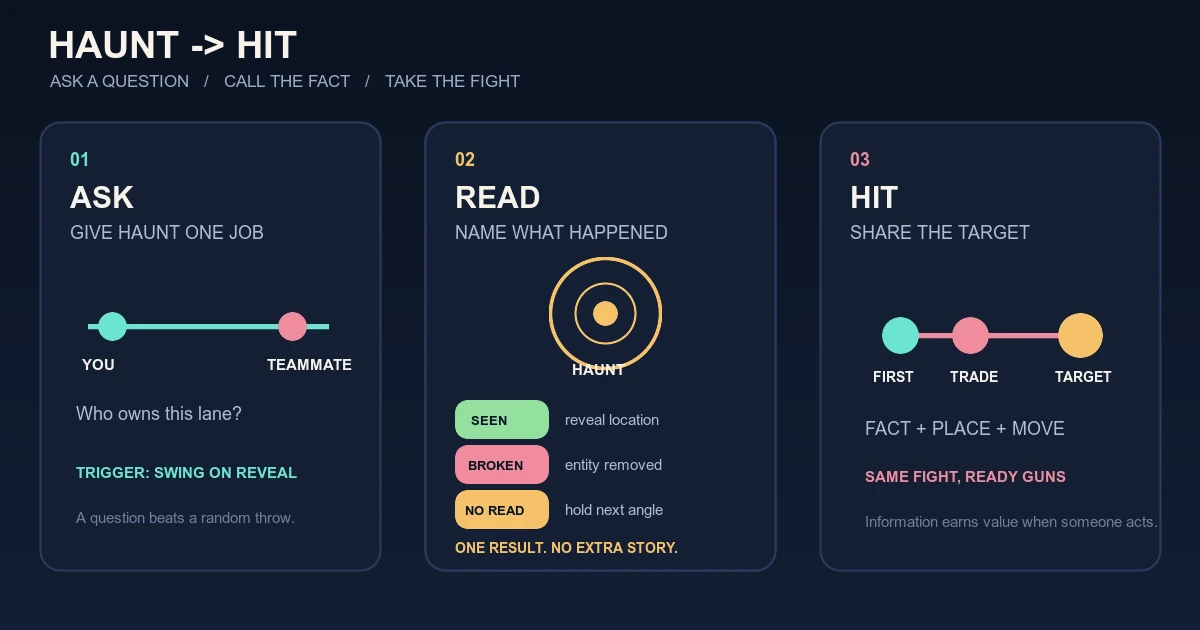
Give Haunt one question, call the answer as a fact, and put a teammate on the same fight. The reveal is not the hit. It is the reason to take a particular hit together.
Riot-documented Fade facts
Riot’s current Fade agent page lists Fade as an Initiator. It describes Haunt as a thrown orb that falls to the ground, then becomes an entity that reveals enemies caught in its line of sight. Enemies can destroy that entity. Fade can re-use the ability to drop the projectile early while it is in flight. Do not turn that description into a whole-site scan or a fixed reveal period.
The same Riot page describes Seize as an orb that creates a zone caught enemies cannot escape by normal means. Prowler travels in a straight line, locks onto enemies or trails in its frontal vision cone, chases them, and nearsights them if it reaches them. Nightfall sends a wave through walls that creates a trail to opponents and deafens and decays them. These are Riot facts. The choices about when to combine them, what to call, and who should swing are Valorant Village coaching interpretation.
Give Haunt one question
Before you throw, say the decision it should answer. “Who owns this lane?” “Can we take this space without fighting the close defender first?” “Which player has to move before we enter?” These are coaching questions, not Riot rules. They stop you from throwing Haunt just because the ability is available.
Give the result an owner. “Haunt this lane, swing if it reveals someone” tells a teammate what the orb is for. “Haunt out” only reports your animation. The Sova guide to Recon information uses the same question-first habit: information earns its value when a teammate knows what to do with it.
Keep the target area shared with the teammate who can act. If nobody can reach the information, do not call it as an immediate hit. A clear question also makes review easier: did Haunt fail, or did the team lack a response?
Read the result without adding a story
Haunt has bounded outcomes. A revealed enemy is a confirmed presence in the entity’s line of sight. If the entity is destroyed before a reveal, call that the tool was removed and gave no read. No reveal is still no reveal. None of those results proves the rest of the site is empty.
Use short calls that preserve that boundary:
- “One revealed, back lane. Swing with me.”
- “Haunt broken. No read. Hold.”
- “No contact from Haunt. Clear the next angle together.”
Use your team’s actual callout. Do not convert “one seen” into “all site,” or turn a destroyed Haunt into a guess about who broke it. Give the confirmed count and label the rest unknown.
The guide to useful VALORANT comms covers the same fact, location, timing, and action handoff. With Fade, the timing is a trigger such as “on reveal,” not an invented number. If nobody acknowledges the call, play the information as information. Do not solo peek to prove the orb was worth using.
Make the hit tradeable
A Haunt hit is a two-player decision. Before you fire, decide who takes first contact and who is close enough to punish the defender’s shot. The first player can be you or the teammate. What matters is the shared target and a weapon-ready answer.
Say the trigger before the orb lands: “I’m first, swing on the reveal,” or “You take contact, I follow the marked lane.” The call is coaching, not a Riot rule. If Haunt reveals somebody deep but the teammate cannot reach that fight, do not call for a swing you cannot support. Take the space it informs, then reset the next angle.
Use the guide to trading a teammate to check the spacing question: if the contact dies, can the second player see the shooter and fight immediately, without crossing the same doorway? If not, Haunt produced a marker but not a tradeable hit. The information looks good on the scoreboard, but the gun is not in the round.
Pick one follow-up
Do not stack every ability because Haunt found a target. Pick the follow-up that changes the next decision.
If the revealed player has to stay in a known zone, Seize can restrict the normal escape route for an enemy caught in it, according to Riot’s Fade page. The coaching use is to make that position easier for a teammate to contest. It is not a guaranteed kill. If the enemy is moving through a visible route or trail, Prowler can be steered toward that information. Riot documents its lock-on and nearsight behavior; the coaching choice is to send it when a player can use the contact, not after the fight has already ended.
Nightfall is a different commitment. Its wave can traverse walls and applies the trail, deafening, and decay described on Riot’s page. Use it as a team-start signal only if teammates know which space they are taking. Sometimes Haunt plus rifles is the better round.
Review three Haunt rounds
After your next three Fade rounds, write down the answer to four questions:
- What exact question did Haunt answer?
- What did I confirm, and what did I assume?
- Who acted on the result, and could I reach the same fight?
- Did Seize, Prowler, or Nightfall help that action, or did I cast it because it was available?
If the third answer is no, change the call or spacing before you change the lineup. A Haunt that gives one honest fact to a player who can act on it is doing its job.
Sources checked
- Fade, Riot Games live agent page, checked 2026-08-15 UTC. Claims used: Fade’s role and the current descriptions of Haunt, Seize, Prowler, and Nightfall.