How to Play a Man-Disadvantage Round in VALORANT
Written by Valorant Village
Source-backed coverage ●
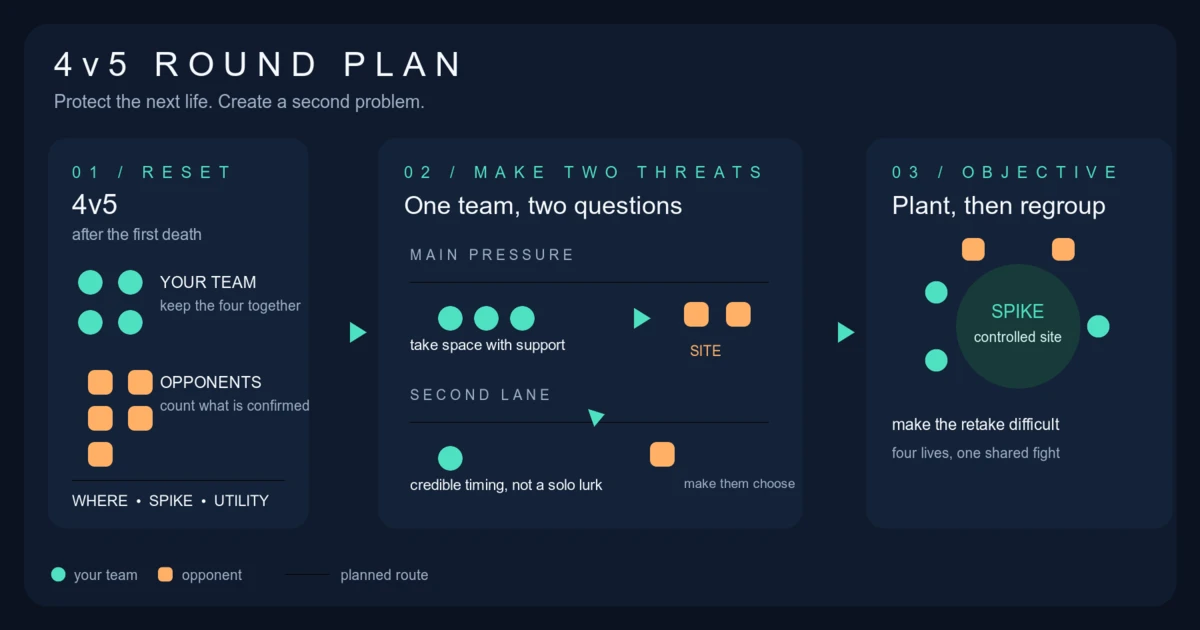
A 4v5 is not a timer telling you to run at the first sound. It is a warning that every remaining life now has to do more work.
“Man disadvantage” is player shorthand for having fewer living players than the opponent. It is not an official Riot mode rule. Riot’s Beginner’s Guide gives the terms that matter here: attackers plant and detonate the Spike, defenders defuse it after a plant, and eliminating opponents makes either job easier. The practical round plan below is Valorant Village interpretation of how to play inside those objectives.
Stop the second free kill
After a teammate dies, do not automatically swing the same angle. First ask three questions: where did they die, is the enemy still close, and can a teammate answer your fight immediately?
If the answer to the last question is yes and the enemy is exposed, take the trade. If the window has gone, keep your life. A solo re-peek because the death feels unfair is usually just a second donation. Fall back behind cover, hold the useful space you still own, or use an ability that gives the team a cheaper way to learn where the enemy is.
The dead player may have left good information. A defender might know the attackers are committed to one entrance. An attacker might have found a weak site or forced a rotation. Say the fact, not the theory: “two seen A Main, Spike still B,” is useful. “They’re all rotating” is a guess until someone confirms it.
Riot’s How we balance VALORANT article describes the tactical cycle as Intel → Plan → Execute → Repeat. Its Intel questions include opponent locations, owned territory, Agents, abilities, guns, and what the opponents did previously. That is a useful reset after a death. Count what you know, mark what you do not, then choose the next fight. Riot’s Beginner’s Guide also recommends asking whether an ability helps the next goal and communicating with voice, pings, or Agent voice lines.
Save space or look for a pick?
Saving space does not mean hiding in spawn. It means keeping a position that helps the Spike, a rotation, a crossfire, or a future retake. Hold it when the enemy has to walk into you, when you have a teammate close enough to trade, or when leaving would give up the route you need.
Look for a pick only when the fight has a reason to exist. A good pick attempt usually has most of these:
- the opponent is isolated or overextended;
- someone can trade you, or your escape is already planned;
- you know what space the kill opens;
- the fight will not strand the Spike or leave the rest of the team guessing.
If those conditions are missing, gather information with sound, a ping, or utility, then move as a group. The goal is not to equalise the count at any price. The goal is to make the next contact cheaper than the last one.
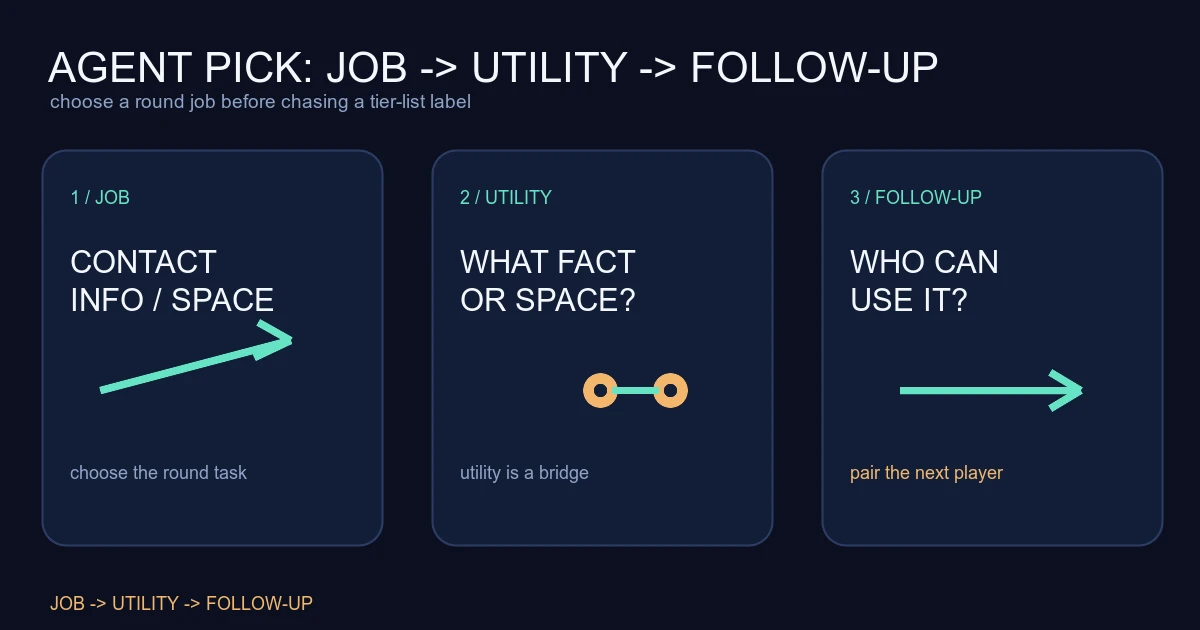
Abilities should serve that decision. A smoke, stall tool, recon ability, or flash can reduce the number of angles you have to face, but only if the team knows what happens next. Riot describes abilities as a critical part of reducing the risk of a plan. In practice, that means saying “flash, then take the corner” or “smoke and give site,” not throwing everything because the round feels lost.
On attack, make the Spike the second teammate
Four attackers do not need four separate lurks. They need the defenders to respect two credible problems.
One option is a main group that can take site while a fourth player holds an alternate lane or a late flank timing. The second threat must be real. If that player has no timing, no information, and no way to help the main group, it is not pressure. It is a solo death waiting in another part of the map.
Choose the trigger before moving: contact on the main group, a defender leaving the site, or a confirmed call from the second lane. If nothing happens, regroup. A slow 4v5 attack with the Spike alive is often healthier than four people arriving at different times.
The Spike should travel with the part of the team that can survive first contact and reach a plant. If the entry player dies but opens a safe plant, that death bought something. If the same player dies in mid while the Spike waits behind, it probably bought only a highlight clip.
Riot’s VALORANT Patch Notes 13.00 say Sentinels are meant to punish repeated, low-information five-player site hits and that strategy should be mixed. That is Riot’s design explanation for Sentinel changes, not a ranked rule. Our read is simple: when you are already down a player, do not make the defence’s job easy by presenting one obvious choke with no second question. After the plant, stop chasing kills and set positions that can answer a retake.
On defence, keep the retake possible
Defence is less about finding the missing kill and more about making the attackers spend time, utility, or position to reach the Spike. Hold a site or lane from a place where a teammate can help. If the enemy shows a full hit, give up a little ground before you give up a life. Keep one useful piece of utility for the plant or the retake.
There is a difference between saving space and surrendering the round. Save space when it gives you a safe fight or a way to delay. Give it up when the angle has become a one-way duel and the team can retake from better positions. Rotate from confirmed information, not from one footstep that could be a fake.
Once the Spike is planted, make a clear choice. If two defenders can fight together with a real advantage in utility or timing, take the contact. Otherwise, wait for the group. A split retake gives the attackers four separate duels. A short delay can turn those into one fight with an answer behind it.
Keep the call short
Try: “4v5. Two A Main, Spike with me. Hold flank. Fight on contact, then plant.” It names the count, location, objective, and trigger without asking teammates to remember a speech.
After the round, review the handoff after the first death:
- Did we give away a second free kill?
- Did we create a credible second threat?
- Did our utility change the next fight’s timing or location?
Those questions tell you whether the team played the 4v5 or simply tried to erase it with aim. In the next disadvantaged round, protect the next life first. Then make the opponent solve the Spike, the space, and the next contact at the same time.
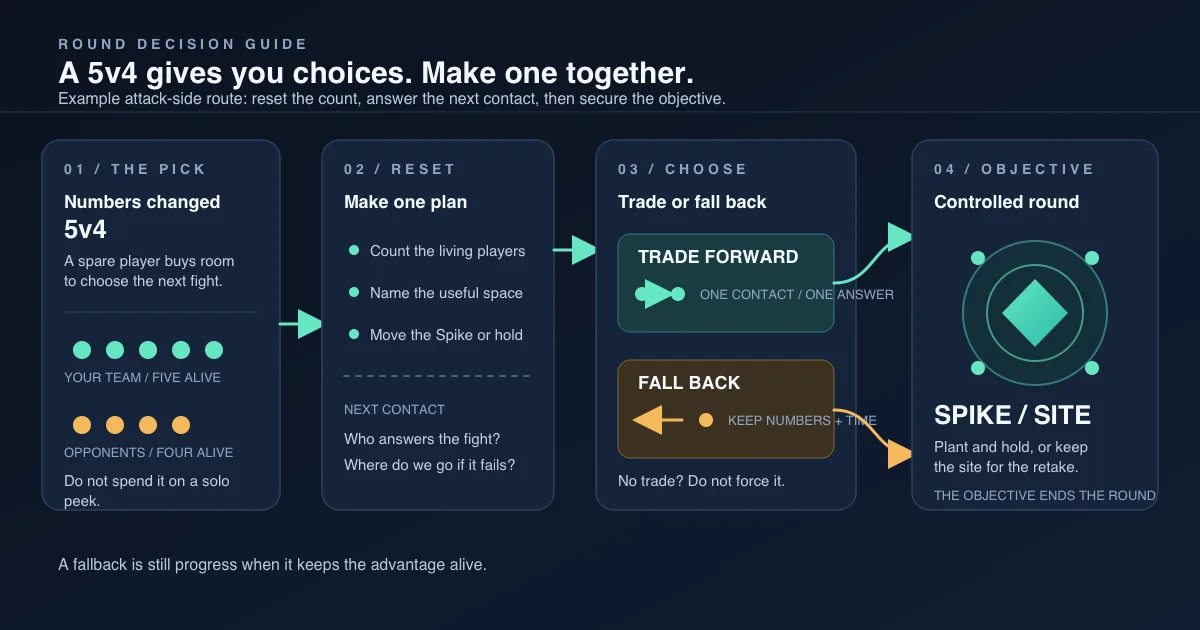
For the call reset, see useful comms. With the numbers, switch to the man-advantage plan.