VALORANT Fundamentals: Five Habits That Make Improvement Visible
Written by Valorant Village
Source-backed coverage ●
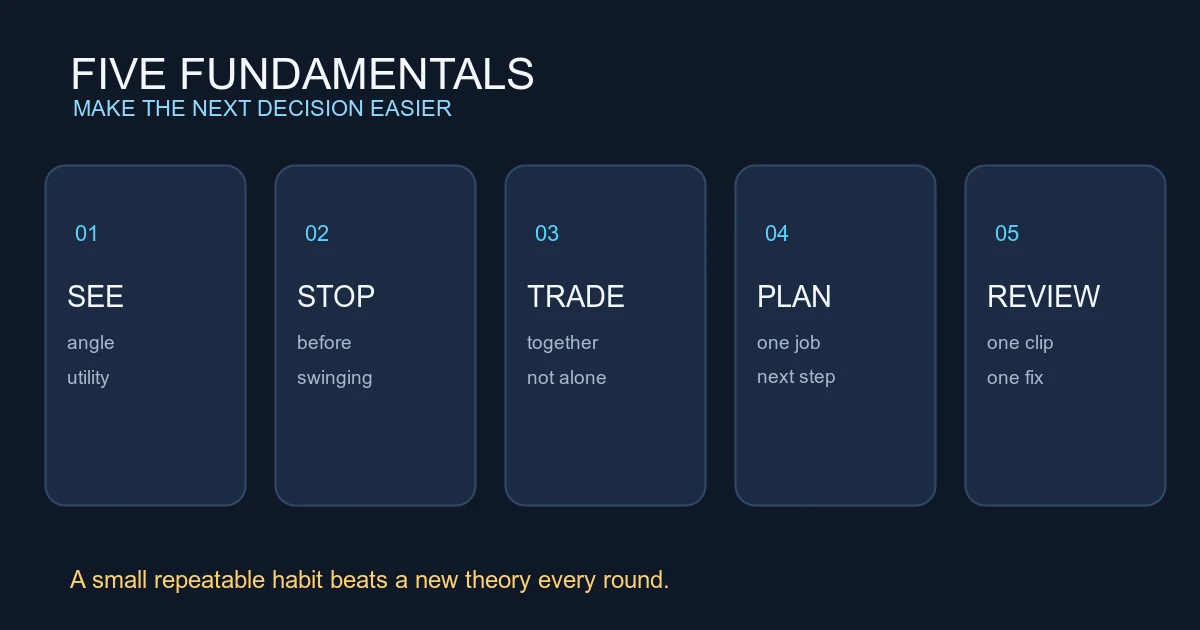
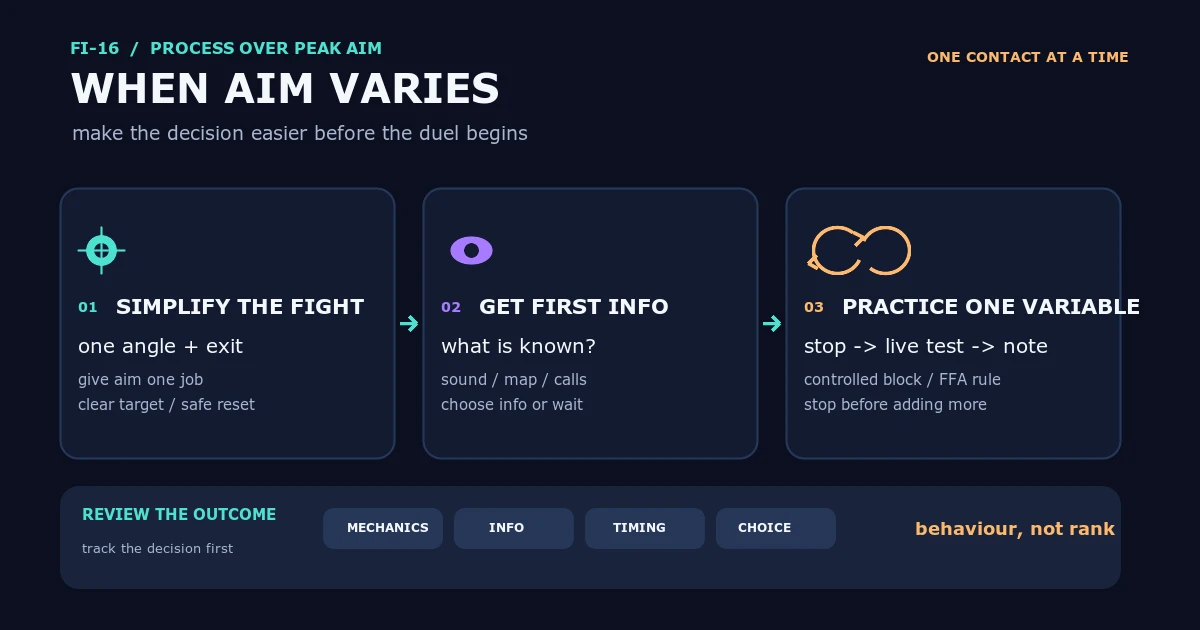
Improvement gets noisy when every loss creates a new project. One match says aim, the next says utility, and the third says the Agent was wrong. A better plan uses a few habits that appear in every round and can be reviewed without guessing what happened.
Riot's Beginner's Guide points players toward learning maps, watching angles and corners, deciding whether to run or walk, asking whether an ability helps the next goal, and communicating. Those ideas make a useful foundation. The five habits below turn them into checks.
1. Hold the next angle before the current fight
Crosshair placement is a route decision. Before you move, choose the first angle that can stop you. Keep the crosshair near the height and side where a defender could appear, then clear one angle at a time.
The crosshair-placement guide has the detailed drill. For a simple review, pause a VOD before each first contact and ask whether your crosshair was already near the threat. If not, fix the route before buying a new crosshair.
2. Stop before you shoot
Movement and shooting are separate jobs. If the fight starts while you are still moving, the crosshair may be correct and the shot can still miss. Practise walking to the angle, stopping, then firing a small burst.
This is not a demand to stand still in every fight. It is a way to notice when panic movement is doing the thinking. A planned strafe can be useful. A late key release is usually just a late key release.
3. Give utility a next goal
Do not ask whether an ability was useful in the abstract. Ask what it helped the team do next. A smoke can block the far angle so an entry player clears close. A flash can make a teammate's swing safer. A trap can make a flank expensive.
The useful comms guide keeps the call concrete: say the result, the location and the next action. If you cannot name the next action, delay the throw or use a smaller piece of utility.
4. Buy for the round, not the last death
Economy is a team habit. Before buying, check the team credits, the next round value and the plan if the opening fight is lost. A single player forcing a weapon can create a round that looks strong in the buy menu and weak after the first exchange.
The economy guide explains the basic decisions. You do not need a perfect spreadsheet in a ranked lobby. You need a short call that prevents five different plans.
5. Review one question after the match
Choose one question before watching a VOD: did I take the first fight with a trade, did I rotate on evidence, or did my utility help the next goal? Watch a small sample of rounds and write what you can see.
Do not call every mistake “bad aim.” If the first death came while isolated, fix the route or communication. If the crosshair was ready and the teammate could trade, then aim may be the next project. The weekly improvement loop gives a way to keep the review small.
Put the habits together
In the next three matches, track one line per round: first angle, stop before shot, utility goal, buy plan and review note. You will miss some checks. That is useful evidence, not failure.
After the session, pick the habit that failed most often and practise it in isolation for ten minutes. Then return to a match and see whether the decision appears more reliably. Fundamentals become visible when they are specific enough to count.
Keep the notes short. “Crosshair low on second angle” is more useful than a paragraph about losing focus. “Smoke thrown before teammate was ready” points to a timing fix. “Bought alone after a save call” identifies a team-plan problem. Good notes make the next practice session obvious instead of making the loss sound mysterious.
These habits also work when the match is going well. A win can hide a late crosshair or a risky buy because a teammate recovered the round. Review the decision, not just the result. The aim is to make the useful round repeatable when the next opponent does not give you the same opening.
That is enough structure for a week. Do not add a sixth habit because one game exposed a new mistake. Keep the five checks stable, collect a small sample, and only replace a habit when the review shows that it is no longer the limiting problem.
Sources checked
- Riot Games Beginner's Guide, published 2024-08-02 and checked 2026-08-14 UTC. Used for map learning, angle checks, movement choices, next-goal utility and communication.
The five-habit structure, drills and review questions are Valorant Village coaching interpretation, not a Riot rank guarantee.