VALORANT Agent Lore: What Is Confirmed and What Is Fan Theory?
Written by Valorant Village
Source-backed coverage ●
VALORANT lore is designed to invite questions. Voice lines, environmental details and Agent relationships can point in the same direction without turning a theory into a confirmed fact. The easiest way to keep a lore article honest is to grade the evidence before writing the conclusion.
An official Agent page can confirm a current role and ability description. An official cinematic, story article or audio log can confirm a narrative event. A wiki, Reddit thread or creator video can help you find a lead, but it is not the final source. The date matters too, because Riot can add, revise or retire story material.
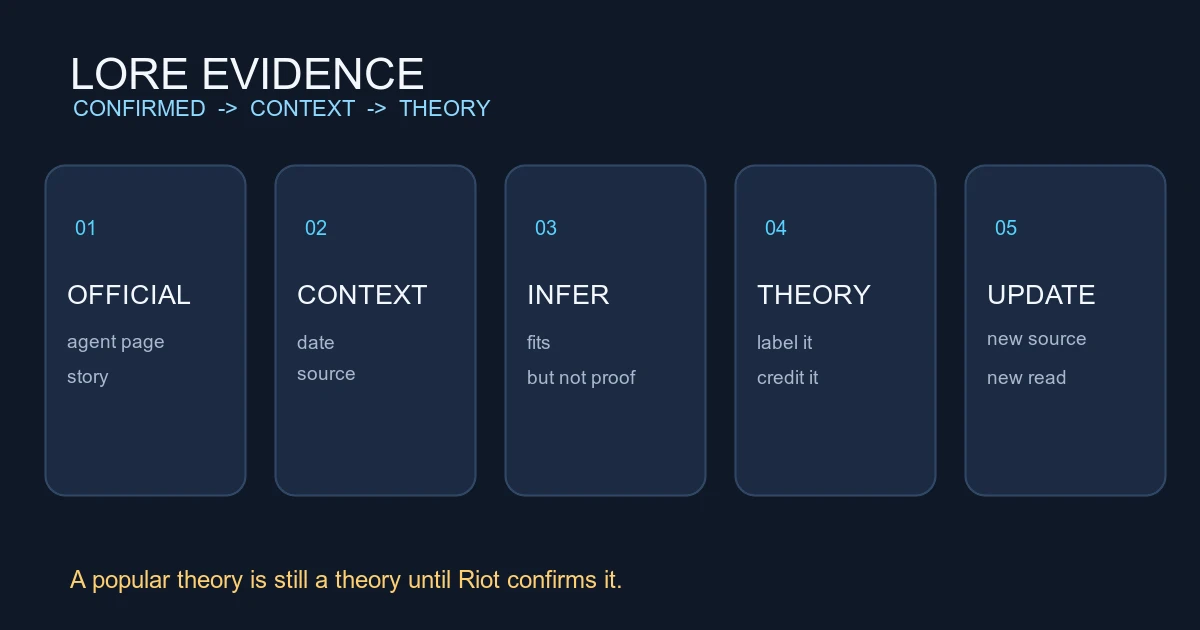
Use an evidence ladder
Start with four levels:
- Direct official text or media: an Agent page, cinematic, story post, audio log or in-client text published by Riot.
- Officially presented context: a developer explanation or a named piece of environmental storytelling that connects the material.
- Reasonable inference: a conclusion that fits the evidence but is not explicitly stated.
- Fan theory: an interesting possibility built from patterns, symbolism or community discussion.
The wording should match the level. “Riot's Agent page describes” is different from “this proves.” “The story strongly suggests” is different from “the canon says.” “A common fan theory is” tells the reader where the boundary sits.
The VALORANT Agents page is a good starting point for current Agent identity and kit information. It is not a complete biography database. If a page says an Agent's role or ability, cite that claim. Do not use the same page as proof of an unlisted family relationship or event.
Story material needs context
Riot sometimes places story details outside a standard article. From the Archives: The Sting Audio Logs explains that an audio log in the Shooting Range carried story about the operation to capture Fade. That is stronger evidence than a fan summary because Riot identifies the source, the setting and the story context.
It is still important to date the material. An archived audio log can establish what Riot presented in that story moment without answering every later question. If a later cinematic changes the context, the article should show both sources rather than quietly treating the first clue as the final answer.
The same rule applies to voice lines. An interaction can reveal character perspective or a narrative hint. It does not necessarily confirm that every line is a literal historical statement. Note who says it, when it plays and whether a later official source clarifies it.
Keep ability facts separate from lore
An Agent guide and a lore article can link to each other, but they do different jobs. Ability facts answer what the client currently lets the Agent do. Lore answers what Riot has shown or said about the world. Mixing the two makes both harder to update.
For example, a current ability page can change after a patch while a story article remains a historical source. The agent-role matchup matrix is useful for gameplay relationships. Do not turn a gameplay counter into a story relationship just because two Agents frequently appear in the same team composition.
When a lore claim depends on a patch note, link the patch and state why it matters. When it depends on a cinematic, link the cinematic or Riot's article about it. A screenshot without a source date is a clue, not a citation.
Write theory without flattening it
Fan theories are part of the fun. The solution is not to remove them; it is to label them. Give the theory its own heading, list the evidence that supports it and name the evidence that cuts against it. Avoid language that turns a pattern into a secret announcement.
A useful theory section might say: the official material confirms A and B; the community connects those details to C; Riot has not confirmed C. That lets readers enjoy the interpretation without leaving the page believing that a speculative relationship is canon.
Do not repeat a theory merely because many accounts repeat it. Popularity is not a source. If a fan creator first noticed the connection, credit the idea and link the original discussion where permission and context allow. Do not copy a long theory post into a new article with light commentary.
Maintain an update log
Lore pages age through accumulation. Add a “sources checked” date, publication date and a short update note when new material changes the reading. Keep the original wording visible when a claim was historically true but is no longer the best description of the current story.
The editorial policy should govern corrections and source changes. If a sentence was too certain, rewrite the sentence rather than adding another paragraph that quietly contradicts it. Readers should be able to tell whether a fact came from Riot, an inference or a community theory.
Sources checked
- VALORANT Agents, checked 2026-08-14 UTC. Used for the current Agent-page boundary between official role/ability information and unsupported biography claims.
- From the Archives: The Sting Audio Logs, published 2022-05-23 and checked 2026-08-14 UTC. Used as an example of official environmental/audio story evidence.
- VALORANT News, checked 2026-08-14 UTC. Used as the official index for dated stories, cinematics and updates.
The evidence ladder and language rules are Valorant Village editorial guidance. A fan theory can be worth reading without being presented as a confirmed Riot statement.