What Pro Timeout Usage Can and Cannot Teach Ranked Players
Written by Valorant Village
Source-backed coverage ●
The pause is easy to overread. A coach leans in, the broadcast cuts away, and the next round looks cleaner. Viewers fill in the missing sentence: they solved A, reset the team, or spotted a flank. Maybe. The pause cannot tell you which.
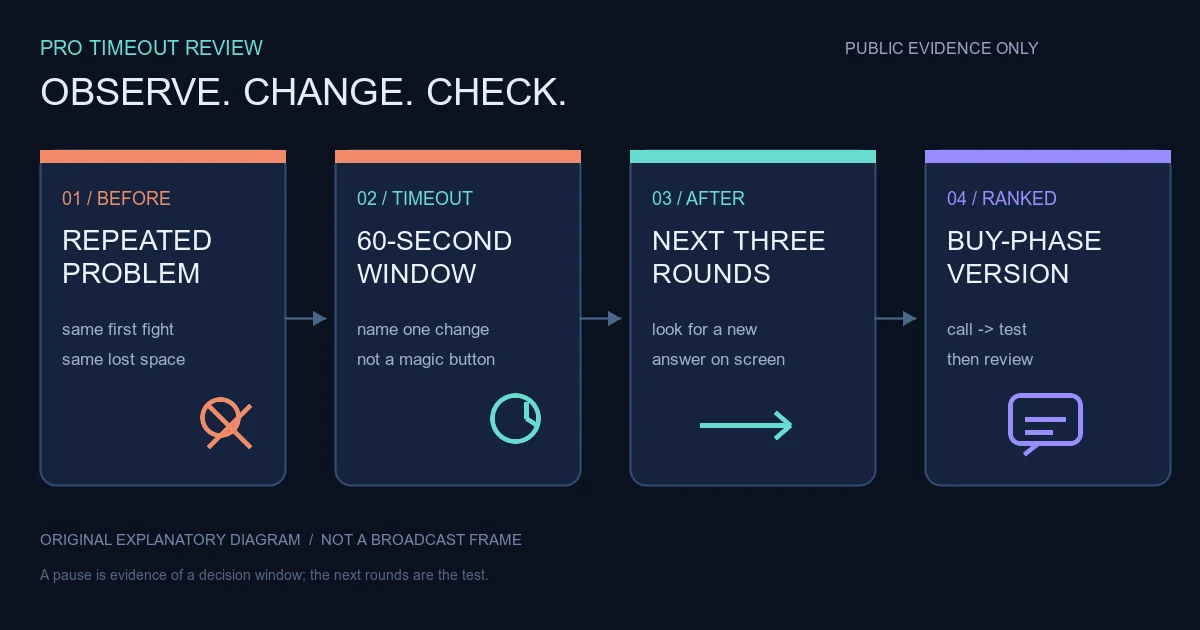
Riot's global VCT Official Competition Ruleset (2026) gives the moment a more useful shape. Each team gets two 60-second timeouts per map during the first 24 regulation rounds. A timeout must be taken within the first 20 seconds of a Buy Phase, and communication during it is limited to players and coaches. In overtime, each team gets one timeout; regulation timeouts do not carry over.
That is a planning window with a clock on it, not a magic button.
Start with the round before the pause
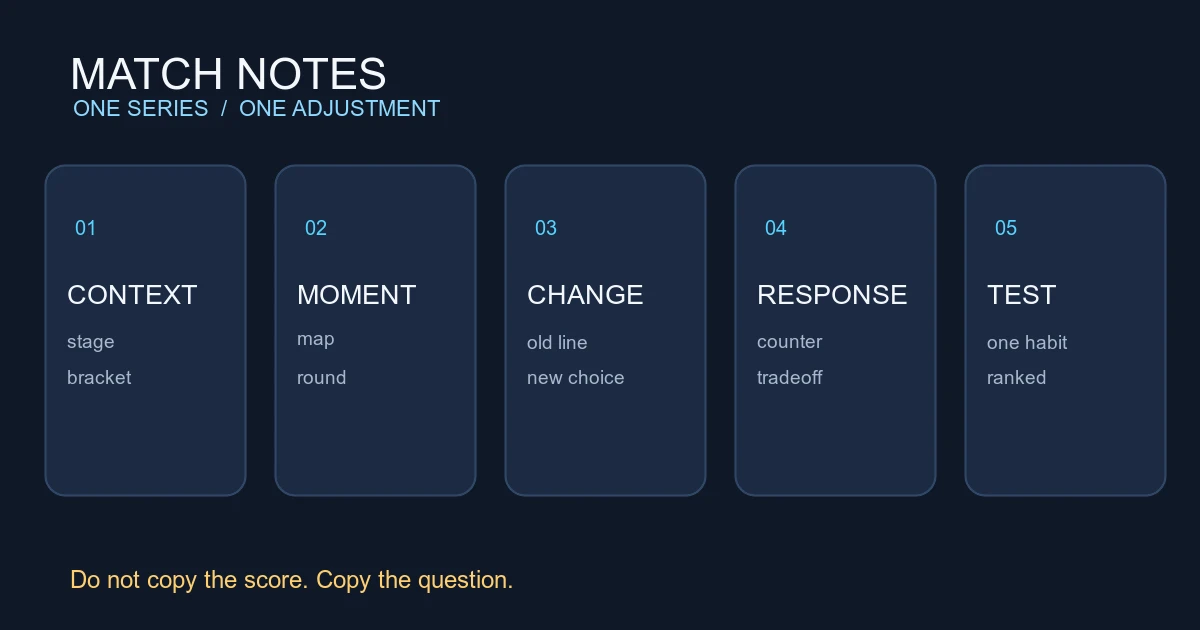
When reviewing a VOD, record the score, side, economy, ultimates, time left and last contacts before the timeout. Then look for repetition. One lost duel is not a pattern; three rounds where the same first fight happens before a trade might be.
Use language a teammate could check next round. “We keep losing” is foggy. “Our first player dry-peeks A Main and the second arrives after defender utility” is useful. It describes footage without claiming to know private thoughts.
The adjustment can be small: hold first contact, change entry timing, keep the trade close, spend one utility earlier, or give up a lane for the retake. You need one change that can show up on screen.
Watch what happens after, not just the pause
The official VCT Americas broadcast of KRU vs BST, dated August 14, 2026, is a good reminder to separate broadcast evidence from private motive. In the transcript, commentary at 14:34 frames the job after one timeout as surviving the first 20 seconds. At 23:11, the broadcast points out a setup after a timeout. At 49:57, it says there was no success after another timeout. Later, at 1:31:38, the commentators describe an adjustment that punished mid aggression.
These are broadcast observations, not team comms. The same match includes a timeout followed by a poor result and another followed by a better adjustment. So “the timeout worked” is too blunt: the pause may change a plan, but the next fight still has to be played and the opponent reacts.
For a ranked review, inspect the next three rounds. Ask three plain questions:
- Did the first contact move?
- Was a trade, escape route or useful utility available?
- Did the opponent face a new problem, or the same round start?
Record the result separately. A good adjustment can lose to a bad duel; a bad plan can win on a spectacular shot. Decision quality and round outcome overlap, but are not the same.
Copy the method in ranked
Ranked has no formal coach timeout. Use the buy phase for a shorter version: make one call, then check it.
- Name one repeated problem: “They fight our first peek with two players.”
- Give one change: “Hold the angle and swing off our flash.”
- Review the next few rounds: did the first fight move, did the trade arrive, and did the opponent answer it?
This is where useful comms beat a speech. A short call gives five players something to remember while buying, moving and listening. If it fails, simplify before adding a second adjustment.
That habit also helps after an early pick. The man-advantage guide makes the broader point: a favorable count creates room for a safer fight, not permission to chase every sound. A timeout review is the same idea in miniature: turn information into a route, then see if it survives contact.
What the pause cannot tell you
Do not call a team tilted after two lost rounds, or say a coach “saw the stack” because the next round went elsewhere. Do not label a timeout a mental reset unless a player or coach said so. A change may have been planned earlier, forced by economy, or based on information the broadcast never showed.
Riot's rules distinguish tactical and technical pauses. During a technical pause, player and coach communication is forbidden unless a League Official instructs otherwise. Treating every stoppage as a strategy lesson sends VOD review in the wrong direction.
Use a simple worksheet: record the observable problem, one testable change, three rounds and what changed. If studying the veto, the VCT veto guide uses the same rule: keep public evidence separate from the private story you are tempted to tell.
Professional timeouts can teach ranked players how to turn a vague losing streak into a test. They cannot reveal the hidden sentence spoken during the pause, and they cannot promise that the test will work. The next three rounds are the evidence.
Sources checked
- VCT Official Competition Ruleset (2026), Riot Games / VALORANT Champions Tour, last updated December 18, 2025; listed in The Library January 11, 2026; accessed August 14, 2026 at 12:33 UTC. Sections 6.1–6.1.2 support timeout count, duration, Buy Phase window, communication limits and agent-control restrictions; sections 6.2–6.2.3 support the tactical/technical distinction.
- The Library, Riot Games Competitive Operations, title “The Library,” accessed August 14, 2026 at 12:33 UTC. Its live VAL filter lists the 2026 VCT ruleset and last-update date.
- VALORANT Esports | Schedule, Riot Games / VALORANT Esports, live page with no publication date displayed; accessed August 14, 2026 at 12:35 UTC. It lists VCT stages, series formats and official VOD links.
- VALORANT Esports | BST VS KRU, Riot Games / VALORANT Esports, accessed August 14, 2026 at 12:36 UTC. It identifies the game-1 recording and links the VCT Americas channel.
- KRU vs BST - VCT Americas Stage 2 Play-Ins - Day 1, VALORANT Champions Tour Americas, dated August 14, 2026; accessed August 14, 2026 at 12:37 UTC. Its transcript supplies commentary observations at 14:34, 23:11, 49:57 and 1:31:38.