CS2 to VALORANT Sensitivity Conversion: Start, Then Calibrate
Written by Valorant Village
Source-backed coverage ●
Moving from CS2 to VALORANT is easier when you keep the first conversion small. You do not need to rebuild your whole mouse setup before playing a round. You need a reasonable starting number, a stable test and enough time to notice whether the problem is sensitivity or a different game habit.
The common starting convention is to divide a CS2 sensitivity by about 3.18 for VALORANT. That number is not a Riot guarantee. It is a community conversion estimate intended to preserve a similar physical distance for a turn. Your final setting still depends on mouse control, resolution, field of view, movement, weapons and the way you clear angles.
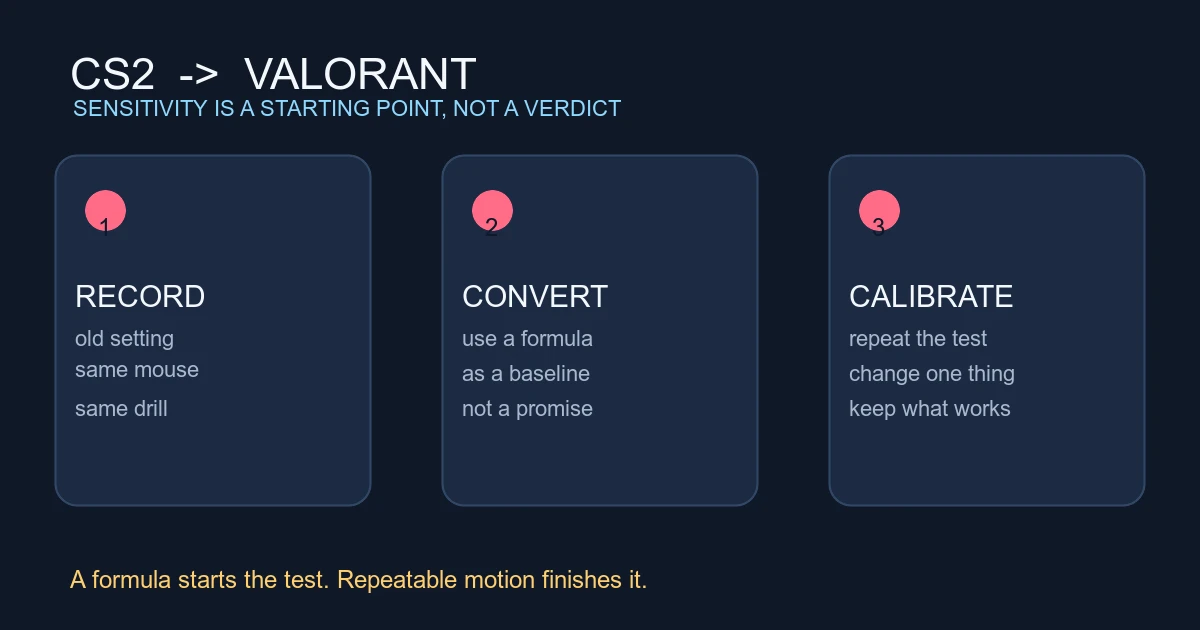
Write down the old setup
Record the CS2 sensitivity, DPI, polling rate, resolution, aspect ratio and any raw-input setting you used. If you only remember the sensitivity number, the conversion has less evidence behind it. The same number can feel different on a different mouse, pad, display or desk.
Keep the first VALORANT setup close to the converted value. Do not lower it immediately because the game feels slower. VALORANT asks for different movement and angle habits, so the first few rounds can feel strange even when the physical turn is similar.
Use the formula as a starting point
Take the CS2 sensitivity and divide by 3.18. Round to a value you can enter and record the result. Then leave it alone for one short practice block.
The formula is a starting estimate, not a source-backed promise. Riot's Beginner's Guide recommends learning maps, watching angles and communicating. It does not endorse a CS2 conversion formula. Treat the formula as a way to avoid choosing a random number, then let your own testing decide.
Calibrate with repeatable motions
Start in the Range or a custom game. Use a fixed target and practise three motions:
- A small correction from one head to the next.
- A medium turn from one angle to another.
- A larger turn that begins from a prepared crosshair position.
The question is not whether every flick lands. Ask whether you stop consistently and whether the mouse movement feels controllable. If you overshoot small corrections, the setting may be high for your current control. If you cannot reach the next angle without lifting repeatedly, it may be low for your desk and grip.
The 20-minute warmup works better after the conversion is stable. Do not use a warmup to change the setting every five minutes. It should teach your hands the value you chose.
Separate sensitivity from movement
CS2 and VALORANT do not ask for identical movement habits. If you fire while moving, clear a different angle order or stop late, a conversion can feel wrong even when the physical distance is close. Check the gunfight-after-utility guide when a missed shot follows a utility use or rushed stop.
Run a short deathmatch without changing the setting. Track whether the first adjustment lands, whether you stop before firing and whether you lose targets because the route was wrong. If your aim is fine in a simple drill but poor when crossing a lane, the answer may be movement or positioning rather than sensitivity.
Make one adjustment
If the converted value still feels wrong after a session, change it once by a modest amount. Use the same drill again. A small reduction can make short corrections easier. A small increase can make turns less cramped. Do not swing from one extreme to the other.
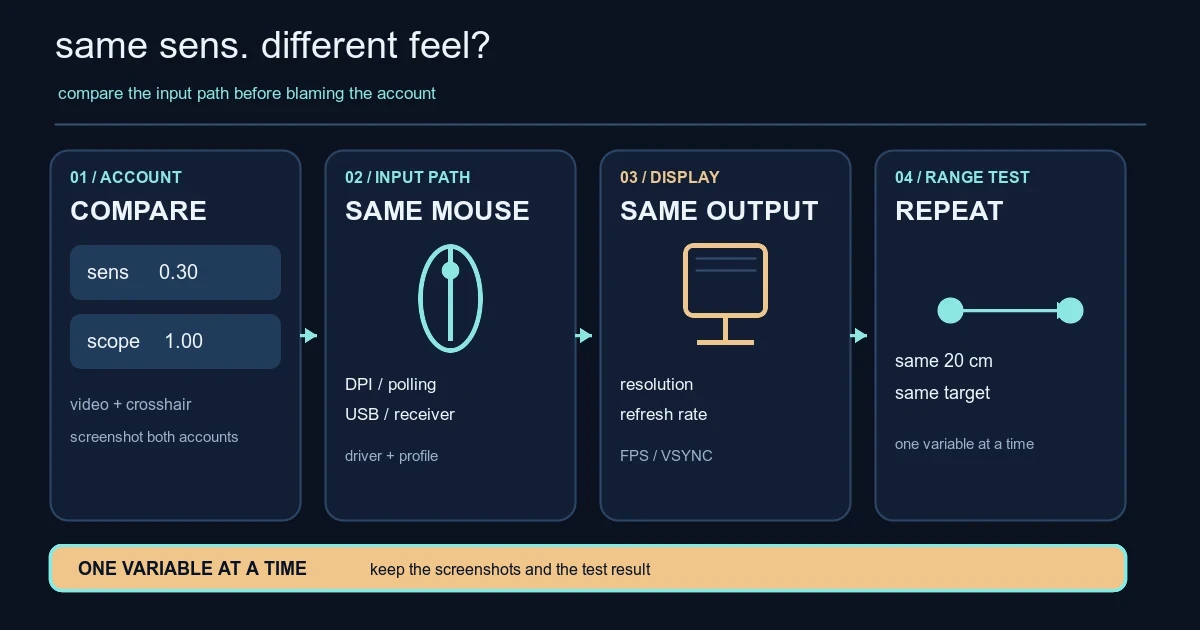
The sensitivity guide is useful when the same number feels different across environments. Check Windows settings, mouse software, display scaling and frame consistency before blaming the game. The goal is a repeatable input path.
Do not compare the converted number with somebody else's number and call one of them correct. Two players can use different sensitivities while making the same controlled turn because their grip, pad and preferred arm movement differ. The conversion only preserves a reference distance. It does not preserve a player's confidence, stopping habit or comfort with small corrections.
If you use a scoped sensitivity or separate ADS value, record that too. Test the weapons you actually use rather than only a rifle spray in the range. A setting can feel fine during a large turn and awkward when you make a small correction through a narrow angle.
Give the setting a full block of matches before deciding that the formula failed. Early discomfort often comes from learning new angles and movement, not from the conversion itself.
Sources checked
- Riot Games Beginner's Guide, published 2024-08-02 and checked 2026-08-14 UTC. Used for map, angle, movement and practice principles.
The 3.18 division is a community starting convention, not a Riot-published formula. The calibration drills, movement separation and adjustment rule are Valorant Village coaching interpretation.