Why You Lose Gunfights After Using Utility in VALORANT
Written by Valorant Village
Source-backed coverage ●
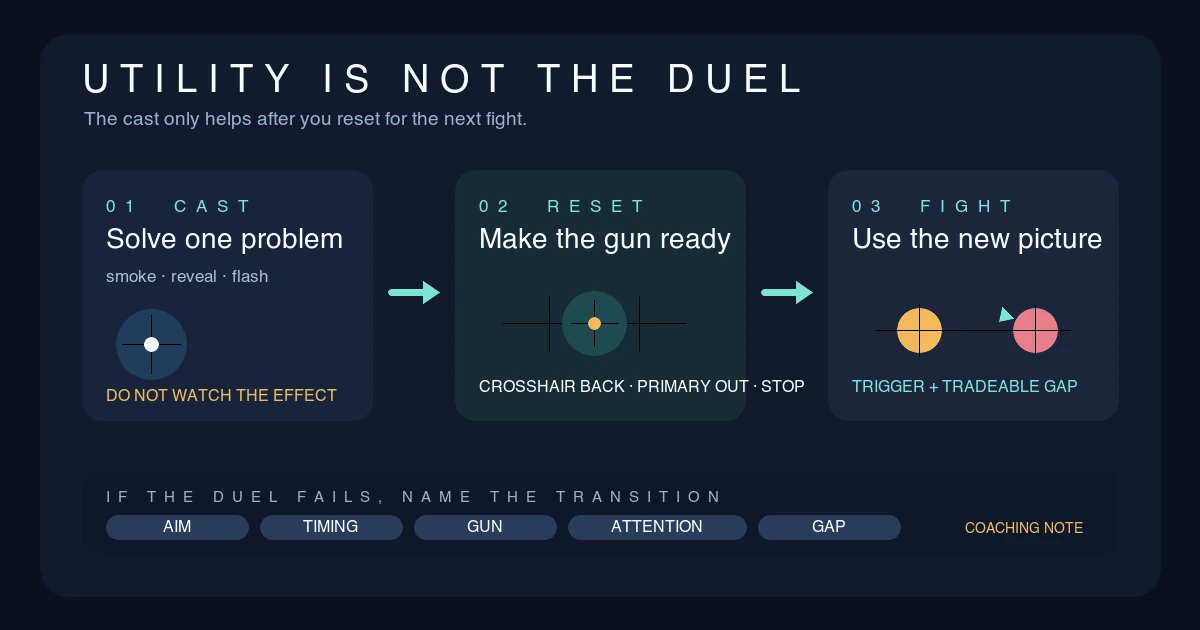
Your utility can be correct and your duel still be awful. The failure is the unfinished transition back to a gunfight: you cast at the ability target, watch the effect instead of the angle, enter off-beat, and meet the enemy with the wrong crosshair or item.
Utility only creates a better fight when you are ready to act on the new picture. Five things decide whether that happens: crosshair placement, timing, weapon readiness, attention, and spacing.
Start with the documented mechanics
Riot’s Beginner’s Guide says Agent skills work alongside one another, asks whether an ability helps the next goal, and tells players to stop before shooting for better accuracy. Riot’s Sova page says Recon Bolt reveals nearby enemies in its line of sight. The Omen page says Dark Cover blocks vision and Paranoia reduces vision range. The Breach page says Flashpoint blinds players looking at it.
Those are documented mechanics. The reset, trigger, and spacing rules are coaching interpretation. The checked Riot pages do not give one universal cast-to-shot number or promise a kill.
1. Your crosshair stays on the cast
Most casts pull your aim toward their landing point. That is correct for the cast and often wrong for the first bullet. You throw Dark Cover, then re-enter with the reticle parked on the orb. You fire Recon Bolt, then stare at the reveal instead of holding the angle the player must cross. Flashpoint pops, but your crosshair is still on the wall.
Choose the first gun angle before casting. Picture the likely head-height exit, cast, equip the weapon, and return the reticle there before exposing. Head height and angle order are coaching advice built around Riot’s instruction to learn enemy routes and watch angles, not a guaranteed headshot rule.
2. You wait past the useful timing
Utility is a trigger, not a ritual. A smoke can block a sightline, recon can reveal a lane, and a flash can deny vision. If you pause, the defender can move, your teammate can become isolated, and the picture can change. Swing too early and you take contact while your action is unfinished.
Do not solve this with an invented number of milliseconds. Name the event: “on flash,” “after recon shows,” or “as smoke lands.” The thrower and fighter should share the trigger. If the effect fails or the teammate is late, cancel and rebuild. A failed trigger is information, not a reason to dry peek.
3. Your weapon is not ready
The most embarrassing death is also the most fixable: the enemy appears while the ability is still in your hand. You panic through the swap, keep moving, or arrive with the crosshair at the cast location. Riot’s stop-before-shooting advice matters. A gunfight cannot use utility’s advantage if the gun is not ready.
Before crossing the danger line, check three things: primary equipped, reticle on the first angle, and movement ready to stop before the shot. If your teammate is taking contact off your cast, reset before they enter. One deliberate utility-to-weapon transition beats layering a second ability for a highlight.
4. Your attention follows the effect
Casting asks you to track a trajectory, target a wall, read a reveal, or watch a flash. The enemy angle does not freeze. Use the effect once, then return your eyes to the gunfight. Recon confirms a location; it does not shoot. Flashpoint blinds players who look at it; it does not place your crosshair. Dark Cover removes one sightline, not every angle.
Ask: what fact changed, and which crosshair position uses it? If one player was revealed near the lane, hold or clear it with your teammate. Do not stare at the marker and donate the angle it helped you take.
5. Your spacing no longer matches the play
Utility changes who should be first. One player may throw, another enter on the flash, and a third hold the exit or trade. If everyone stands in the same choke, there is no room to change angles. If the gap is too large, the cast and gunfight become separate events.
Call the physical plan: “I throw, you swing on flash,” or “I scan, we clear the marked lane.” Stand where that call is possible. The gun-ready player should be close enough to act, but not hide the first angle or walk into the same danger. Spacing is coaching, not a Riot formation. Test it on your doorway.
Before, during, after
Before the cast
- Name the job: information, blocked sightline, denial, or a forced move.
- Choose the first gun angle and the event that starts the swing.
- Tell the teammate who throws, who enters, who trades, and where the gap is.
During the cast
- Cast, read the result once, and stop watching the animation.
- Get the primary weapon out and put the reticle back on the first angle.
- Stop before shooting. If the trigger fails or the teammate is late, hold or cancel.
After the cast
- Call the fact, not the story: “Recon saw one close,” not “site is clear.”
- Reset to the next angle while preserving the trade line.
- Review the death as one category: placement, timing, readiness, attention, or spacing.
Practise one entry in a custom game with one ability and one teammate. Repeat it without chasing frame data. Log the first failure, fix that transition, then add another ability. Use the crosshair placement guide for the aim reset, how to trade a teammate for the gap, and this comms guide for the call.
Before pressing the next ability key, finish this sentence: “When this happens, I will fight from here with this angle.” If you cannot fill it in, the utility is still only a button.