Deadlock Guide: GravNet, Barriers and When to Anchor
Written by Valorant Village
Source-backed coverage ●
Deadlock is easy to make busy and surprisingly hard to make patient. A round can start with all three tools gone before attackers show a plan. You may feel active, but you have traded away the tools that turn first contact into a second decision.
The useful question is not “Where is my setup?” It is “What information do I have, what move can I delay, and can I still contest the next fight?” This guide separates Riot’s current ability descriptions from coaching. The order is information, delay, contest, then early spending with a clear job.
The current mechanics
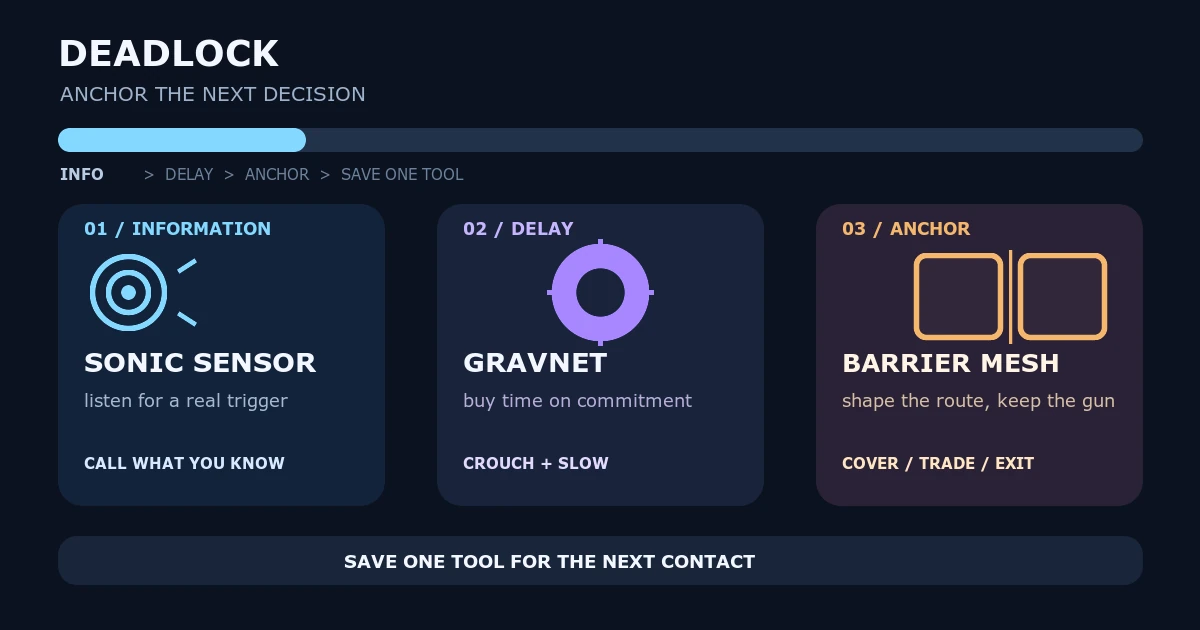
Riot’s live Deadlock agent page lists her as a Sentinel and describes the relevant tools without publishing a universal setup. Sonic Sensor monitors an area for enemies making sound, then concusses it when it detects footsteps, weapon fire or significant noise. Barrier Mesh is a disc thrown forward that generates barriers from its landing point which block character movement. GravNet detonates on landing and forces caught enemies to crouch and move slowly. The page also notes normal and underhand throws.
Those are the mechanics. They do not say where to place a sensor, when to swing, or how long to save a grenade. Riot’s Patch Notes 13.02, published July 29, 2026, mention Deadlock for an Annihilation bug fix involving Omen’s From the Shadows. No new GravNet or Barrier Mesh tuning appears there, so this guide avoids old numeric claims.
Riot’s Beginner’s Guide says Agent skills work alongside teammates and asks whether an ability helps achieve the next goal. That is the official team principle. The ranking below is editorial coaching, not a Riot rule.
1. Start with information
Use Sonic Sensor when a monitored route can change your decision. The output is not “the enemy is definitely here.” It is “noise happened in this area, so check the next piece of evidence.” Call what you know: “Sensor A main, footsteps,” or “Sensor triggered, no visual.” Keep your gun on the angle the sensor does not cover.
If the sensor activates behind you, do not turn a sound cue into a full rotation by reflex. Ask whether a teammate saw anyone, whether the spike or clock makes the route plausible, and whether you can arrive in time to help. The sensor has done its job when it changes your position or call. It has not ordered you to swing.
2. Delay a committed move
GravNet is more valuable when an opponent has to finish a route, take a fight, cross a choke or stand in a plant area. Its current effect forces caught enemies to crouch and move slowly. The coaching goal is not a guaranteed kill. It is time for a teammate, predictable movement, or a safer moment to leave.
Throwing it into an empty lane at round start may protect a habit rather than a real problem. If the sensor or a teammate confirms contact, wait until the enemy is committed enough that the delay matters. Then call the response before the grenade lands: swing from cover, fall back to the next angle, or let a teammate take the space.
3. Anchor the fight, not the setup
Barrier Mesh changes movement by creating barriers from the landed disc’s origin. It does not decide where your rifle should be or turn a bad position into a good one.
Anchor when three conditions line up: you have cover for the first duel, a teammate can trade or support the contest, and you have a route that does not require crossing open space to leave. Use Mesh where it changes the route the enemy must solve, then hold the gun angle the barriers do not cover. A barrier that isolates a lane can buy a fight. One thrown with no information can simply announce where you are.
If one condition is missing, delay instead of forcing the anchor. Let the enemy spend time clearing or walking around the barrier, then fall back while your team rotates. Staying alive with a useful angle is defensive value. Anchoring does not mean promising to die on site.
4. Spend at round start only for a reason
Do not spend every tool because the round timer started. Use one early when it secures a specific objective: Sensor watches a route that must be heard, Mesh changes a planned opening, or GravNet answers a called rush. Otherwise, keep at least one control tool for the first real contact.
This is a default, not a rigid economy rule. Before using an ability, finish the sentence: “I am spending this now so that…” If the answer depends on an enemy action you have not seen, wait. If it protects a teammate’s plan or denies a known route, spend it and tell the team what happens next. A saved tool is value reserved for the event that makes it matter.
A four-question anchor check
When contact arrives, ask in order:
- What did the information actually confirm?
- Can GravNet delay the move the enemy has chosen?
- Does Barrier Mesh improve my cover, trade or exit?
- If I fight now, who arrives next and where do I fall?
That sequence keeps the abilities connected. Sensor gives a reason to look. GravNet buys a window. Mesh shapes the space. Your gun and escape route decide whether the anchor is worth holding.
For short calls that keep the information factual, use our guide to useful VALORANT comms. Our Killjoy anchoring guide explores the same information-to-fight problem with a different Sentinel kit. If your delay creates the first pick, switch to the spacing rules in how to play a man advantage.
Your round-start rule can be one line: sensor for information, one tool for the first committed move, gun for the fight, and the last tool for the next problem.