How to Get More Value From Sage’s Wall, Slows and Resurrection
Written by Valorant Village
Source-backed coverage ●
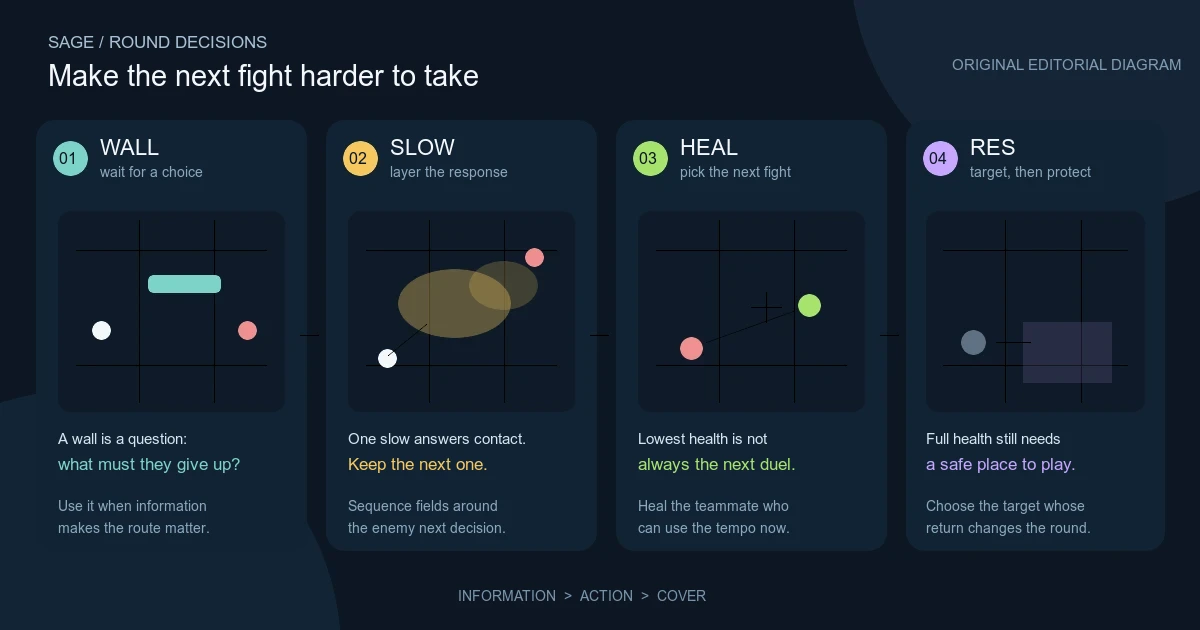
Most Sage rounds are lost before the first fight. The wall goes up because the clock started, the slow lands where nobody is going, and Resurrection arrives after the team has already run away. Sage is easy to understand. Getting value from her means waiting for a decision, then making that decision harder.
Riot’s current Sage agent page lists her as a Sentinel. It says Barrier Orb places a solid wall, Slow Orb creates a lingering slow field, Healing Orb starts a heal-over-time on a damaged ally or on damaged Sage, and Resurrection brings a dead ally back at full health after a brief channel. Those are the Riot facts. The timing advice is Valorant Village’s read.
Barrier Orb: wait until someone has to answer
Riot’s page says Barrier Orb places a solid wall and that ALT FIRE rotates the targeter. It does not tell you where the wall belongs. That depends on your information and the other side’s plan.
The useful question is not “Can I put a wall here?” It is “What choice will this wall force?” On defense, wait for a committed entry or information that makes the route matter. A wall across a narrow approach can split the first wave from the players behind it, while a wall protecting a teammate’s real hold can buy a different fight. The point is to change the next few seconds, not decorate the site before anyone appears.
On attack, say what the wall is buying. “Wall for plant, then play off the break” gives the team an endpoint. If nobody can reach or cover the space, save it for the next piece of information.
Late walls often do more than early walls because the enemy has less time to choose a comfortable answer. Review the first wall after the round: did it separate a fight, protect an action or make the other team spend attention? If not, ask what information was missing.
Slow Orb: layer decisions, not effects
The current Riot description says Slow Orb is thrown, detonates on landing and leaves a lingering field that slows players caught inside. It does not publish a universal lineup for every map.
Use that field where somebody has to cross, swing or stand still. A slow at a choke can delay a push; one around the spike can make a tap or retake awkward. A slow behind site can punish a defender’s retreat route. Those are practical inferences. Map, round state and information should decide the location.
Treat the two slows as separate decisions. One can answer the first committed move; the other can wait for a wall response, plant attempt or retake. “Layering” means sequencing around the enemy’s next choice, not claiming that fields stack, last a fixed time or work identically in every client version.
Sage gets more annoying when utility arrives in steps. Wall first, then slow as the enemy solves it, then a gunfight on the slowed route is one possible sequence. It is not a script. If the enemy rotates, save the second slow for elsewhere. Review who it caught and what they were trying to do. If it caught nobody, the problem may have been timing rather than aim.
Healing Orb: choose the next fight
Riot says Healing Orb can be fired over a damaged ally to start a heal-over-time. ALT FIRE starts a self heal-over-time when Sage is damaged. The page does not say “heal the lowest health player first,” and that is a rule to avoid.
Look at the next important fight. A teammate with less missing health may still be right if they are holding contact, carrying needed utility or able to take space now. A very low player rotating away may not be the best use. Your own heal can make sense while anchoring a threatened area; it is less useful after the round moves across the map.
Call the target when timing matters. “Healing our next contact” is more useful than pressing the button in silence. The decision is about tempo, not rewarding whoever took the most chip damage.
Resurrection: pick a target, then protect the cast
The live Riot page says to target a dead ally, complete a brief channel and bring that ally back with full health. It does not promise a safe cast location or an immediately favourable fight. Protection is a team responsibility.
Choose the dead teammate whose return changes the next fight. That might be the player in the best position, the teammate with needed utility or someone who can contest the objective without repeating the death. The top fragger is not automatically the right target. Neither is the closest body.
Before you cast, answer three plain questions:
- Where will the revived player stand, and what can they see?
- Who is watching Sage during the channel?
- What does the enemy do if it gives up the original fight and attacks the resurrection?
Use the wall or a slow when it supports the cast, and ask teammates for cover. On attack, the return may help finish the plant or hold post-plant space. On defense, it may help contest the spike or close the retake. These are round-state decisions, not universal rankings.
A review habit that makes Sage better
After a session, review three moments: the first wall, the first slow and the Resurrection decision. Write down your information, the action you wanted and what the enemy did next. Do not judge a wall only by kills. It may have bought a rotation, split an entry or kept a teammate alive for the useful duel.
Riot’s Beginner’s Guide tells players to ask whether an ability helps achieve the next goal and treats Agent skills as tools that work alongside teammates. That is a good Sage review question. If your team also struggles to make use of space, our guide to playing the man advantage in VALORANT is a useful companion read.
When the first death goes the other way, use the same review in how to play a man-disadvantage round. Sage’s wall and Resurrection are often the difference between a grouped retake and four isolated fights.
Sage does not need a wall lineup for every round. She needs a reason to spend each ability, a teammate who knows what the cast is buying and enough patience to let information arrive first.