Killjoy guide: turn Turret information into a real site anchor
Written by Valorant Village
Source-backed coverage ●
Killjoy rounds often go wrong quietly. The Turret fires, the cue arrives, and you keep holding the same angle as if a tiny robot has taken your shift. Then the site falls. Her setup should give you a choice: take a supported fight, delay with utility, or leave before the enemy turns your anchor into a trap.
Information matters only when it changes your position, timing, or call. Anchoring means staying close enough to contest a site, not becoming furniture beside your gadgets.
Riot’s facts, then the coaching
Riot’s live Killjoy agent page lists her as a Sentinel. It describes Turret as a deployable device that fires at enemies in a 180-degree cone and can be recalled. Alarmbot hunts enemies in range, explodes on its target, applies Vulnerable, and can be recalled. Nanoswarm becomes covert on landing and can be activated to release damaging nanobots. Lockdown has a long windup, Detains enemies in its radius, and can be destroyed.
Those are ability facts. The page does not tell you where to place a Turret, when to swing off Alarmbot, or which plant spot deserves a Nanoswarm. Everything below that sentence is coaching advice, not an official Killjoy rule.
The latest Riot patch page I checked, VALORANT Patch Notes 13.02, dated July 29, 2026, lists Phoenix’s ultimate-cost change, Retake maps, and agent bug fixes, but no Killjoy balance entry. The relevant KJ-specific note is VALORANT Patch Notes 11.08, dated October 15, 2025. Riot said it was adding counterplay around range-restricted utility and asking players to choose between keeping it active and repositioning. Its old Turret and Alarmbot timing and health values are historical; do not treat them as current. The decision still matters.
Place Turret for a fight
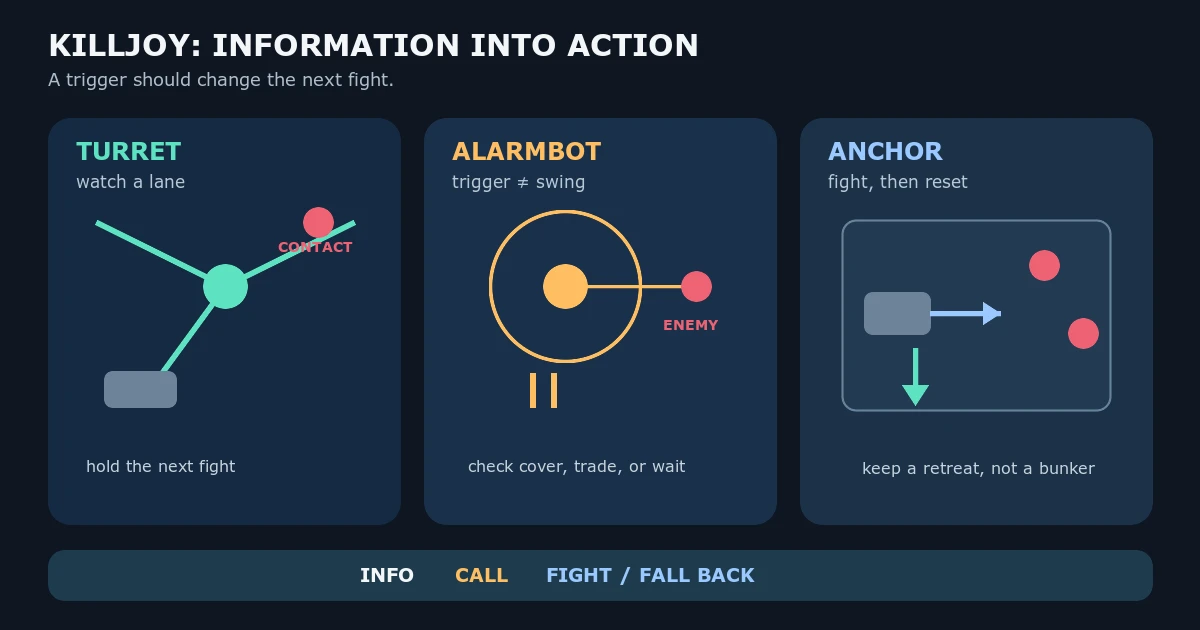
The Turret location should answer a sentence: “If it sees someone, I will hold this angle, swing with this teammate, or fall to this cover.” If you cannot finish the sentence, the device is probably watching empty space.
A good anchor Turret sees contact before the enemy is in your face. It should make clearing it awkward or give you time to move. Deep behind site, it may fire only after the fight starts. In a wide lane, it may be destroyed for free. There is no universal best spot; use the one that supports this round’s fight.
Do not stand beside it by default. Hold the gun angle the Turret does not cover, keep a route back to a teammate, and pay attention to the direction of the contact. If the Turret fires behind you while you are isolated, the information is not permission to sprint into a 1v3. Call it, turn if the fight is playable, or give ground.
Alarmbot discipline: a trigger is not a command
Alarmbot going off means you have a reason to check the lane. It does not mean “swing now.” Before peeking, ask: can someone trade me, do I have cover, and does this protect the site or Spike? If the answer is no, let the bot do its job and hold the next angle.
Call confirmed information, not a story. “Alarmbot A main, one contact” is useful. “They are all A” may be a guess. Check the minimap, sound, teammate call, and whether the enemy had time to pass. Vulnerable makes a supported duel more attractive, but it does not turn an unsupported peek into a good one.
Pair the bot with a planned response. That response might be a crossfire, a short swing from cover, or a Nanoswarm that makes the enemy leave a plant or clearing position. The bot’s job is to narrow your next choice; your job is to choose.
Anchor without becoming passive
A real site anchor has two jobs. First, it makes the entry expensive in time, health, attention, or utility. Second, it contests the space while the enemy is dealing with that cost. If you only wait for a perfect trigger, you are not anchoring; you are donating the site with extra steps.
Keep one piece of the setup for the next event. Turret can give first contact. Alarmbot can make a lane harder to clear. Nanoswarm is often more valuable when the enemy must stand still for a plant, clear a teammate, or cross an escape route. Riot’s page confirms that Nanoswarm can be hidden and activated later; the timing advice is ours. Throw it when the enemy has a bad exit, not just because the first red outline appeared.
Then choose the fight. Swing when a teammate can trade or the enemy is stuck solving your utility. Fall back when your cover is gone, your teammates are too far away, or the contact has pulled you into a second angle. Falling back is not passive if it preserves the gun and makes the next fight harder.
Lockdown needs the same follow-through. Riot says it has a long windup, Detains enemies in its radius, and can be destroyed. Before you press the button, call who takes the space, who watches the device, and where you go if defenders run. If the team waits at the edge for the effect to finish, the ultimate has bought time for the other side instead of space for yours.
Attack: use information while the team moves
On attack, a Turret can watch a flank or late rotate while the team works toward site. That is useful only if somebody reacts to its contact. Call the direction and keep the Spike plan moving. If the Turret fires, the team might pause, clear the flank, or change the hit. It should not turn into five players staring at the same corner.
For a site hit, keep the setup simple: one clear trigger, one person ready to take the first space, and a fallback if the entry stalls. Killjoy utility can protect the round’s plan, but it cannot plant the Spike or trade a teammate on its own.
The short review
After the round, ask: what did the Turret tell me, what did I change, and did I keep a way out? If Alarmbot activated, did I make a fact-based call or invent a rotation? If Nanoswarm or Lockdown was saved, what event was it waiting for?
For comms that turn a trigger into a team action, read our guide to useful VALORANT comms. If your anchor creates a numbers advantage and you are unsure how to hold it, our man-advantage guide covers the next decision.
Killjoy is strongest when her gadgets make the enemy answer a question and she is already moving toward the answer. Set the trigger. Name the fight. Then leave the bunker.