VALORANT Economy for Beginners: Buy, Save, Half-Buy or Force?
Written by Valorant Village
Source-backed coverage ●
VALORANT credits are a team resource, not a personal score to empty before the timer runs out. The purchase that feels strongest right now can leave three teammates with bad options next round. A cheaper round can also be the right call if it gives the team one clear way to fight.
Riot's Beginner's Guide says the pre-round period is there to buy items and skills. It also says your credits, Agent, playstyle and team strategy should shape the purchase. Riot does not define “full buy,” “save,” “half-buy” or “force-buy” as permanent formulas. Players use those labels as shorthand for a plan.
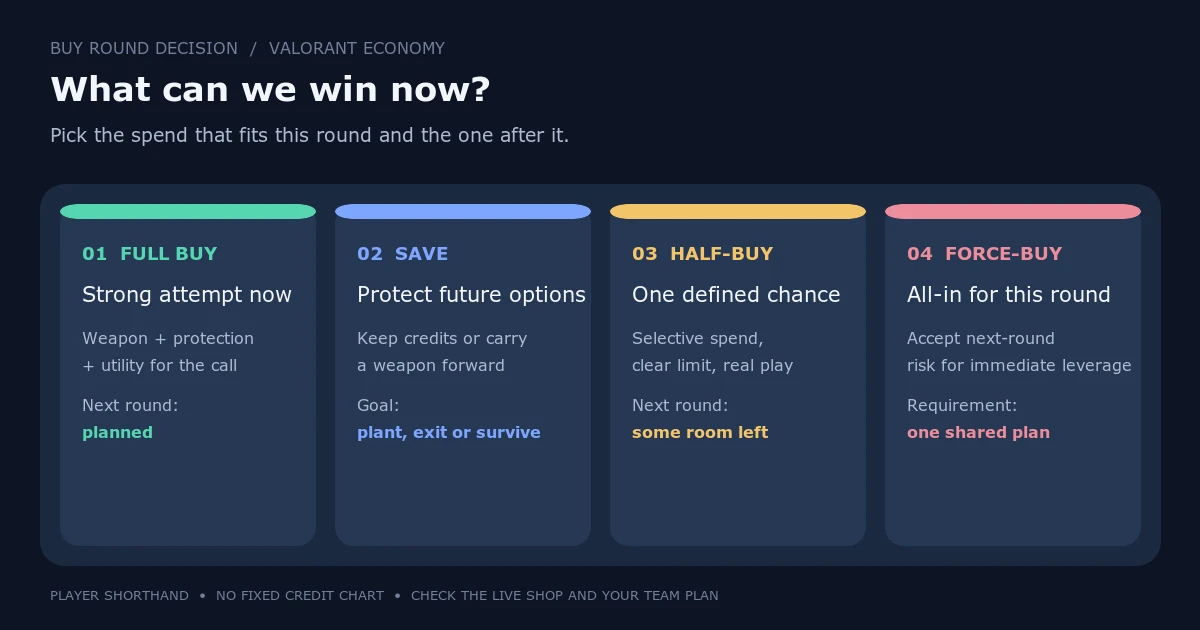
The useful question is simple: what can we win this round, and what do we need next round?
Start with the next round in mind
Before opening the shop, look beyond your own balance. Notice who kept a rifle, who is short on utility, and whether the team can make one coordinated play. A saved weapon needs a different purchase from a player who died with nothing.
Riot's Welcome to VALORANT describes a five-versus-five game with one life per round, abilities, strategy and a Spike objective. That makes the economy a team decision. Five expensive weapons do not fix five unrelated plans.
What a full buy means
A full buy is the team's best serious attempt to win the current gun round. Usually that means a strong weapon for the job, protection and enough utility to run the call. It does not mean every player buys the same thing.
A controller may prioritise smokes for a site take. An entry player may need the ability that makes first contact possible. Someone with a saved rifle may spend on protection and utility instead. Those choices fit a full-buy plan if everybody knows what the round is trying to do.
Say the plan out loud: “full buy, default first, hit when we get the flank,” or “full buy, fast A, trade the first player.” If the purchase cannot be connected to an opening action, it is just a collection of expensive items.
Save together when the next gun round matters
A save means keeping credits and accepting that this round will have a narrower goal. The team might still look for a Spike plant, a safe weapon pickup or exit kills, but it should not pretend that five disconnected duels are a normal buy round.
The classic beginner mistake is the accidental half-save: two players spend heavily, two players save, and one player buys whatever is left. The result is often a weak current round and no clean buy after it. If the call is “save,” name the limit: keep the rifles, take one close fight, or play for the plant and get out.
Saving includes protecting what you already own. If you have a weapon worth carrying, do not throw it away on a first-second peek just because the round was labelled a save.
Half-buy for one defined chance
Half-buy is not a fixed percentage of your credits. It is selective spending that creates a real chance to win while leaving room for the next purchase. The mix depends on the player, map, weapons and team idea.
That might mean a cheaper weapon for a close-range stack, one piece of utility for a trap, or protection that makes a carried weapon more forgiving. “We can make their rifles uncomfortable in this choke” is a reason. “I had money, so I bought” is not.
Agree on the limit before somebody starts buying. A half-buy that turns into five separate upgrades during the timer usually becomes a force-buy without the confidence of one.
Force-buy when the present round is worth the risk
A force-buy spends most of the available resources even though the team may not have the ideal loadout next round. It is a gamble for immediate pressure. The call can make sense when the current round has unusual value, the opponents are also short, or the team has a close-range or fast-execute plan that does not need a perfect shop.
It can also be the wrong response after a lost pistol. Do not force because one teammate typed “buy.” Ask what a loss leaves behind, whether the team can take the same fight together, and whether the next round is more important. If you force, commit to the reason: “force, fast B, trade everything,” not “force, then play five different defaults.”
Make the team call short
Riot's Beginner's Guide calls communication a priority and points out that players can use voice chat or ping a location. A buy call does not need a speech. Include the purchase, the first idea and the next-round expectation.
- “Full buy, play slow, save utility for the hit.”
- “Save together. Keep the rifle and fight only for a plant.”
- “Half-buy for close B. No solo rebuys.”
- “Force one plan. Trade the entry and do not lurk for a hero play.”
If money is uneven, adjust the call instead of pretending it is not. A team that knows who can afford utility will make a better round than a team that only checks the biggest weapon on the screen.
Common economy mistakes
Buying alone. One player buys a rifle while the rest save, then dies before the weapon can matter. Agree first.
Skipping the part that makes the gun useful. A weapon, protection and utility are separate choices. Do not copy a teammate's purchase when your role needs a different tool.
Saving with no objective. “Do not spend” is not a strategy by itself. Pick the fight, plant attempt or weapon-preservation goal that makes the save worthwhile.
Throwing away a saved weapon. If the point was to carry it forward, do not volunteer it on the first dry peek.
Treating an old chart as law. Prices and systems can change. Riot's current patch notes should be the place to check a live change; an old table is not a substitute for the shop in front of you.
A four-question buy check
Ask these before the timer ends:
- What weapons and utility does the team already have?
- What is the first fight or action this purchase supports?
- If we lose, can we still make a sensible next-round call?
- Has everyone heard the same plan?
If the answer to the second or fourth question is no, buying more will not solve the problem. Pick one plan, tell the team, and spend only what that plan needs.
For the next step, our man-advantage guide covers what to do after the first pick, while the RR performance guide explains a different ranked question. Economy is the bridge between those moments: a good round gives the next round more options.