VALORANT Penalties: AFK, Dodging, Chat and Rank Manipulation Explained
Written by Valorant Village
Source-backed coverage ●
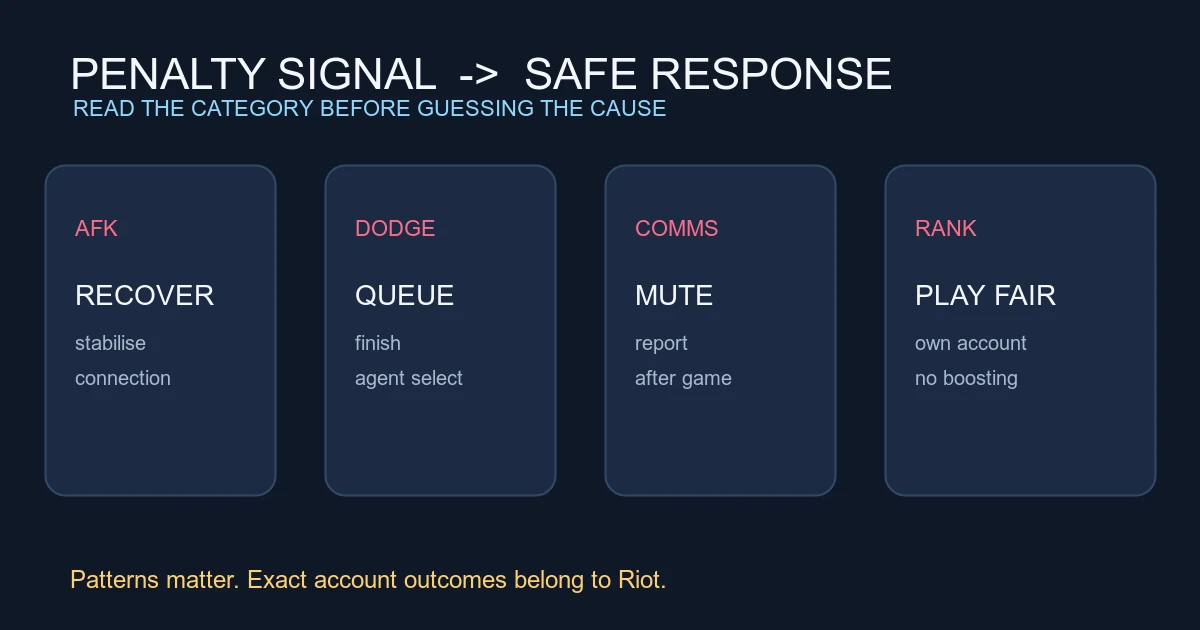
VALORANT penalties are easy to misunderstand because players often mix four different problems together: leaving a match, dodging agent select, abusive communication and manipulating ranked progress. Riot does not publish one permanent table that turns every incident into a fixed number of minutes or Ranked Rating. The client message attached to your account is the useful evidence.
The practical rule is simple: if something goes wrong once, recover and finish the next match cleanly. If the same behaviour keeps happening, do not treat the next warning as a negotiation about the previous one. Riot describes systems that look at patterns, severity and confidence. The details can change with patches.
AFK is a participation problem
AFK means more than physically walking away from the keyboard. Riot's systems-health explanation describes it as leaving a match, not participating, disconnecting for rounds or being detected as a bot. That matters because a player can be technically connected while contributing almost nothing to the match.
Riot has also explained why the system cannot be reduced to a single missed round. Its older AFK work describes an effort to avoid harshly punishing an unusual power or connection failure while escalating for repeated behaviour. That is a description of the system's design direction, not a promise that every modern incident is forgiven.
If your connection fails, reconnect as quickly as possible and play the rest of the match. Do not assume that moving the mouse once or buying a weapon makes an extended absence harmless. If your network is unreliable, fix that before queuing Competitive. A short-term annoyance in an unrated mode is still less costly than repeatedly creating a four-versus-five ranked game.
Queue dodging is not the same as surrendering
Queue dodging usually means entering a match and leaving during agent select, often by timing out. Riot's participation update calls out the extra wait this creates for everyone else. It is different from surrendering after the match has begun, and both are different from a remake vote when a player never properly joins.
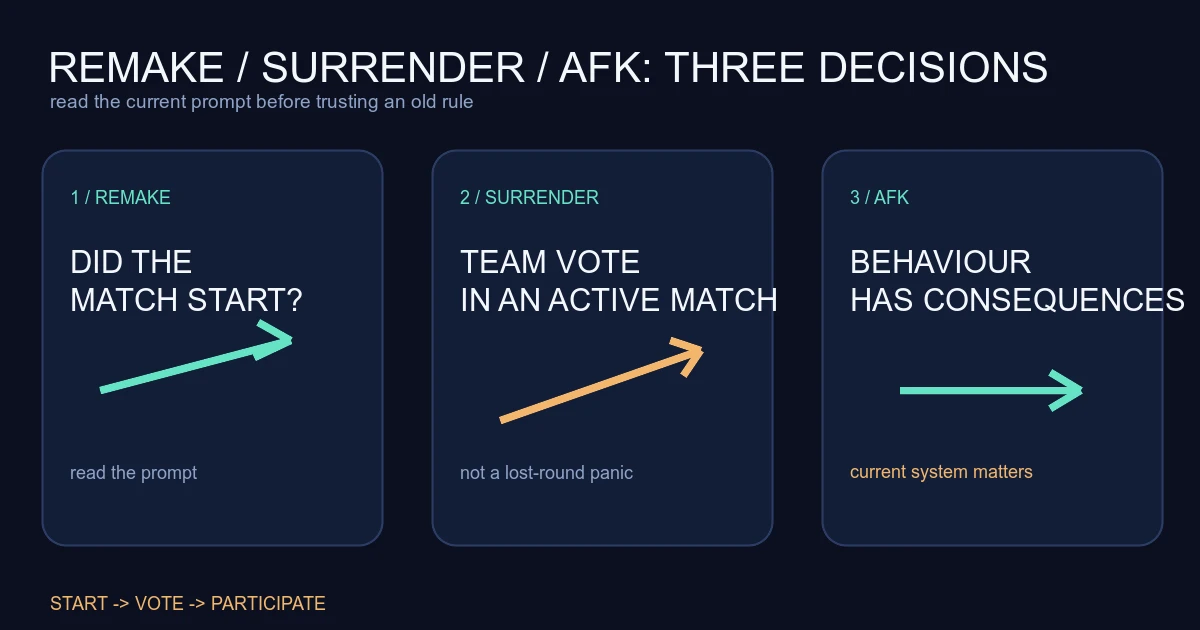
The distinction is useful when reading an account message. A dodge penalty is not evidence that the game judged your round decisions, and an AFK penalty is not a statement about your aim. They are participation signals. The remake and surrender guide covers the match decisions separately, including why an early missing player does not turn every later loss into a remake.
Riot's 2023 systems-health update said repeated queue dodges would receive greater Ranked Rating loss and that excessive AFK behaviour could reach a one-day ranked restriction sooner. Those are dated changes, not a current universal schedule. Use them to understand the direction of the system, not to calculate what your next incident will cost.
Chat and voice penalties follow behaviour, not an argument
Riot has described warnings, communication restrictions, queue restrictions and game bans as possible responses to chat-based offences. The important part for a player is that replying to abuse can still create evidence of your own abusive message. The system is not a courtroom deciding who started the argument.
Patch 9.06 also documented increased penalties for repeated comms abuse and described blocking communications with another player. In a live match, mute text, voice or pings when the conversation stops helping. Report the behaviour through the client after the game. A report is a record for Riot to assess; it is not a promise that you will receive a specific result.
Rank manipulation is a separate integrity category
Riot's current Patch 13.01 notes say its updated tools can detect rank manipulation and that confirmed cases may receive account suspensions, rank reversions and ranked-reward reversions. The related Playing Fair article defines examples such as boosting, win-trading and stream sniping.
That article also draws a line between ordinary play and manipulation. Playing with friends, helping a new player, having a bad match or using an alternate account that you created yourself are not automatically rank manipulation. Sharing, purchasing or borrowing accounts, intentionally tanking a rank and coordinating outcomes are different questions.
This is why a single strong game is not proof that an account is being boosted. Conversely, a player does not need to wait for a public explanation before reporting behaviour that looks coordinated. Riot says it looks for repeated patterns and strong evidence before taking action. Players cannot see that evidence threshold from the outside.
What to do when you receive a penalty
First, read the exact category in the client and record the date. Do not rely on a teammate's description of the message. Second, remove the cause: stabilise the connection, stop queueing while distracted, mute instead of arguing, or play only on your own account. Third, use Riot's support route if the message indicates an account problem or if you need to provide technical context.
Keep ordinary performance questions separate. A penalty does not explain why your RR and MMR feel different, and a bad game does not prove that the penalty system misread you. If you are troubleshooting a client prompt rather than a match result, the first-time message guide gives you a cleaner starting point.
Avoid guides that promise an exact number of safe dodges, a secret AFK timer or a method for avoiding detection. Those claims age quickly and encourage the behaviour the system is designed to find. The durable advice is less exciting: finish the match, communicate without abuse, report through the client and leave ranked manipulation alone.
Sources checked
- VALORANT Patch Notes 13.01, published 2026-07-14. Used for current rank-manipulation detection, penalty categories and reporter/bystander feedback.
- Playing Fair: Anti-boosting and other smurfing countermeasures, published 2026-07-14. Used for the definitions of boosting, win-trading, stream sniping, allowed play and possible consequences.
- VALORANT Systems Health Series: AFK and Queue Dodge Update, published 2023-04-11. Used as a dated explanation of participation categories and the direction of repeated-dodge and excessive-AFK interventions.
- VALORANT Patch Notes 9.06, published 2024-09-24. Used for the documented comms-abuse update, communication blocking and draw-vote treatment of AFK players.
The response workflow and the separation between confirmed rules and player inference are Valorant Village editorial guidance. Exact account outcomes remain subject to Riot's current client and support systems.