VALORANT RR and MMR: What Riot Confirms and Players Guess
Written by Valorant Village
Source-backed coverage ●
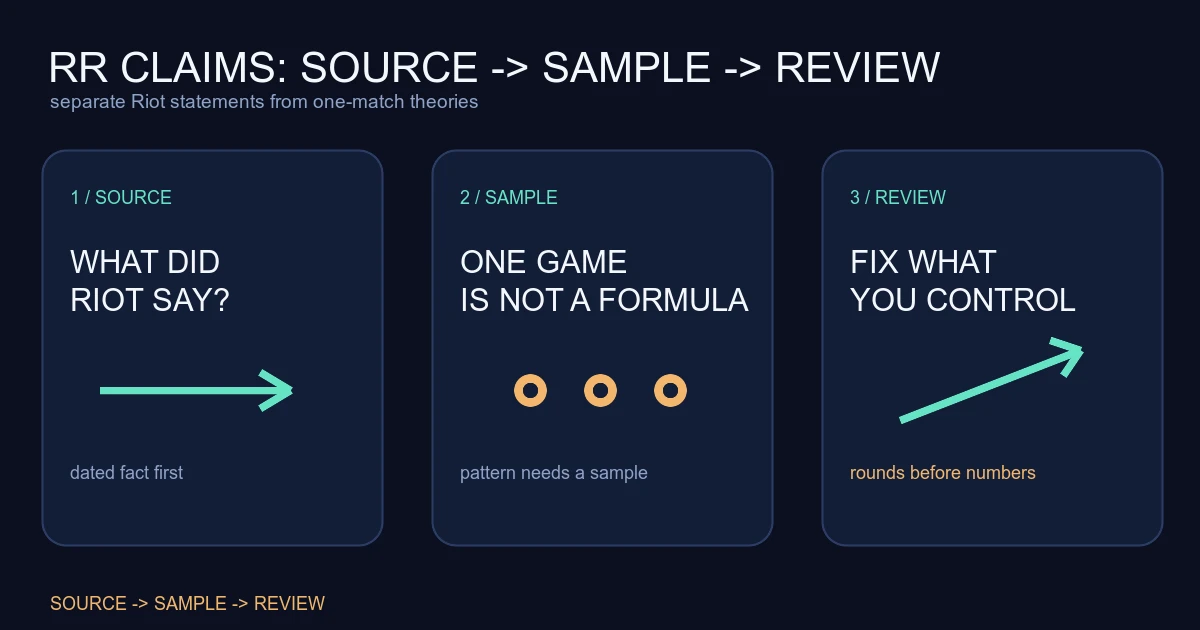
Ranked discussions often begin with a real match and end with a theory about the entire system. Someone wins 19 RR, another player loses 21, and the numbers become evidence that a hidden rule has been discovered. A single result cannot explain the system, especially when the client does not show every input used by matchmaking and rank calculation.
The useful approach is to separate what Riot has published from what a player is inferring. That makes the review less exciting, but it gives you a better decision about what to change next.
What Riot currently documents
In Patch Notes 13.00, published June 23, 2026, Riot said it was adjusting Ranked Rating calculations after earlier MMR changes had time to settle. Riot described the aim as making consistent winners feel less stuck and improving rank consistency in Competitive lobbies. The note also said matchmaking changes were intended to keep average team ranks within one sub-tier more often.
Those are Riot's public statements about that patch. They do not publish a complete current formula that lets a player calculate an exact RR result from kills, assists, first deaths or a screenshot. Any article or video claiming a universal formula should show a stronger source than one match history.
Outcome is the first variable
The first question after a ranked game is whether the team won or lost and what the round decisions looked like. The improvement loop gives a simple way to keep the review useful: choose one repeatable question, inspect a small set of rounds, and practise that one correction.
This does not mean every player in the match has the same experience. Rank, MMR, party composition, match history and the system's current tuning can affect the result. It means the match outcome is still more meaningful than treating one scoreboard line as a secret key.
Why the scoreboard is weak evidence
Kills are visible, which makes them easy to use as an explanation. They are not a complete account of the round. A player who takes first contact, creates a trade, or anchors a lane may have a different team value from a player who hunts late kills after the site is lost.
The same-first-death guide is useful for this reason. Review when the death happened, what information it created, and whether the team could trade it. Do not turn a ranked result into an accusation that the system is ignoring every good decision because the scoreboard does not show those decisions neatly.
The same caution applies to performance bonuses. The article on what determines the performance bonus should be read alongside Riot's dated notes, not as a promise that one stat will produce a fixed reward in every current match.
Separate four kinds of claim
When you hear a ranked explanation, label it:
- Riot-documented: a statement in a current or dated official note.
- Client-visible: a value shown in the match history or end screen.
- Observed pattern: a player has seen similar results across a sample.
- Speculation: a theory that connects hidden inputs without a primary source.
The first two can support a factual article. The third can be an interesting observation if the sample is clear. The fourth should not become advice until Riot confirms the mechanism or the player has a test that rules out simpler explanations.
What to control after a loss
You can control the next round's job, the quality of your first call, your buy decision, your trade distance and the one mistake you choose to review. You cannot force the system to award a particular RR number by changing your KDA in a single match.
If the loss feels unfair, record the lobby rank, result, RR change, party context and any visible match details. Keep that note separate from your tactical review. The first record helps identify a repeated system issue. The second helps you play better while the question is unresolved.
Avoid changing sensitivity, role, crosshair and strategy at once because a ranked number felt bad. That creates four new explanations and no useful comparison. Make the next test small.
For example, choose one defensive round question for the next session: did you give the first contact a trade, did you keep the Spike safe, or did you rotate on confirmed information? That review will not reveal the hidden formula, but it can reveal a repeatable decision that is costing rounds. The number on the end screen is a result to record, not a substitute for watching the round.
Sources checked
- Riot Games VALORANT Patch Notes 13.00, published 2026-06-23 and checked 2026-08-15 UTC. Used for the documented RR/MMR adjustment intent and average-rank consistency statement.
The outcome-first review, scoreboard caution, claim categories and controllable-actions list are Valorant Village coaching interpretation. Riot's current client and future patch notes remain the authority for live formula changes.