VALORANT Ultimate Economy: When to Spend an Ult Instead of Saving It
Written by Valorant Village
Source-backed coverage ●
An ultimate being ready does not make it correct to spend. It is a separate resource from credits, and it has two costs: the Ultimate Points you have banked and the future round where you might want the ability. The button glowing is information, not an instruction.
Riot’s Beginner’s Guide, published 2024-08-02T16:00:00Z, frames the buy phase as a choice shaped by your credits, Agent and playstyle. It also puts the Spike objective and team communication at the centre of a round. That is the right starting point for ult economy: ask what the team can actually win, then decide whether the ult helps.
Keep Ultimate Points and credits in separate columns
Ultimate Points fill an Agent’s ult meter. Credits pay for weapons, shields and bought abilities. In a standard Spike round, the point meter grows through round events such as enemy kills or deaths, Spike actions and Ultimate Orbs. A messy round can still move you closer to an ult even when your shop was poor. A wealthy round can still leave you without one.
Agent costs can change. Riot’s Patch Notes 13.02, published 2026-07-28T13:00:00Z, raised Phoenix’s Run It Back requirement from 6 to 7 points to reduce cast frequency. Check the live client rather than an old chart.
Credits change the calculation. On a full buy, the ult may be the piece that makes the team’s execute or retake work. On a weak buy, it may be the one advantage that creates a plant chance. Neither case makes the cast automatic. If the team has no gun, no protection or no one ready to follow, the ultimate can turn a bad round into a more expensive bad round.
Name the win condition before you cast
Riot’s older balance explainer, published 2020-06-26T15:00:00Z, describes a tac cycle: Intel, Plan, Execute, Repeat. The useful part for ultimates is the middle. You need a plan that says what winning this round looks like.
That might be taking a defended site, forcing a Spike plant, making a retake possible, denying a defuse or creating enough space for the Spike carrier to cross. A kill is one possible result, not the only one. A site-wide ultimate that pushes defenders away can be valuable even when it deals no damage. A resurrection can turn a bad player-count situation into a playable fight. An entry ultimate can take the first contact that your rifle buy cannot safely take.
Say the purpose in one sentence: “I’m using this to clear the site; follow behind me and plant.” Or: “I’m using this to stop the defuse; hold the flank while I play the timer.” If the sentence has no objective and no next action, the cast is probably running on emotion.
Timing is part of the price
Riot’s Patch Notes 11.08, published 2025-10-14T13:00:00Z, says abilities should be used strategically and intentionally to gain advantages at the right time and place. The timing matters because most ultimates create a short window. Your teammates need to be alive, close enough and looking at the same problem.
Cast before contact when the ult creates space for the players behind it. Cast after information arrives when it answers a known setup. Use it during the plant or defuse when the objective is the fight. Do not wait so long that the round ends before anyone can act. “I still have my ult” is not useful if the team has no time left to use what it creates.
The next round matters, but only when it is a real comparison. Look at the score, your credits, saved weapons, Ultimate Points, the enemy’s likely buy and how much time remains in this round. A future full-buy ult on match point may be worth protecting. A future round you are imagining while four teammates are ready to win this one is much weaker evidence.
A good spend and a panic spend
Good spend: your team is attacking with a weak buy, the Spike carrier and two teammates are grouped at the planned entry, and you still have a flash or smoke to support the play. You use an entry or space-making ultimate, call the timing, take the first dangerous contact and let the team follow for the plant. Even if the ult gets no kill, it has changed the route to the objective and created a chance the weapons alone did not offer.
Panic spend: you lose the opening duel, hear the ult-ready sound and cast immediately from the other side of the map. The Spike is elsewhere, teammates are not in position and there is no time to build a new play. The cast may look active, but it has not changed the win condition. If the next round needs the credits and the current round has no credible recovery, keeping the ult is the better decision.
There is a quieter version of the same mistake. A defender uses a site-denial ultimate alone after the attackers have already left the site, without a teammate nearby to hold the detained or displaced players. The ability may be powerful, but the timing has removed its audience. Wait for the fight it can affect, or spend it on a different problem.
Six questions before the timer runs out
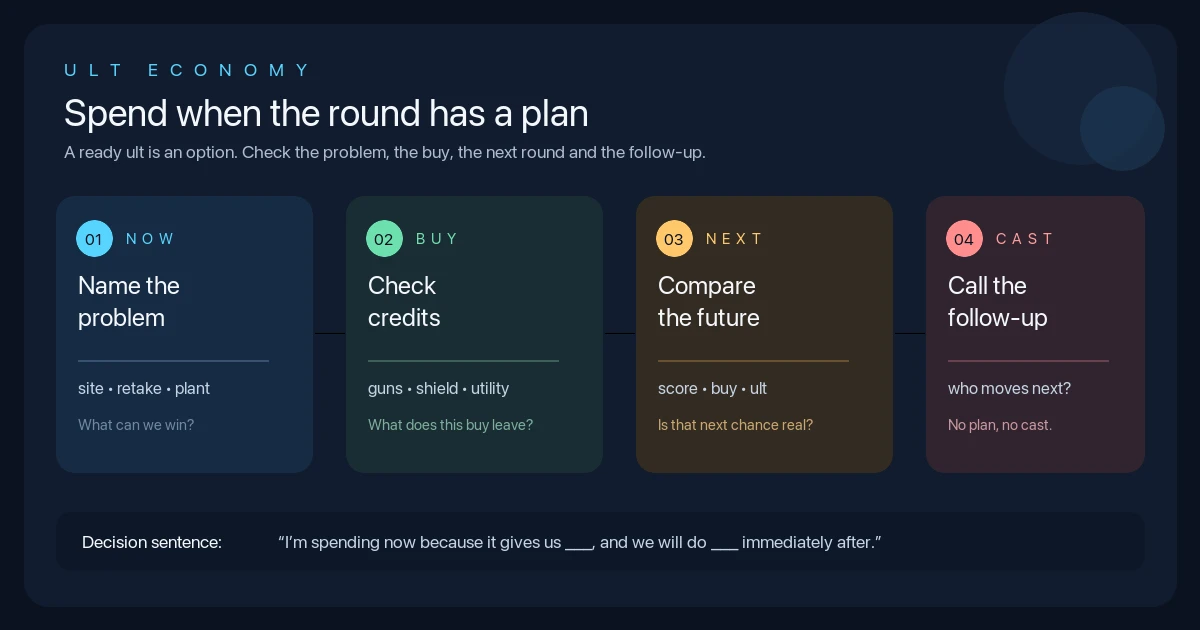
- What is our win condition this round?
- What specific problem does the ult solve?
- Who is ready to follow, and what do they do next?
- Does our credit state make this a full buy, a weak-buy chance or a round to preserve?
- Is the next-round value real, based on the score, credits and likely fight?
- What is the trigger for the cast: contact, plant, defuse, retake or a clear enemy position?
A useful decision sentence is: “I’m spending now because it gives us ___, and we will do ___ immediately after.” Fill in both blanks. If you cannot, wait or make the plan clearer. That is not a universal save rule. It is a way to stop the glowing icon from making the decision for you.
Riot’s Patch Notes 7.04, published 2023-08-29T13:00:00Z, describes high-impact ult costs as a choice between pressure, round pacing and future availability. That is the trade in plain language. Spend when the present win chance is clear enough to justify giving up the next one. Save when the future chance is more concrete than the play you can make now.
For the shop context, read economy for beginners and the man-disadvantage plan.