VALORANT Remake, Surrender and AFK: Separate the Decisions
Written by Valorant Village
Source-backed coverage ●
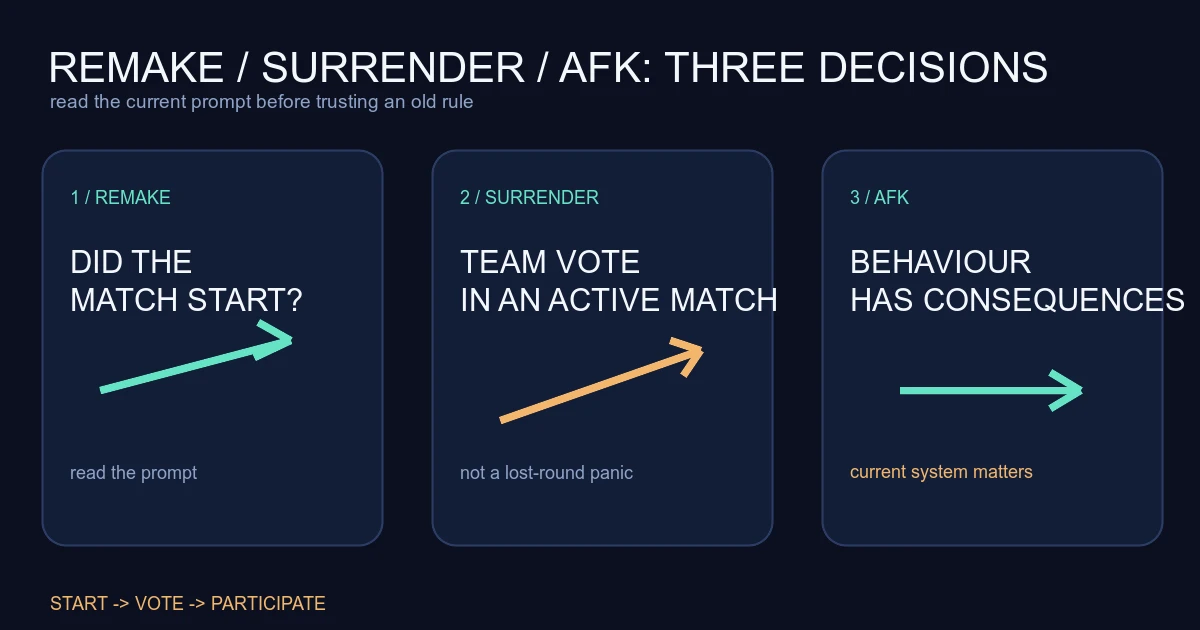
Remake, surrender and AFK penalties are often discussed as if they are one rule. They are not. A remake addresses a match that began without a participating player. A surrender is a team decision to stop playing a match. AFK systems address the behaviour that leaves teammates without a player or causes repeated disruption.
The distinction matters because a confident but outdated answer can make a bad round worse. Riot has changed these systems over time, and the current client prompt is more relevant than an old screenshot or remembered vote threshold.
What Riot's dated sources confirm
Riot's Patch Notes 1.03 documented surrender changes in 2020. The note distinguished Unrated from Competitive voting and said a surrender vote could be called earlier than before. It also explained that an AFK player who was not spawning in was not counted as a voting participant in the example given there.
Riot later described further participation changes. Patch Notes 6.07 said repeated ranked queue dodging could lead to more Ranked Rating loss and that frequent excessive AFK behaviour could bring a ranked restriction sooner. Riot's Behavior Detection and Penalty Updates explains that interventions can vary with repeated behaviour.
These are dated source statements, not a promise that every threshold or punishment still uses the same number. The communication framework below is Valorant Village coaching interpretation.
Remake is about the start of the match
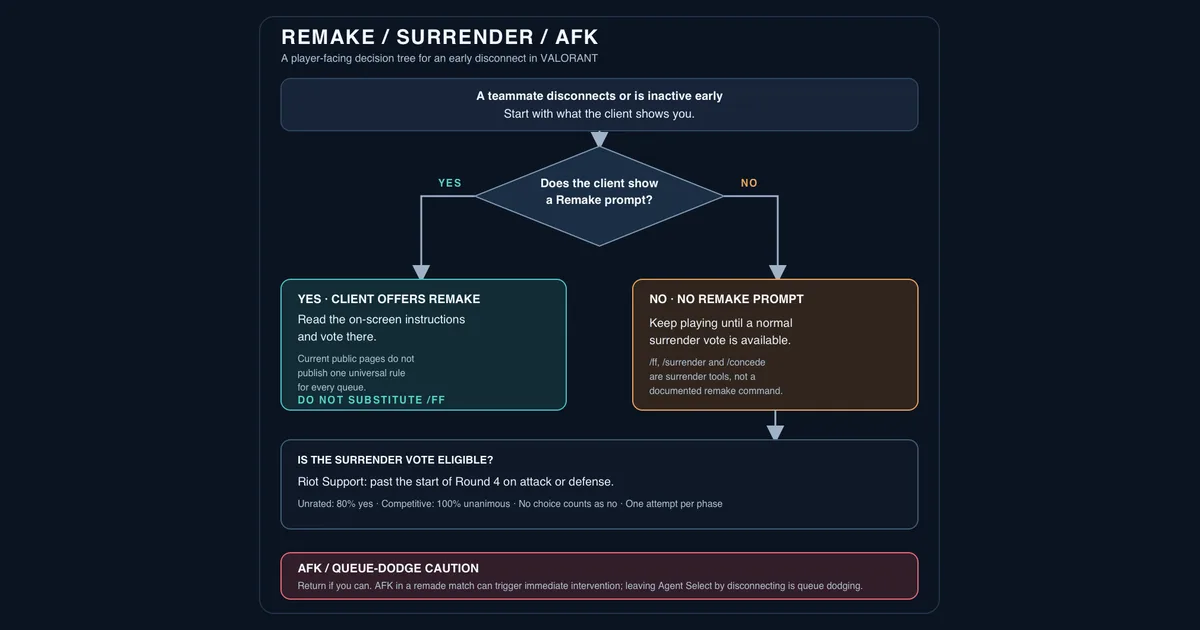
If a player does not connect or does not spawn, read the current client prompt carefully. A remake is a narrow decision about whether the match can fairly continue. It is not a general escape button for a bad buy, a lost pistol or a teammate who is playing quietly.
The useful call is factual: “one player has not spawned, remake prompt is visible.” Avoid announcing the vote from memory if the prompt has not appeared. The useful comms guide gives a simple rule for high-pressure information: say what you can see, where it matters, and what the team should do next.
If the player reconnects, the decision may change. Check the client state rather than continuing an argument about what the rule used to be. A screenshot from another episode cannot tell you what the current queue is doing.
Surrender is a team choice
Surrender is different because the team has started the match and is deciding whether to stop. A poor score is not proof that surrender is correct. Neither is a teammate's demand that everyone continue. The team needs a quick read of the objective, the available players and the willingness to play the next round.
Use the vote when the current match state gives the team a reason to stop, not because one round felt embarrassing. If the vote fails, stop repeating it as a form of chat pressure. Play the next round with a smaller plan: buy or save according to the economy guide, choose one lane, and communicate the first action.
In Competitive, surrender has rank consequences. That makes an old Unrated threshold especially bad evidence for a current Competitive claim. Open the current client instructions or Riot support article if the exact timing or vote requirement matters.
AFK is a behaviour problem, not a tactic
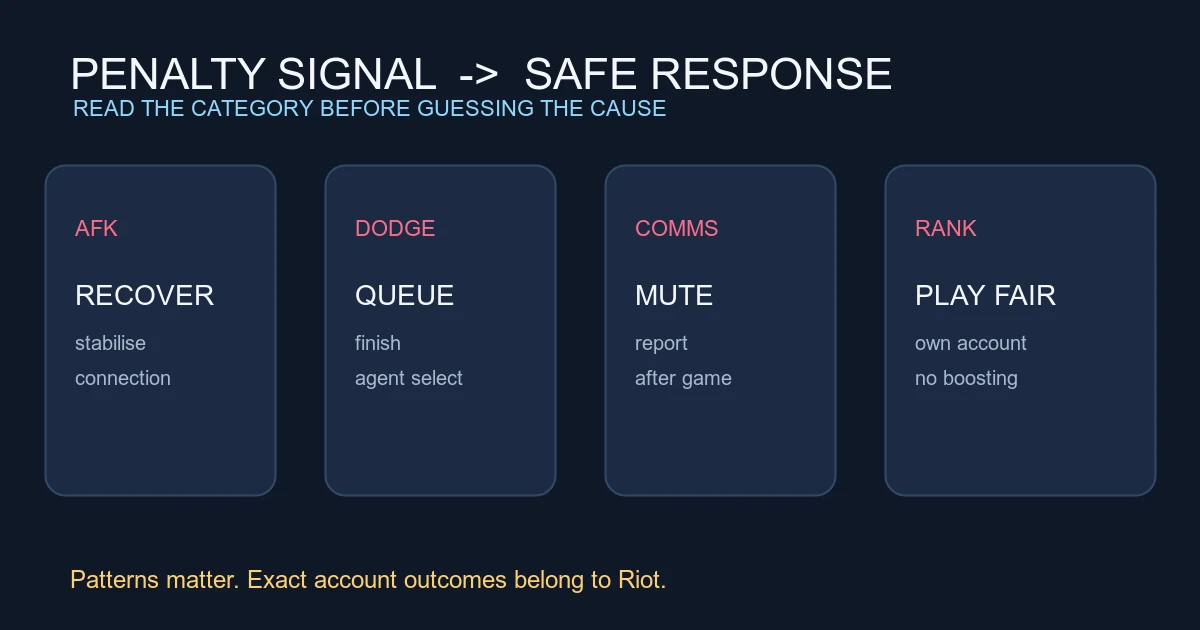
An emergency connection failure and a repeated choice to leave are not the same experience for the team, but the system may need to respond to patterns rather than private explanations. Riot's behaviour notes describe interventions that can include warnings, XP denial, queue restrictions, ranked deductions and more serious consequences for persistent disruption.
Do not tell a teammate that one missed round is harmless or that a particular penalty is guaranteed. You do not know their account history, the current intervention rules or how the client classified the behaviour. Ask them to reconnect, keep the call concise, and use the report tools after the match if appropriate.
A decision checklist for the live match
When the problem appears, ask three questions:
- Is this a start-of-match participation problem? Read the remake prompt and count what the client confirms.
- Is the team choosing to stop an active match? Treat surrender as a vote, not an argument about old thresholds.
- Is a player repeatedly absent or disrupting the game? Focus on the current round, then use the available report and support paths.
The checklist keeps the team from confusing a system decision with a tactical one. A player who is alive but silent is not automatically AFK. A player who disconnects is not fixed by a surrender vote. A lost round is not a remake.
Sources checked
- Riot Games VALORANT Patch Notes 1.03, published 2020-07-07 and checked 2026-08-15 UTC. Used for the dated surrender and voting examples.
- Riot Games VALORANT Patch Notes 6.07, published 2023-04-11 and checked 2026-08-15 UTC. Used for documented AFK and queue-dodging intervention changes.
- Riot Games Behavior Detection and Penalty Updates, checked 2026-08-15 UTC. Used for the historical categories of behaviour intervention.
The decision checklist and communication advice are Valorant Village coaching interpretation. For a live threshold or penalty, trust the current client and current Riot support information.