How to Review One VALORANT VOD Without Getting Lost
Written by Valorant Village
Source-backed coverage ●
VOD review gets bad when it turns into a courtroom. You pause every missed bullet, build a case against yourself, and finish two hours later with the same vague verdict: “I played badly.” That is not analysis. It is replay-shaped frustration.
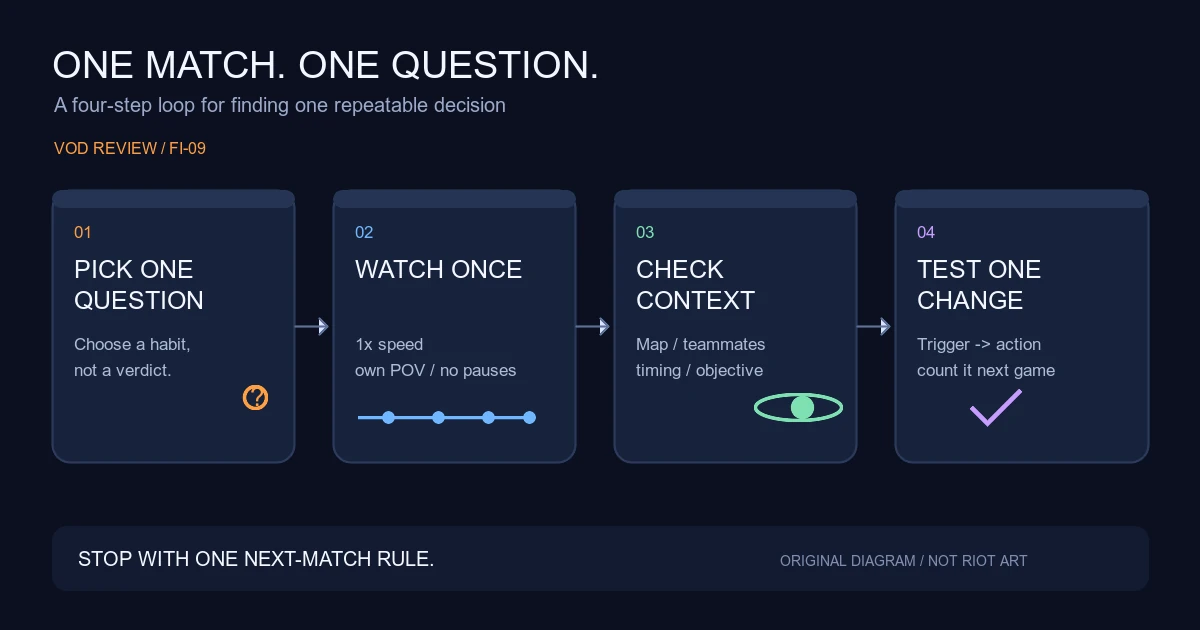
Use one match, one question, and one experiment for the next queue. Riot’s “Replays: Everything You Need to Know”, published September 17, 2025, says the system was built to show a complete view of recent matches so players can understand what went right or wrong. Treat that as access to evidence, not a command to inspect everything.
Pick the question before you press play
Do not start with “Why did we lose?” Pick something you can recognize in a round:
- Do I keep taking a second fight after my teammate has lost contact?
- Do I use utility after the duel has already started?
- Do I stop moving after gaining space, then give it back for no reason?
Choose one. If you bring five questions into the replay, every moment will look important and none of them will get a proper answer. A useful match is often one where you remember feeling stuck, not necessarily the game with the ugliest scoreboard.
Write the question at the top of a blank note. Then watch the first few rounds before deciding that you have found a pattern. Three bad-looking clips can be three different problems.
Pass one: watch your own POV normally
Watch at 1x speed with your own perspective. No pausing. No enemy outlines. No detective work yet.
Mark the first decision that changed the round, not the final death. A last-second two-versus-four may already be lost. The useful moment could be twenty seconds earlier, when you swung alone, stayed after a kill, or rotated without telling anyone what you had seen.
Keep notes short: “no trade,” “late flash,” “held after kill,” “fought with no exit.” Short labels make repetition visible. “I am terrible” tells you nothing and usually makes the next review less honest.
Riot says the Replay system can jump to each round, move along the timeline, change playback speed, and mark kills, deaths and ultimate use. Use those controls to get through the match without turning every walk from spawn into homework. The timeline is a filing system. It is not a list of crimes.
Pass two: check the information you actually had
Rewatch only the marked rounds. Now turn on the minimap and HUD, then change perspectives when a specific question needs an answer. Riot’s Replay explainer lists all ten first-person views, a third-person free observer camera, minimap and HUD toggles, and the combat report. Those tools are useful because they show context. They also create hindsight traps.
For each marked fight, write three lines:
- What did I know before I moved?
- What did my teammate know or expect?
- What information would have made the next action safer?
If the enemy was unseen and the round gave you no reason to expect the fight, you may have made a reasonable probe that failed. If your teammate was already fighting and you arrived late, the problem is timing or trade distance. If the minimap clearly showed the gap and you still walked into it, that is a decision habit. If the plan was sound and your crosshair or movement failed, that is a mechanics problem.
Riot’s “Beginner’s Guide”, published August 3, 2024, tells players to ask whether an ability helps their next goal, learn where enemies can come from, watch angles, stop moving before shooting, and communicate information. Those are good review questions too. Do not ask whether the play looked clean. Ask whether it served the round’s next goal.
Pass three: look for one repeated decision
Go back to the three or four moments that match your original question. Compare them side by side. You are looking for the same decision under slightly different pressure.
Maybe the common thread is not “bad aim.” It is taking the first fight before your flash arrives. Maybe it is not “bad rotations.” It is leaving a teammate without a trade because you keep watching the minimap from too far away. The mechanical error may be real, but it is often the last link in a longer chain.
Give each moment one label: plan, information, timing, mechanics, or reasonable risk. Do not force a mistake into the first four categories just because the round ended badly. Good decisions lose sometimes. A review becomes useful when it shows a repeat, not when it makes every death sound preventable.
Turn the notes into one experiment
Finish with a conditional rule that fits in one breath: “After first contact on defense, I fall back unless a teammate can trade.” Or: “After I use utility, I reset my crosshair before I re-enter.” The trigger tells you when to act. The replacement tells you what to do. The next match gives you a way to count whether you followed it.
“I will never die first” is not an experiment. It encourages hiding, ignores the round’s objective, and cannot tell you what to change. Count the times you followed the new rule instead. If you followed it five times and still lost, that is information. If you forgot it every round, make the rule smaller.
For the team-fight branch, read how to trade a teammate. If the review keeps finding bad player-count decisions, the man-disadvantage plan is a useful follow-up.
Stop when you have one repeatable decision and one next-match rule. The point of a VOD is not to remember every mistake. It is to make the next round a little less familiar.