Ascent Attack Defaults: Learn the Map Before You Commit
Written by Valorant Village
Source-backed coverage ●
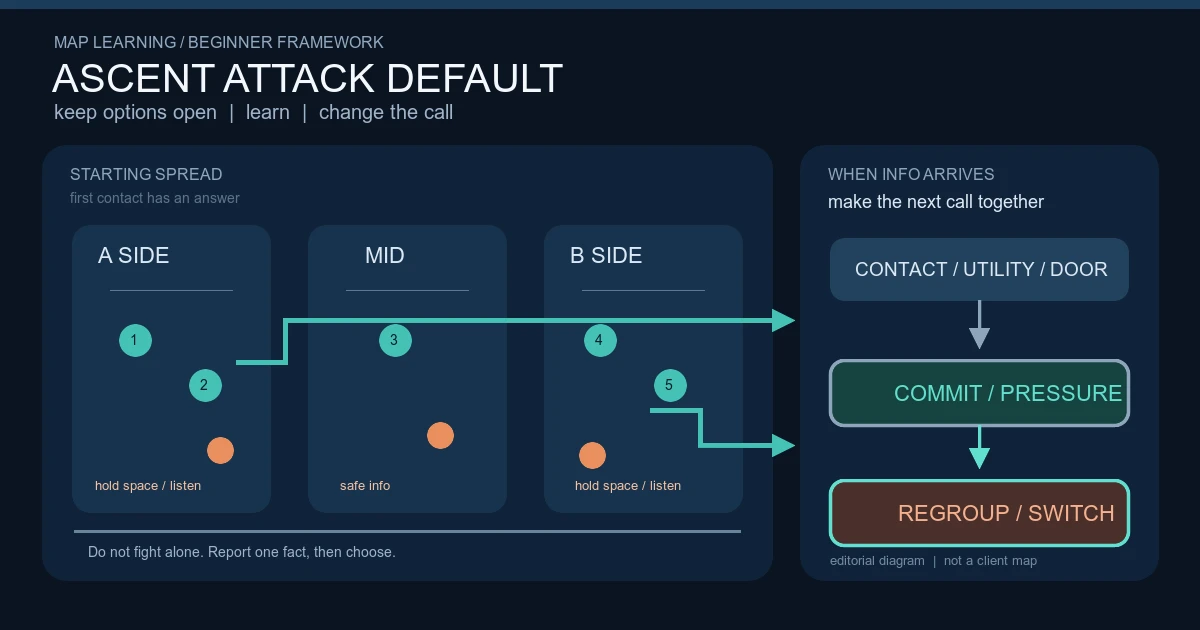
A useful Ascent attack default is a short information phase, not five people waiting in different corners until the round timer becomes the enemy. You start with more than one route, ask the defense a small question, then make the next call together.
Riot’s current Maps page describes Ascent as two sites divided by “small wars of position and attrition.” It also says each site can be fortified by irreversible bomb doors. Riot’s Beginner’s Guide, published August 3, 2024, says attackers try to plant and detonate the Spike, recommends learning maps and watching the angles enemies can use, and points players toward communication through voice, pings, or Agent voice lines.
Those are the source facts. The default shape, information checklist, and change triggers below are Valorant Village editorial guidance. Riot does not publish a mandatory Ascent default in those pages.
What the default is trying to learn
For this guide, “default” means a starting spread that keeps two site choices alive while the team learns how the defense is positioned. You are looking for one useful fact: who is contesting a lane, what utility is being spent, whether the defense is pushing, or whether a door state has changed.
That fact needs a follow-up. “We saw one defender A side” is information. “Hold A pressure, keep B quiet, then regroup mid” is a plan. If nobody knows what the next call will be, the team is not defaulting. It is just drifting.
A simple Ascent starting shape
Use a 2-1-2 shape as a teaching exercise: a pair on the A side, one player responsible for safe mid information or the rotate, and a pair on the B side. The exact split can change with your agents and comfort. The important part is that the first fight has an answer.
The middle player should not take a lonely duel to prove the default is working. Hold a safe angle, listen for a push, or join the side that gets useful contact. The pairs should be close enough to trade, but not stacked so tightly that one burst or piece of utility catches both. If you cannot answer a teammate’s fight immediately, change the spacing before you change the route.
Before the barrier drops, make the call short: “A and B pressure, mid holds, regroup on contact.” Add one question, such as “Do they contest A?” That gives everyone something to report instead of five people inventing separate missions.
Turn information into a decision
Start with low-cost information. Take a little space with a teammate, listen for movement, and notice what the defense spends. Riot’s Beginner’s Guide asks players to consider whether an ability helps the next goal. Use that as a filter: if the ability does not help you take space, survive the next contact, or prepare the plant, save it.
Call facts before guesses. “One seen A side, smoke used, no contact B” is useful. “They must all be B” is a guess wearing a fact’s jacket. No contact is still information, but it does not prove a site is empty.
Ascent’s doors make the round state easier to read and easier to misread. Riot calls them irreversible bomb doors and says a downed door must be destroyed or bypassed. My practical read is to treat a door state as part of the call, not as an automatic execute signal. Say whether the door is up or down, then ask which route remains safe for the Spike and the players who need to plant.
When to change the plan
Change the default when the information makes the old shape unsafe or pointless.
- The first fight cannot be traded. If a teammate is isolated by distance or utility, stop feeding the same angle. Fall back, bring a second player, or use a different route.
- The defense shows a real commitment. Multiple defenders, repeated utility, or an early push can make one lane expensive. Keep pressure there only if it helps the other side. Otherwise, regroup and use the space you have learned is safer.
- A route’s state changes. A door going down, a smoke fading, or a key ability being used changes what the next player can safely see. Update the call; do not run the old plan from memory.
- Waiting stops buying information. After one useful information pass, group and choose. Time is not free just because nobody has died.
The call should name the action: “commit A,” “regroup mid,” or “leave this lane.” A player who quietly rotates alone has changed the plan without giving the team the information that justified it. That is how defaults turn into five separate rounds.
Practise the handoff
Run the same starting shape three times in a custom game. After each attempt, write down the first confirmed fact, the call it produced, and whether the first contact was tradeable. Change one variable at a time: the first peek, the utility, or the moment you regroup. If you cannot name the trigger, the default is unfinished.
Riot’s Beginner’s Guide says to stop moving before shooting. Keep that basic rule in the drill: take the information, stop, then fight from an angle your teammate can answer. The goal is not a clever route. It is recognising the moment when the original plan has done its job.
If the first contact is still hard to answer, read how to trade a teammate. If teammates hear the information but do not know what to do with it, pair this guide with how to make useful comms.