Defaulting Explained: When a Slow VALORANT Round Creates More Options
Written by Valorant Village
Source-backed coverage ●
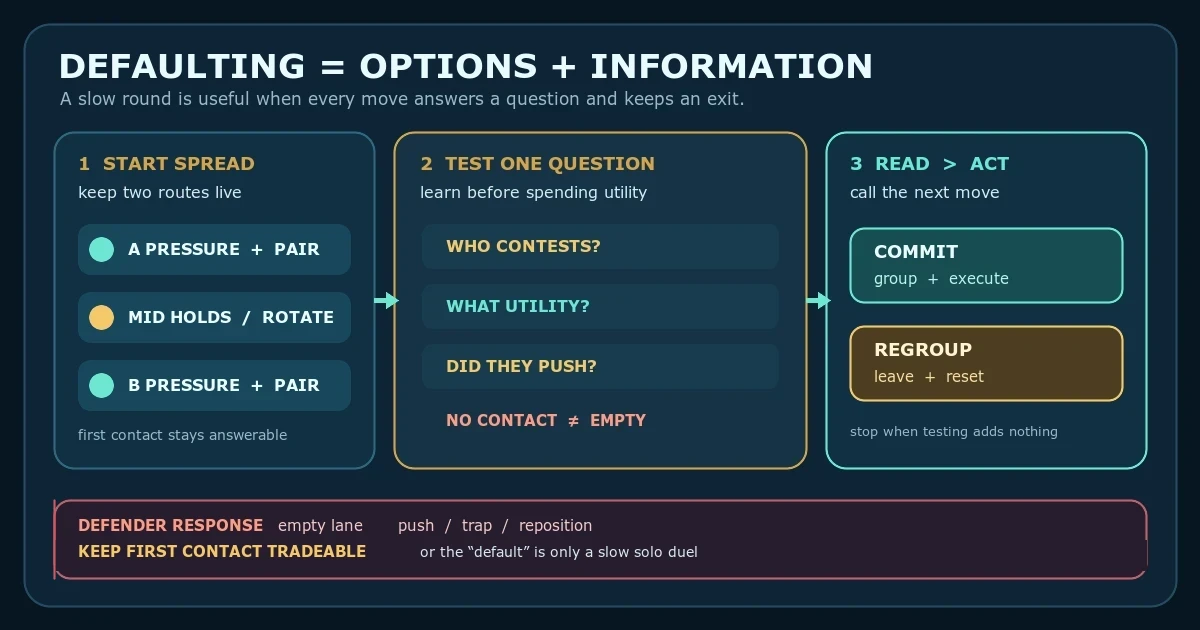
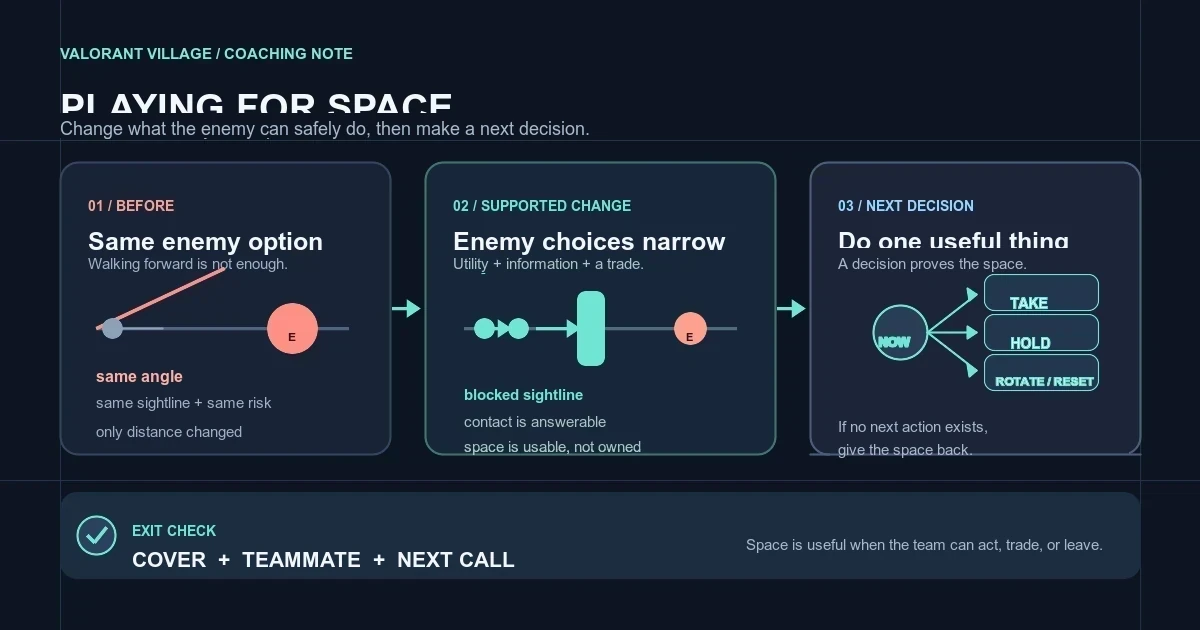
A slow attacking round can be disciplined without being passive. A default is a reversible information-gathering plan: players take safe, connected positions, test a question about the defense, and keep more than one next move available. It is learning something before spending the team’s lives, utility, and route.
What Riot documents
Riot’s Beginner’s Guide, dated August 3, 2024, says attackers try to plant and detonate the Spike while defenders try to defuse it. It recommends learning maps and enemy angles, asks whether an ability helps the next goal, advises stopping before shooting, and points to voice chat, pings, or Agent voice lines.
Riot’s Welcome to VALORANT describes a five-versus-five, one-life-per-round tactical shooter built around abilities, strategy, teamwork, and the Spike. Riot’s tac cycle is Intel → Plan → Execute → Repeat. Its Intel questions include opponents’ location, owned territory, abilities, guns, and previous actions.
Those are source facts. Riot does not publish a required default, a universal team split, or a timer that tells every team when to execute. The shape, tests, trade rule, and stop triggers below are Valorant Village coaching.
Build a default that can change
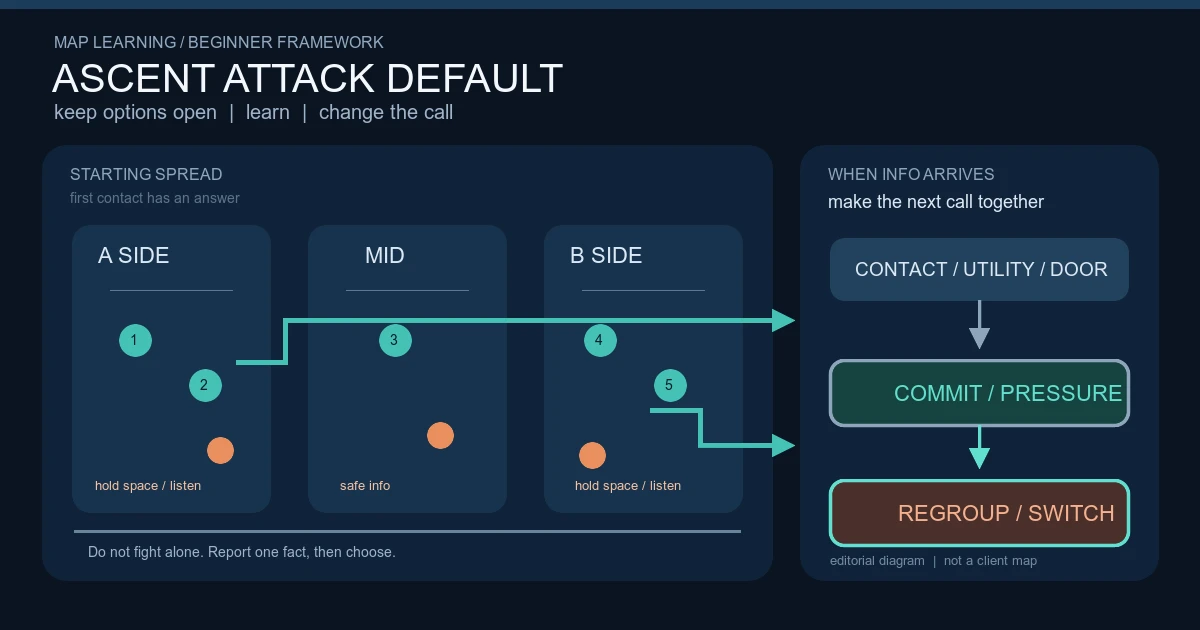
Use a simple teaching shape: two players apply paired pressure on one lane, two do the same on another, and the fifth holds a safe middle, rotate, or flank responsibility. This is a template, not a rule for every map or composition. If the fifth player cannot help either first fight, narrow the spread.
Before the barrier drops, give the shape a question and a trigger. “Pressure both sides, hold mid, regroup on contact” is enough. The question might be: who contests this lane, what utility do they spend, are they pushing, or can we take one more piece of territory without losing the trade?
Each move needs a safe exit. A paired peek can fall back together, while a lane with no contact can stay quiet as the team regroups. If a player walks so far forward that the next fight cannot be answered, the default has stopped being reversible. It has become an isolated duel with a slow explanation attached.
Test facts, not guesses
Call what happened before saying what you think it means. “One seen A, smoke used, no B contact” gives the team a current picture. “B is empty” turns one missing sighting into a conclusion. No contact is information, but it is not proof that nobody is there.
Abilities should serve the next question. Riot’s Beginner’s Guide asks whether an ability helps the next goal. Use a small piece of utility to take safe space, force a defender off an angle, or protect the information gatherer. Save the rest for the plant or the fight that read makes more likely. A default that spends every tool to confirm an empty lane has sold its options.
Keep the first contact tradeable. The front player can take the first look, but a teammate should be close enough and ready enough to see the likely shooter immediately. Do not stack on the same frame or stand so far back that the first death becomes a free kill. If this is the part your team misses, read How to Trade a Teammate in VALORANT.
When to stop defaulting
Stop when new information changes the value of the routes. Make the call an action, not a mood.
- The defense commits. Multiple defenders, repeated utility, or a push can make one lane expensive. Keep pressure there only if it helps the other side. Otherwise, use the safer space.
- A teammate or route is no longer safe. Utility, a lost trade partner, or a changed choke can invalidate the old shape. Fall back or bring the group before testing again.
- The team has a usable read. If you know where the resistance is and which route can carry the Spike, group and execute. Further solo movement gives defenders time to rotate.
- Waiting buys no new information. The timer is not a scouting tool. When the next test cannot change the call, stop testing and choose.
Say “commit B,” “regroup mid,” or “leave this lane.” A quiet solo rotate changes the plan without sharing the reason. For a map-specific version of this handoff, see Ascent Attack Defaults: Learn the Map Before You Commit.
How defenders punish empty movement
An unattended lane is not empty. It is space a defender may reclaim. Riot’s current Maps page says Haven’s extra real estate gives defenders room for aggressive pushes. Riot’s current Cypher page describes Spycam as a placeable camera whose dart reveals a struck player’s location, and Cyber Cage as a zone that blocks vision and slows enemies who pass through it.
Those are ability facts, not a mandatory setup. The coaching read is simple: when attackers spread without a clear next check, defenders can push the quiet side, reposition, hold the late rotate, or make the next entry pay for lost space. A defender can keep one player watching the vacated route and punish the moment attackers assume “no contact” means “no danger.”
Attackers can deny that punishment by making the default accountable. Name who owns the flank, which player can answer a push, and when the team will regroup. If the defense makes the first move, that is the information: stop trying to run the old route and decide whether to take the fight together or give up the space.
Practise the decision
In a custom game, repeat one starting spread five times. After each round, write down the first confirmed fact, the call it produced, whether first contact was tradeable, and how the defender responded. Change one variable at a time: the first peek, the utility, or the regroup trigger.
The default worked when the team learned something and acted together. It did not need a kill, a perfect read, or five players standing still. For cleaner fact-to-action calls, pair the drill with How to Make Useful Comms in VALORANT.