Summit Map Guide: Lanes, Sites and the First Five Things to Learn
Written by Valorant Village
Source-backed coverage ●
Summit is easier to learn as questions than as a poster full of names. Riot confirms three lanes, two sites and droppable walls that can change the battlefield for the round. Learn where a route goes, what changed, and who can act on the information.
What Riot confirms
Riot’s Patch Notes 13.00 describe Summit as a 5v5 Spike map in a Radiant training academy in the mountains of China, with three lanes, two sites and droppable walls. The current Maps page says the walls can change the layout for an entire round.
That explains the learning problem without giving us a complete public callout sheet. Exact names and current geometry belong to the client and a custom game. The route advice below is Valorant Village coaching.
A small vocabulary that survives the first week
- Lane: a broad route. A-side, middle and B-side are useful notes, not official Summit callouts.
- Site: where the Spike is planted. Pair the client’s A or B label with a fact, not a guess.
- Main, lobby or link: shorthand for an approach or connection. Confirm the client labels.
- Wall state: the current condition of a droppable wall. Say it before giving a plan.
The VALORANT callouts guide has the right rule for unfamiliar names: give the location, confirmed fact and next action.
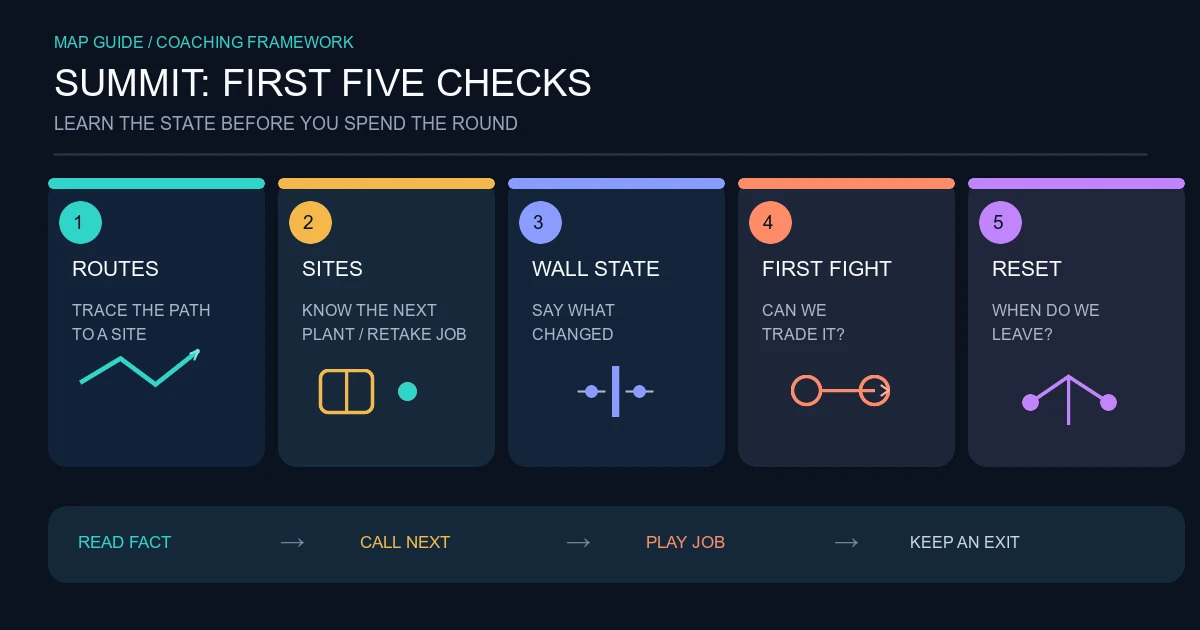
The first five things to learn
1. Trace every lane to a destination
Start a custom game and walk from each spawn without abilities. Follow each lane until you can answer two questions: which site can it reach, and where can another player help? At each junction, check the next angle and route behind you. For your first five minutes, write simple notes such as “middle can help either side,” then replace them with client labels.
2. Learn the site as a decision
Knowing that a site exists is not knowing how to play toward it. On attack, ask who carries the Spike, clears the first angle and trades the entry. On defence, ask which route gives information and lets teammates help.
Riot’s Beginner’s Guide frames the round around the Spike: attackers plant and detonate it; defenders defuse it. Trace the plant, exit and retake routes before queueing.
3. Read the wall before you spend the round
Before leaving spawn, notice the wall state. After it changes, call the fact and update the route. “Wall changed; our help route is different” gives the team something to solve. “Go now” does not.
Riot says the wall change reshapes the battlefield for an entire round. The practical inference: a plan built around the old layout may be bad ten seconds later. Ask what it removed, exposed and who can use the new shape.
4. Make the first fight tradeable
Three lanes help only if the team can support them. Take space with a teammate, a clear utility job or an exit. Contest only when you know where help comes from and where you fall back. An unsupported first duel is a spacing problem.
Riot advises players to watch angles and corners, stop before shooting, and ask whether an ability helps the next goal. Use those as your filter. The first fight should answer a question, protect a route or create playable space.
5. Set the reset condition
Decide what makes you leave before the fight: no teammate in trade distance, a wall removing your exit, two defenders, or utility failing to clear the next angle. When it appears, fall back, regroup or change lane.
After a good fight, hold gained space long enough for a teammate to use it. The defaulting guide explains why: information matters when it keeps more than one action alive.
Attack and defence priorities
Attackers should preserve two options until information says one is better. Pressure more than one lane, keep the Spike and first contact close enough to support, and update the call after a wall change. A site hit needs an exit plan.
Defenders should collect information without donating the first death. Hold a position that can be helped, record the lane and utility, then contest, give ground or rotate. If the wall changes a help route, say so.
Mistakes new Summit players make
- Memorising names while never walking the routes between them.
- Taking one fight in each lane and calling that a default.
- Treating a wall change as a command instead of a new piece of information.
- Rotating alone because a teammate said “quiet” without saying what they checked.
- Planting without knowing the first retake angle or the safe place to play after the plant.
These mistakes need a clearer question, not a new lineup.
A 15-minute Summit practice pass
Spend five minutes tracing lanes from both spawns, five changing the wall state and noting which route needs a new call, then five rehearsing attack and defence. Say the fact, location and next action out loud.
In live matches, review one round from each side: did you notice the wall, was the first fight tradeable, and what was the reset condition? If you swung alone, practise the handoff with the teammate-trading guide.
Sources checked
- Riot Games, “VALORANT Patch Notes 13.00”, published 2026-06-23T13:00:00Z, checked online 2026-08-14 UTC. Used for Summit’s 5v5 Spike-map setting, training-academy context, three lanes, two sites and droppable walls.
- Riot Games, “VALORANT Maps”, publication date not displayed on the current page, checked online 2026-08-14 UTC. Used for the current Summit description and Riot’s statement that droppable walls change the battlefield layout for an entire round.
- Riot Games, “Beginner’s Guide”, published 2024-08-02T16:00:00Z, checked online 2026-08-14 UTC. Used for map and angle learning, utility-to-next-goal questions, stopping before shooting, communication, and Spike objectives.
The lane vocabulary, five checks, attack/defence priorities, reset conditions, practice routine and mistake list are Valorant Village editorial interpretation. Riot’s public pages do not provide a complete Summit callout dictionary; confirm exact labels and current geometry in the client or a custom game.