VALORANT Crosshair Placement: The First Aim Habit Worth Fixing
Written by Valorant Village
Source-backed coverage ●
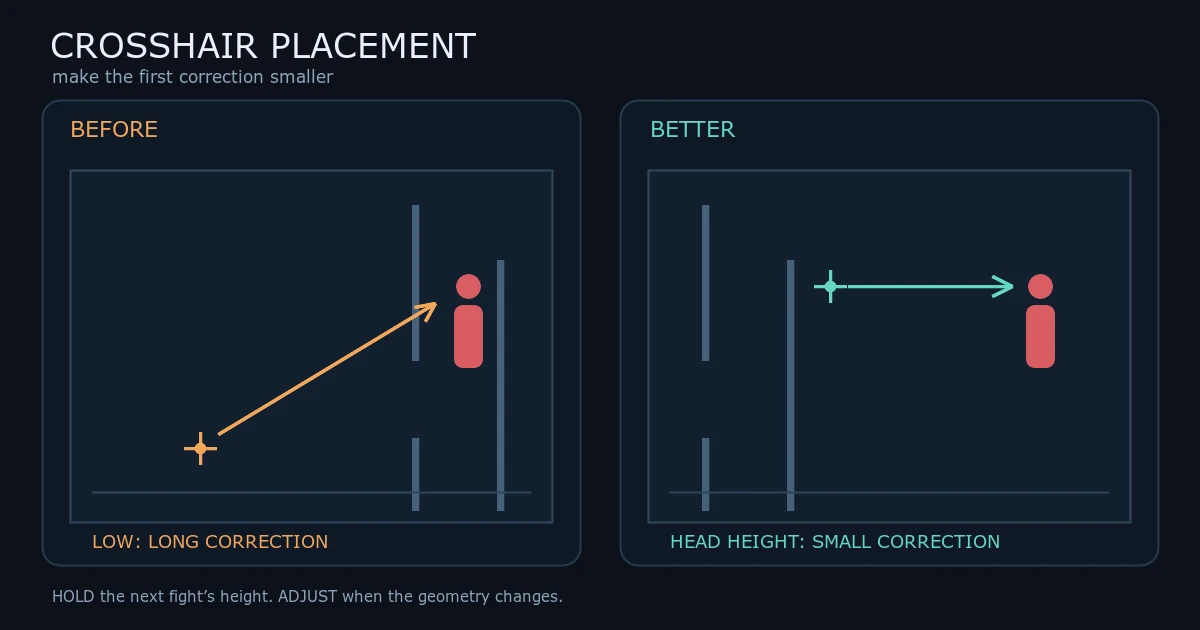
If your crosshair is sitting on the floor when you turn a corner, changing sensitivity will not fix the first problem. You will still have to drag the mouse a long way before you can shoot. Crosshair placement is the habit of carrying your aim toward the place an opponent is most likely to appear.
That does not mean staring at one perfect pixel. VALORANT has ramps, boxes, steps, and awkward little changes in elevation. Your crosshair needs to travel with the space you are clearing. The aim is to make the first correction small enough that the fight begins with a decision, not a rescue mission.
Start with the Riot fact
Riot’s Beginner’s Guide gives the official baseline: stop moving before shooting if you want to be more accurate. The same guide tells new players to learn where enemies can come from, watch angles, and check corners.
Riot does not prescribe a universal crosshair path or say that holding head height guarantees a headshot. The method below is Valorant Village coaching interpretation built around that movement-and-angle baseline.
Treat head height as a moving reference
“Keep your crosshair at head level” sounds like a flat line across the whole map. It is not. Head height changes when you look up a stairway, hold a raised box, or clear an angle where the opponent can stand on different ground.
Use the nearest useful reference. On a flat lane, line up with the head of a friendly model or a practice bot. As you approach a corner, ask where an enemy’s head would be if they were standing in the first playable spot beyond it. Hold that height as you move. If the floor rises, move the crosshair with the floor instead of dragging it back to the old horizon.
The goal is a short correction, not a frozen mouse. Players who force the crosshair to stay perfectly still often stop reading the map. Let the geometry change it. That is part of the job.
Clear one angle at a time
Crosshair placement falls apart when you try to cover a whole doorway at once. Pick the first dangerous angle, place the crosshair where a player could appear, and expose that angle before moving on to the next one.
That is what pre-aim means here. You are choosing a sensible starting point before the opponent is visible, not predicting the exact pixel where they will stand. On a normal rifle fight, it might be the near edge of a box or the first slice of a doorway. A player holding a wide off-angle can still force an adjustment, but you are no longer starting from the ground.
Your route changes the order. A teammate taking first contact, a smoke blocking the far side, or a common off-angle can make another angle the real priority. Do not copy a “perfect crosshair path” from a clip and assume it works on every clear. The path belongs to the angle order, your movement, and the information you have.
Reset after utility
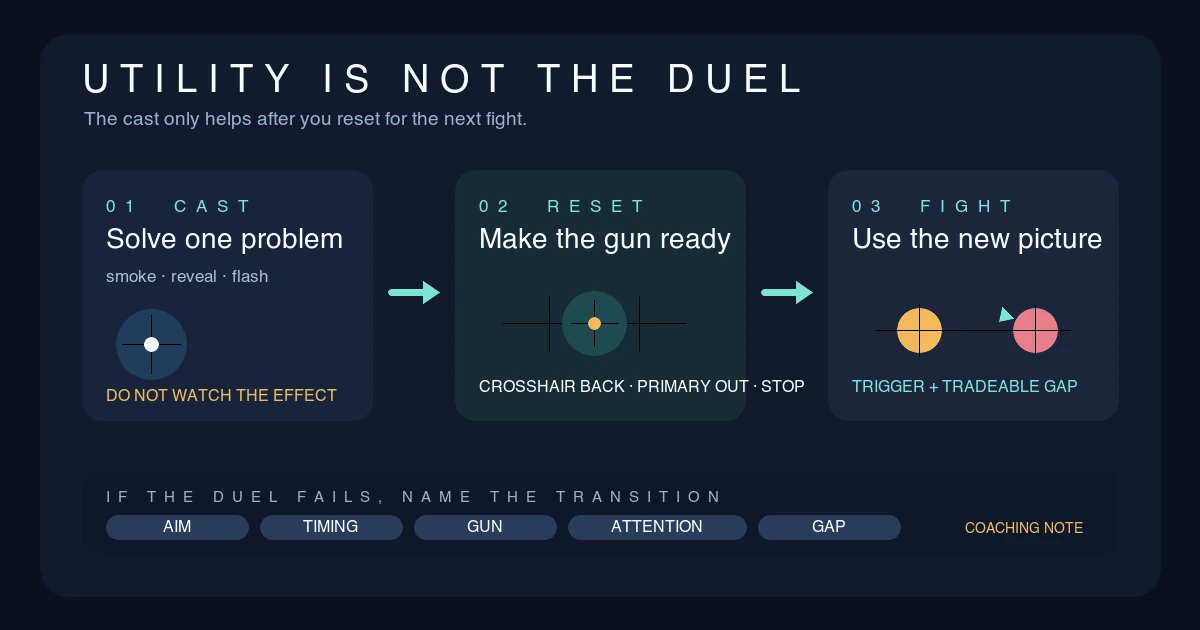
This is a common place to lose the habit. The crosshair looks fine while you walk with your rifle out, then you equip an ability, cast it, and re-enter with the mouse still aimed at the cast location.
Before you peek, reset the weapon toward the next likely head height. It can take less than a second. If a teammate is taking first contact, that tiny reset is usually a better use of time than rushing in with the gun pointed at the floor. This is coaching advice, not a Riot-documented rule about ability animations.
Use a short drill with visible feedback
Use the Range or a custom game. The drill is deliberately boring:
- Pick one rifle and one short route on a map you know.
- Walk through the route without firing. At each entry, say which angle you are clearing first and watch where the crosshair sits before you see a target.
- Repeat the route and stop at each chosen angle before firing at a bot or marked target. This keeps Riot’s stop-before-shooting baseline in the exercise.
- Make a third pass at normal round speed. Notice the places where the crosshair drops, floats too far from the corner, or stays at the wrong height on a ramp.
Do not judge the drill by a high score. Write down two or three locations where the placement failed, then revisit those spots in a custom game. If you cannot name what changed after ten minutes, shorten the route. Repeating a vague problem for an hour rarely makes it clearer.
Diagnose the first mouse movement
When you review a death, watch the first half-second rather than the final bullet. If the crosshair starts far below the opponent and travels upward after they appear, placement is probably the habit to train. If it starts near the right height but you miss after stopping, look at timing, angle choice, or recoil control next.
Ask one question after each opening duel: “Was my first mouse movement toward the enemy, or was it a correction from somewhere unreasonable?” Keep the answer for five rounds. One bad fight is noise. The same correction five times is a useful practice target.
Keep settings in their lane
Riot’s Patch Notes 4.05 added crosshair import and export through auto-generated codes. Riot later noted in Patch Notes 12.07 that the PC Settings screens had been revamped with hover tooltips and a visual refresh. If you need to move a reticle between profiles, use our crosshair-code guide and resolution guide. A code can reproduce settings; it cannot practise the angle for you.
Sources checked
- Riot Games, “Beginner’s Guide”, published 2024-08-03, checked 2026-08-14 UTC. Riot claims used: stop moving before shooting to be more accurate; learn enemy routes, watch angles, and check corners.
- Riot Games, “VALORANT Patch Notes 4.05”, published 2022-03-23, checked 2026-08-14 UTC. Riot claim used: crosshair settings can be imported and exported with auto-generated codes.
- Riot Games, “VALORANT Patch Notes 12.07”, published 2026-04-15, checked 2026-08-14 UTC. Riot claim used: PC Settings screens were revamped with hover tooltips and a visual refresh.
The head-height reference, angle order, utility reset, drill, and death-review method are Valorant Village coaching interpretation, not official Riot instructions or a promise of better results.