Cypher Guide: Trips, Camera Information and Trap Discipline
Written by Valorant Village
Source-backed coverage ●
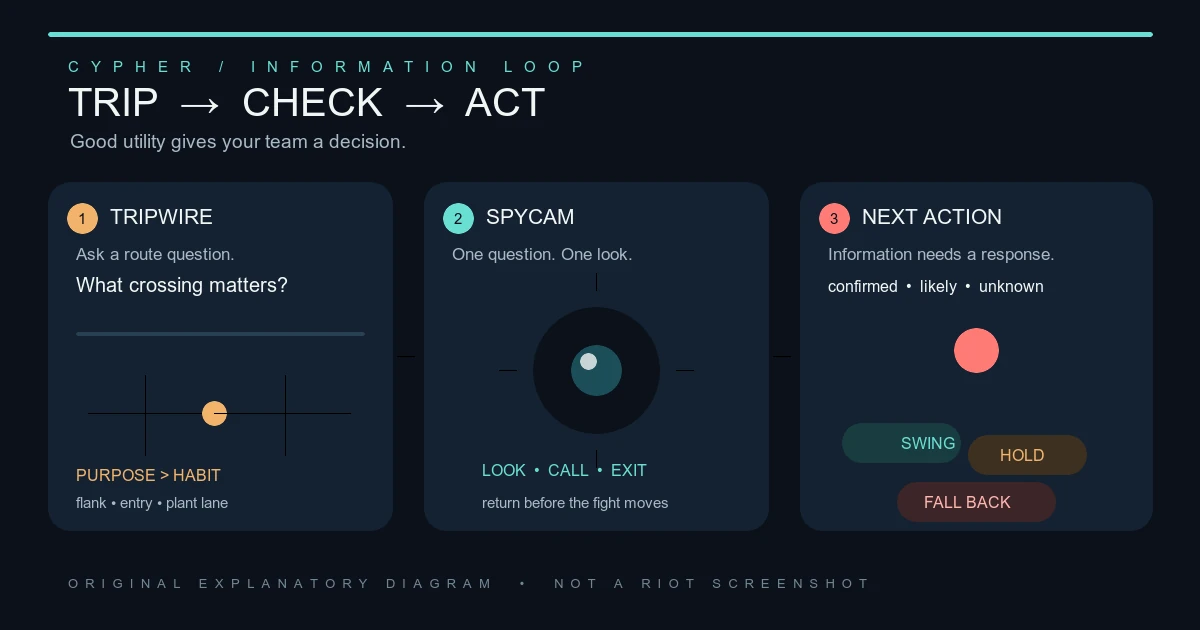
Cypher is easy to play on autopilot. Put down two wires, park a camera in the usual place, then keep holding the same angle when the first cue arrives. The utility did its job. The player did not.
Information is useful only when it changes a position, timing, or call. A Trapwire should answer a route question. A Spycam should be checked when its answer can still change the round. After the answer arrives, Cypher needs a next action, not another look at the minimap.
Riot's current mechanics
Riot's current Cypher agent page lists him as a Sentinel. It describes Trapwire as a covert, destructible tripwire between its placed location and the opposite wall. An enemy who crosses it can be tethered, revealed, and dazed after a short period if the device is not destroyed, and the wire can be picked up for redeployment. Spycam can be placed, re-used for camera control, used to fire a dart that reveals the location of a struck player, and picked up to be redeployed. Cyber Cage blocks vision and slows enemies who pass through it. Neural Theft, used on a dead enemy in Cypher's crosshairs, reveals the locations of living enemies.
Those are the ability facts. The placement, timing, and response rules below are Valorant Village coaching, not official Riot instructions. I also checked Riot's Patch Notes 13.02, published July 29, 2026. Its Cypher entries are bug fixes for Cyber Cage visuals and a rare Neural Theft disconnect, so this guide avoids old numeric claims about health, cooldowns, or durations.
Give every tripwire a question
Before placing a wire, finish this sentence: “If this trips, I will know that…” The answer might be “someone crossed our flank,” “the hit entered this choke,” or “the player clearing this lane is now committed to looking down.” If you cannot complete the sentence, the wire is probably filling space rather than collecting information.
The best location depends on the fight you want. On defense, a wire can watch the route you are not holding, protect a retreat, or make an entry crosshair point easier for a teammate to contest. On attack, it can watch a flank while the team works toward site. Those are purposes, not universal placements.
Separate the signal from the story. “Trapwire triggered A Main” is confirmed. “The whole team is A” is a guess unless another player or piece of evidence supports it. A destroyed wire may show attention on that route, but not the enemy count or whether they stayed. For calls that keep facts and guesses apart, use the structure in our useful comms guide.
Spycam timing: one question, one look
Do not enter Spycam because the ability is available. Enter it because you have a question with a deadline. Is the lane occupied before your teammate crosses? Is the flank still clear while the team commits to the other side?
Set the check before the round reaches that moment. When it arrives, look for the answer, call the location and timing, then leave. If the view shows nothing useful, return to your weapon. Cypher loses value when the camera becomes a comfortable place to hide from the next fight.
The dart is also a decision, not a ritual. If a teammate is ready to pressure the revealed player, tagging can make the information actionable. If nobody can use the location before the enemy moves, exit the camera and hold the space your team still needs. On attack, a narrow camera that protects the flank can be correct even if it does not show the site.
Audio can refine a camera read, but it does not complete the picture. The VALORANT sound-cues practice list is useful here because it treats sound as a clue to check against the minimap, timer, and known positions.
What to do after information arrives
Use a short conversion loop:
- Call the fact: location, trigger, and when it happened.
- Check the response: can a teammate trade, can the enemy be forced through a bad route, and is the objective still safe?
- Choose one action: swing with support, hold the next angle, give space to preserve the setup, or rotate because a second piece of evidence supports it.
- Spend the next utility only if it helps that action.
Cyber Cage can block vision and slow enemies, so it can support a crossing, isolate a fight, or make a retreat harder to chase. Throw it for the action you just called. A cage placed after the team has already lost the space, with nobody ready to move, is just late noise.
Neural Theft is stronger when its reveal changes the route. Riot says it reveals all living enemy locations from a dead player. Call the useful split, then tell the team what to clear or protect. Do not treat every marker as permission to sprint toward the nearest duel. If the reveal produces a numbers advantage, the next choice belongs to the round plan. Our man-advantage guide covers the reset, trade, and fallback decisions that follow a pick.
Four autopilot traps
Repeating the same wires every round lets the enemy budget for them. Move the question when the opponent starts clearing it for free.
Checking the camera on a fixed timer makes the view more important than the round. Tie the check to a crossing, trigger, plant attempt, or rotate that your team can still answer.
Treating a trigger as a command creates unnecessary first deaths. A signal earns a supported peek, not a solo peek.
Overcalling a rotation turns one clue into a team-wide mistake. Say what is confirmed, what is likely, and what remains unknown. Ask for the second piece of evidence before moving everyone.
For the next three rounds, write one question beside each tripwire and one camera moment beside the plan. After each round, answer three things: what did the utility confirm, what did I change, and did the change help a teammate act? If the last answer is no, alter the purpose before you alter the lineup.
Header image: an original explanatory diagram made for Valorant Village. It is not a Riot screenshot, client image, or live-match image.