Which VALORANT Patch Changes Affect Pro Preparation?
Written by Valorant Village
Source-backed coverage ●
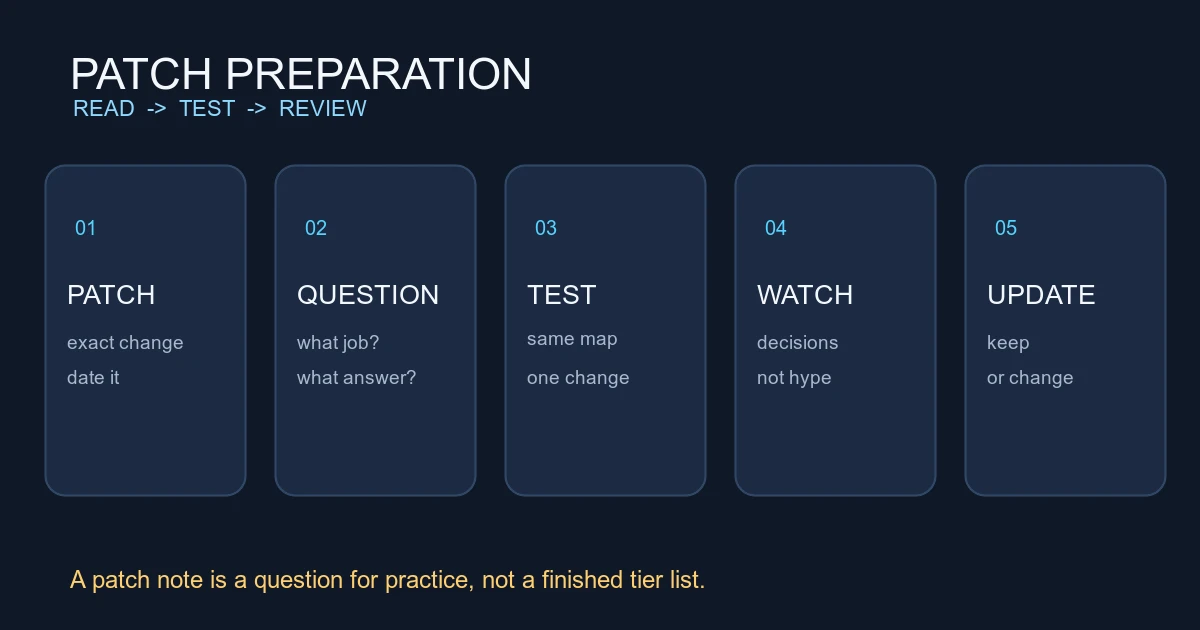
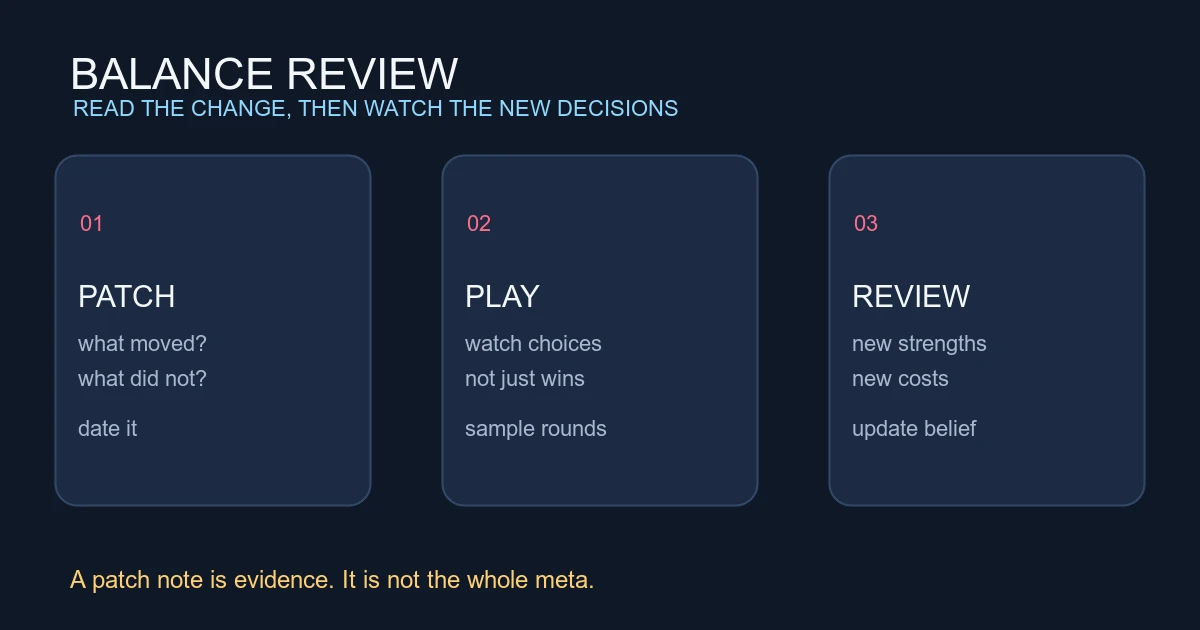
A professional VALORANT patch does not arrive as a finished tier list. It arrives as a set of changed conditions that teams have to test. An ability may equip faster, an ultimate may cover less space, a weapon may reward a different timing or a map change may remove a familiar default. The important question is not “who is instantly meta?” It is “which decisions have become different enough to practise?”
Riot's own balance writing gives useful context. Its balance overview discusses data, player sentiment, design goals and the tactical dialogue created by a round. Patch 11.08 then describes a tuning pass intended to create clearer counterplay and reward more deliberate ability use. Those statements are design intent. The preparation method below is Valorant Village analysis.
Start with the condition, not the headline
Read the full patch note and copy the exact change into a small table. Mark whether it affects damage, timing, area, cost, information, movement, map geometry or a rule outside the round. A change that looks tiny in isolation can matter if it alters the moment a teammate can swing or the amount of time an opponent has to respond.
Patch 13.02 is a good example of why context matters. Its title includes a Phoenix ultimate change, new maps for Retakes and other fixes. The headline tells you where to look. It does not tell you which team compositions will survive a full tournament. A serious review asks what the change makes possible, what it makes punishable and what old habit no longer works.
Keep the changed condition separate from the expected consequence. “The duration increased” is a patch fact. “Teams will use the ability for a late-round fake” is a testable prediction. A prediction can be useful without becoming a statement about what every professional team is already doing.
Convert notes into preparation questions
For each meaningful change, write three questions:
- What round problem does this solve?
- What response does the opponent still have?
- Which timing or spacing has to be rehearsed?
Imagine a flash, smoke or movement change. The first question might point to an entry problem. The second asks whether the defender can break line of sight, trade the user or wait out the effect. The third turns the reading into practice: which player moves first, which angle is covered and what happens if the utility misses?
This is the part that separates a patch note from a pro preparation plan. Teams do not practise a number. They practise a sequence that depends on the number. A change can be strong in a laboratory and awkward in a live round because the required setup costs a teammate's utility or reveals the plan too early.
The balance-direction review is a useful companion for this distinction. Read Riot's intent, then ask whether the new interaction creates a clear response rather than treating every buff as a demand to pick the Agent.
Build a small practice matrix
Do not test every idea at once. Choose one map, one side and one round job. Record the old version and the changed version. Run the same scenario several times with a second player acting as the defender. Track whether the plan creates space, forces a response, preserves a trade or simply consumes too much time.
Then test the failure case. If the entry utility is destroyed, can the team still take the round? If the opponent saves a counter, does the plan have a second beat? If an ability is stronger only when the team is already coordinated, that is important information. The patch may increase mastery rather than increase solo value.
This kind of practice also helps a ranked player. You do not need a professional team's schedule to ask what changed in your own default. Use the agent-role matchup matrix to name the problem, then review one VOD instead of changing every Agent at once.
Watch matches for decisions, not proof of a tier list
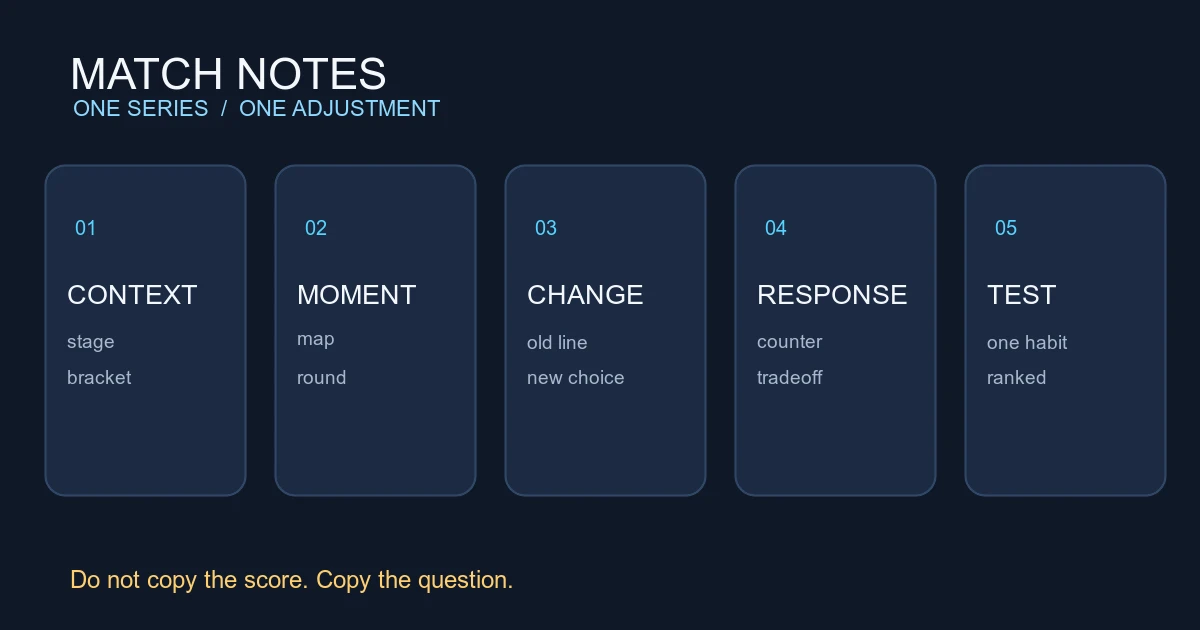
When the patch reaches competition, note the sample and the date. A single series can show a clever use, but it cannot prove that an Agent is solved across a region. Watch for repeated choices: when the team spends the ability, what they hold for the next phase, how the opponent responds and whether the plan survives after a timeout.
The VOD review guide gives a simple structure. Pick one map and one question. Do not begin with “what was the meta?” Begin with “what problem did this team solve, and what did the opponent try next?” That wording keeps your conclusion close to the footage.
Patch effects also arrive unevenly. Teams may have prepared a response before the public patch, or they may choose a conservative composition while they gather information. A popular pick is evidence that someone found value. It is not evidence that every ranked player should copy the pick immediately.
Keep the review dated
Patch articles age quickly when they hide their evidence. Put the patch number and access date in the source notes. If a later patch changes the same ability, update the headline, body and image caption together. Do not leave an old prediction looking like a current rule.
The best preparation loop is small: read the exact change, identify the round problem, test the response, watch a sample and update the plan. Patch notes tell you what moved. Practice and match review tell you whether the movement changed a decision worth keeping.
Sources checked
- How we balance VALORANT, published 2020-06-26 and checked 2026-08-14 UTC. Used for Riot's discussion of data, player sentiment, design goals and tactical tradeoffs.
- VALORANT Patch Notes 11.08, published 2025-10-14 and checked 2026-08-14 UTC. Used for the dated discussion of counterplay and deliberate ability usage.
- VALORANT Patch Notes 13.02, published 2026-07-28 and checked 2026-08-14 UTC. Used for the current-era example of an Agent and mode patch with multiple preparation questions.
The practice matrix, match-reading method and tier-list caution are Valorant Village editorial interpretation, not claims about private team preparation.