How to Practise VALORANT Post-Plants When Teammates Will Not Communicate
Written by Valorant Village
Source-backed coverage ●
Post-plant is not a hiding exercise. It is where you decide which angle can stop the defuse, which fight is worth taking, and how much space you can give away without losing the Spike.
That gets harder when teammates go quiet. One player wanders off, another holds a different angle, and the plan becomes “hope someone swings with me.” A memorised lineup does not solve it. The plant spot, safe line, and defender’s next action still decide what the lineup should accomplish.
Riot’s Beginner’s Guide says attackers try to plant the Spike and have it detonate while defenders try to defuse it after the plant. It also recommends learning where enemies can come from, watching angles and corners, asking whether an ability helps the next goal, and stopping before shooting. Riot Support’s Welcome to VALORANT describes the game as a one-life-per-round 5v5 where strategy, abilities, the Spike and teamwork all matter.
Those are the objective rules. The routine below is Coaching inference, written to help you practise the decisions around them. It is not a Riot rule or a promise that one position works on every map.
Make the plant spot your first constraint
Coaching inference: choose one map, one site and one repeatable plant spot. Use a Custom Game if your client allows it. Otherwise use a recorded round and pause at the plant. You are rehearsing a decision state, not reproducing a live retake.
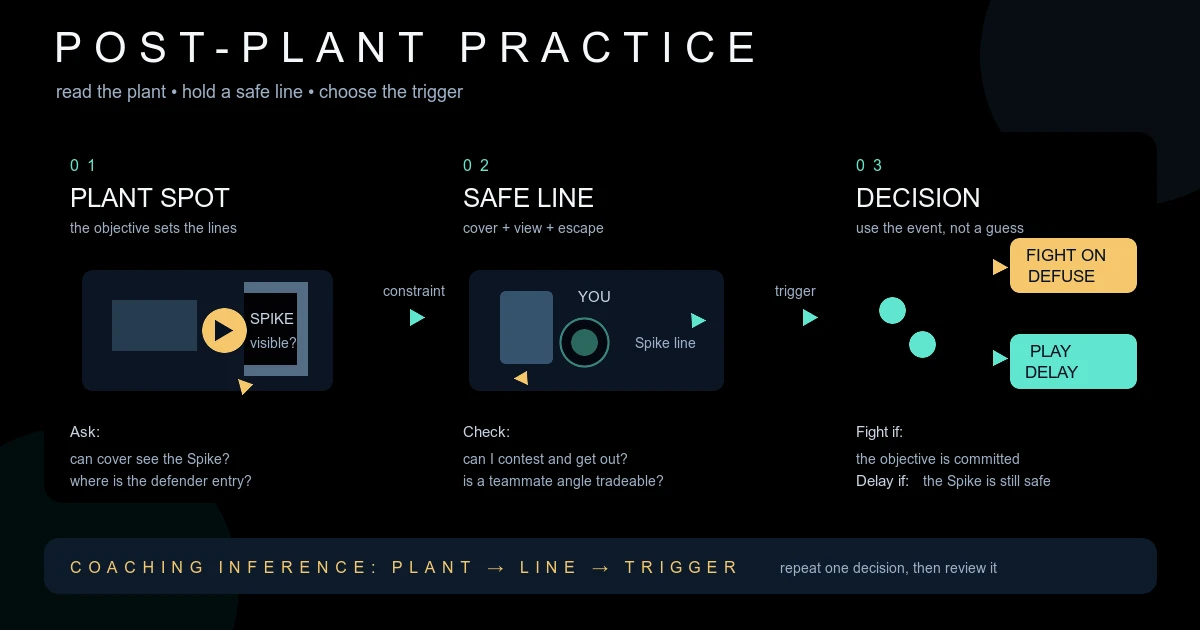
After the plant, answer these questions out loud:
- Can I see the Spike from cover, or must I expose myself to contest it?
- Which defender approach is most likely to clear my line first?
- Where can I retreat while keeping the Spike relevant?
- If a teammate is alive, where could their second angle see the same entry?
The plant is a constraint because it determines your useful lines. A visible plant may support a direct hold; a hidden plant may require a closer contest, delay utility, or a different teammate angle. Do not practise the same answer after changing the plant.
Run three post-plant states
Riot’s How we balance VALORANT describes a tac cycle of Intel, Plan, Execute and Repeat. Use it as a review lens: collect the intel you have, make one plan, then name what would change it.
Run the same plant three times. First, imagine a defender approaching but not committed to the site. Hold the safe line and decide whether moving improves information or simply gives away the Spike.
Second, imagine the defender has reached the site and must clear your angle. Decide whether a controlled fight changes who owns the Spike area. If not, keep cover and wait.
Third, use the defuse cue as the trigger. Ask: “Can I stop this from my current line, and can I survive the contest?” If yes, take the shortest fight that changes the objective. If no, move or use utility that delays access. These are coaching choices, not fixed timings.
Read the clock without inventing timings
You do not need a universal number of seconds for every post-plant. Riot’s Patch Notes 13.00 describe Retake as a mode with a pre-planted Spike, a ticking timer, and rounds that end on elimination, defuse or detonation. That supports objective pressure, not a ranked timing formula. Mode details can change with later patches.
Coaching inference: read state changes instead of made-up counts. Is the Spike active? Has a defender committed to the defuse? Did your teammate make contact? Do you have a safe route to contest? A defuse cue means the defender chose the objective. Tie your response to that event, not to “hold for five” or another number that may not fit the round.
Use a safe line before a clever line
Coaching inference: a safe line lets you see or contest the Spike, uses cover, and gives you an escape or second position. It is not a magic pixel or a promise that you win. Start with a direct line, keep your crosshair at the likely entry, and stop moving before shooting as Riot advises.
Utility should have one job. A smoke can remove a route, damage utility can make a defuse costly, and a reposition can create a new angle. Value depends on the Agent, plant and patch. If you cannot explain the change, save it until the defender gives information.
Crossfire, trade, or reset
Coaching inference: a crossfire is two offset lines answering the same entry, not two teammates stacked together. If a teammate is alive, choose a contact point and a second angle that sees the enemy after the first fight. Give one short call or ping. Riot’s guide supports these communication options, but does not require a particular call.
If nobody answers, do not swing on an imaginary trade. Hold the line that protects the Spike or reset to cover. If a teammate makes contact and you can see the opponent immediately, take the trade. Could you see the killer and shoot without crossing the same doorway? The guide to how to trade a teammate covers that problem.
Fight when the enemy is exposed, committed to clearing you, or touching the Spike. Play delay when the Spike is safe, you have cover or useful utility, and a peek exposes you to multiple angles. A kill matters when it changes access to the objective. A kill taken from impatience can leave the Spike undefended.
Review one round, then change one variable
After the repetition or a real round, write five answers:
- What did this plant let me see?
- Did my safe line include cover and an exit?
- What event made me fight: contact, defuse, or impatience?
- Could a teammate actually trade my angle?
- Did my choice preserve control of the Spike?
If the answer is no, change one thing next time: the plant, the line, or the trigger. Use how to make useful comms for a short location-and-action call, and how to review one VALORANT VOD when you want to test the same question in a full match. One repeated decision is enough for the next session.