Range, Deathmatch or Aimlabs: Choosing the Right VALORANT Drill
Written by Valorant Village
Source-backed coverage ●
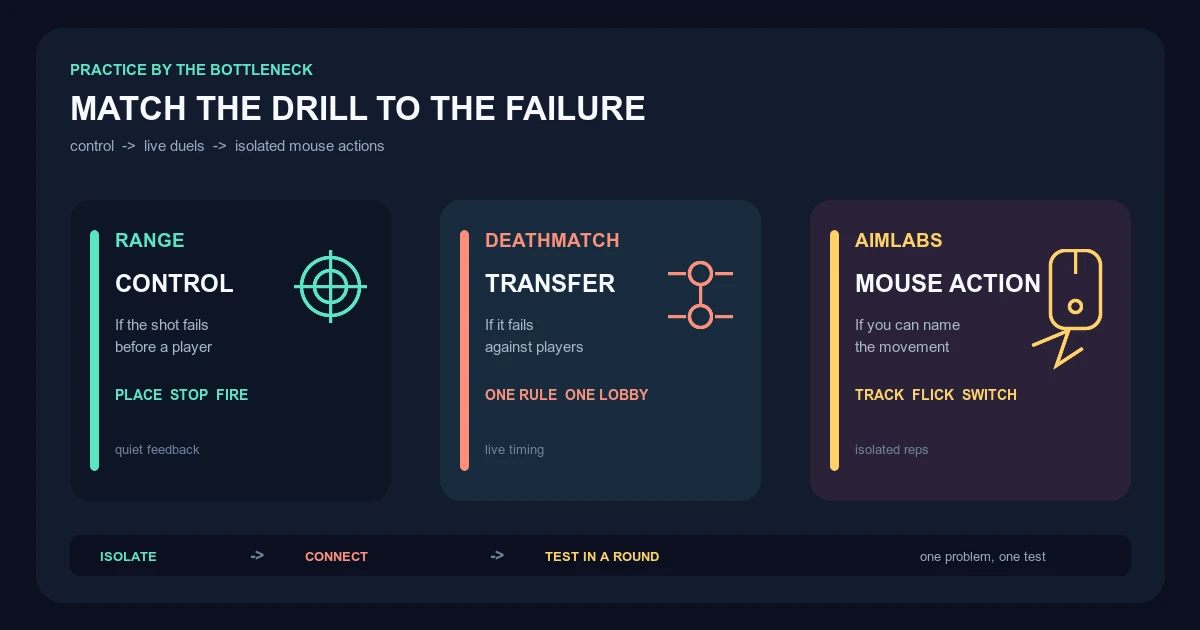
More practice is not automatically better practice. The Range, Deathmatch and Aimlabs each remove or add different parts of a VALORANT fight. Pick the one that isolates the mistake you can actually describe, then stop when the session has answered that question.
Riot’s Patch Notes 9.02 say current PC players can reach Basic Training and The Range from the Practice menu. Riot’s Beginner’s Guide supplies the official baseline behind the drills: learn where enemies can come from, use abilities toward a goal, and stop moving before shooting to be more accurate. The tool choices below are Valorant Village coaching advice, not an official Riot training prescription.
Use The Range when control is the problem
Choose The Range when the error is visible before another player gets a say. Your crosshair starts on the floor. You fire while still moving. A small correction becomes a wide mouse drag. You spray because the first bullet missed and you cannot tell whether the problem was placement, stopping or panic.
Run a five-minute test with one rifle. Place the crosshair on a target, strafe a short distance, stop, and fire one shot. Reset rather than chasing the miss. Repeat at a few distances, then add a controlled burst if the first shot is consistent. Keep one question in your head: “Did I stop before I fired?”
This is useful because the same action can be repeated without a player changing the timing. It is also the limit. The Range cannot show whether you held the right angle, chose a sensible fight, or reset after a teammate used utility. A clean target drill proves that you can perform the motion in a quiet setting. It does not prove that the motion survives a round.
If your first symptom is the crosshair arriving from the floor, use the crosshair placement guide after the drill. It covers the starting position that the Range exercise is meant to expose.
Use Deathmatch when the motion disappears against players
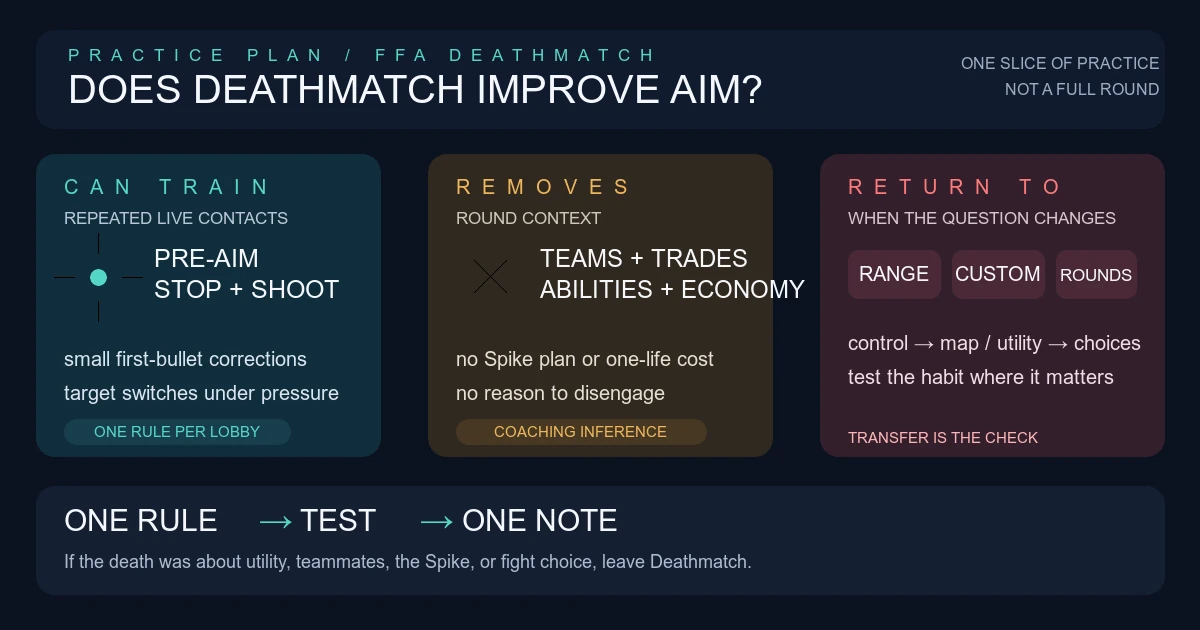
Riot’s FFA Deathmatch explainer describes a no-team mode with up to 14 players, no abilities, infinite money, weapon swapping, respawns near the action and a finish at 40 kills or nine minutes. Those rules create frequent gunfights and short resets. That makes Deathmatch a reasonable place to test whether a Range habit survives surprise, movement and imperfect timing.
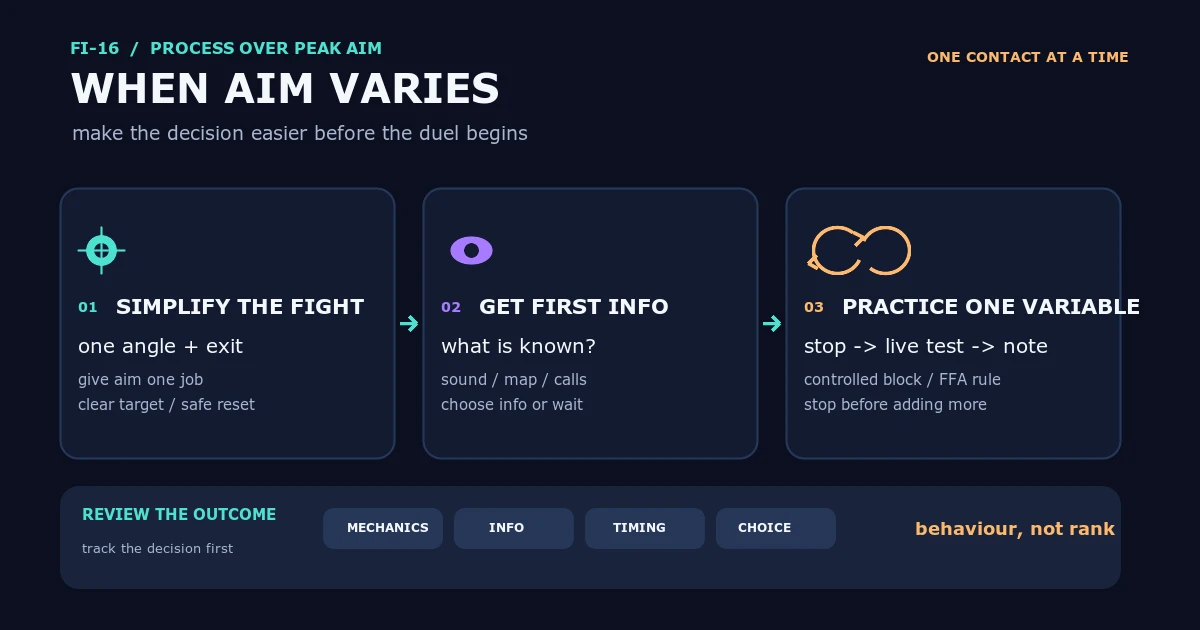
Enter with one rifle and one rule. For example: keep the crosshair at a likely head height, or fire only after the movement stop. Do not change the rule because the first few spawns feel bad. After a death, ask one quick question: was the first problem my crosshair, my movement, or the fight I chose? Write down the answer when the same one appears more than once.
Deathmatch is not a miniature Competitive round. The mode removes abilities, team spacing, economy decisions and the Spike context. A risky re-peek can be a poor round decision even if it creates another duel in FFA. Treat the lobby as a live aim test, not as a scoreboard verdict. If your problem is choosing when to expose yourself, the peeking guide is a better follow-up than another automatic queue.
Use Aimlabs when one mouse action is the bottleneck
Aimlabs is most useful when you can name the movement without mentioning the map. “I cannot keep a moving target centred,” “my target switches are late,” or “I lose a small click after a larger one” is specific enough. “My aim is bad” is not.
Aimlabs’ official VALORANT training guide describes task families for tracking, flicking, target identification and reacting to audio. Choose one family for five to ten minutes, use a VALORANT-oriented task where possible, and keep the difficulty low enough that you can see the movement you are trying to improve. The aim is to isolate the mouse action, not to collect a better-looking number.
The limit is transfer. An Aimlabs target does not ask you to stop before firing, carry your crosshair around a doorway, respect a teammate’s timing or decide whether the fight serves the Spike. That is an editorial inference from the difference between an isolated task and a round. Use Aimlabs to identify or rehearse a mouse action, then return to The Range to connect it to VALORANT movement and a rifle. Test it in Deathmatch or a real round before calling the routine useful.
Aimlabs’ more recent intentional-training guide makes the same practical point in its own terms: diagnose a weakness, isolate it, then verify whether it changed. Borrow that loop, not the assumption that more repetitions must help.
A short decision tree
- If the miss happens on a still target or the first shot comes before your stop, start in The Range.
- If the Range looks controlled but the habit vanishes when a player appears, play one focused Deathmatch.
- If you can name a mouse action such as tracking, flicking or switching, use a short Aimlabs block, then reconnect it in The Range.
- If the death came from utility, teammate spacing, the Spike, economy or choosing the fight, use a custom game, an Unrated round or a VOD review. None of the three aim tools contains that full problem.
Not sure? Run five minutes in The Range, one focused Deathmatch, and record the first repeated failure. Do not stack all three because the session feels unfinished. The 20-minute warm-up shows how to keep a short practice block from turning into a second match.
The comparisons, drill instructions, transfer tests and limits are Valorant Village editorial advice. They are not guarantees of better aim, wins or rank.