Peeking in VALORANT: Wide Swing, Jiggle, Shoulder and Late Peek
Written by Valorant Village
Source-backed coverage ●
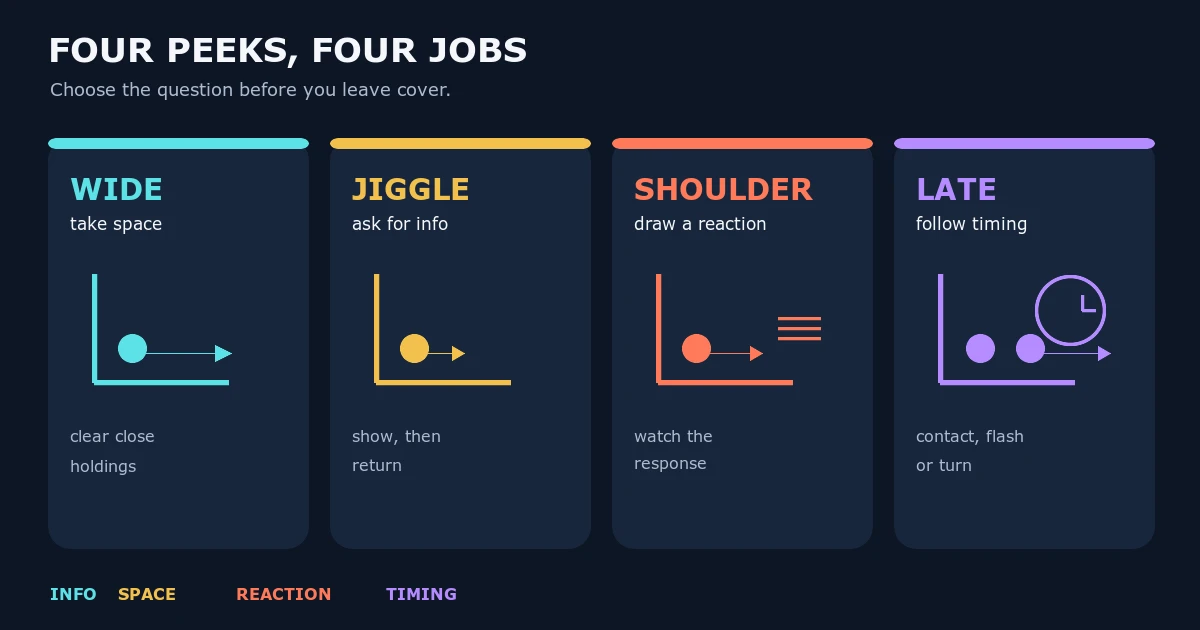
“Just peek better” is not advice. Before you leave cover, decide what the movement is meant to buy: space, information, a reaction or a better timing window.
Wide swing, jiggle peek, shoulder peek and late peek are player terms, not four official VALORANT mechanics. There is no universal best one. The right choice depends on the angle, weapon, teammate, utility and question you need answered.
| You need to… | Coaching choice | What you might learn | Trade question |
|---|---|---|---|
| Clear space or a close angle | Wide swing | How many angles are occupied and whether the defender gives ground | Can a teammate see the fight as you enter? |
| Ask a small yes/no question | Jiggle peek | Whether someone is watching, fires, or gives away utility | If you see nothing, can you return safely? |
| Draw a reaction | Shoulder peek | Whether the enemy is holding the lane and how they respond | Who acts if they shoot or turn? |
| Appear after a useful event | Late peek | Whether attention, utility or a rotation changed the fight | Is the delay coordinated, or are you leaving a teammate alone? |
What Riot says, and what this guide adds
Official facts: Riot’s Beginner’s Guide tells players to decide whether to run or walk, ask whether an ability helps achieve the next goal, and stop moving before shooting to be more accurate. Riot’s Welcome to VALORANT describes a one-life-per-round tactical shooter built around teammates, abilities and the Spike. In How we balance VALORANT, Riot describes Intel → Plan → Execute → Repeat and lists timing, coordination, abilities and shooting under execution.
Valorant Village coaching interpretation: the four labels, decision table, tradeability tests and examples below. Riot does not publish a fixed number of frames for a safe jiggle or guarantee that a shoulder peek draws a shot. Riot’s Patch Notes 3.0 changed movement-state accuracy in 2021, so old timing charts are not permanent rules.
Wide swing: buy space
A wide swing carries you farther from the corner than a small probe. Use it when you need to clear a close hiding spot, take the next piece of ground or make a defender move their crosshair away from a comfortable edge hold.
The cost is exposure. The farther you travel, the more of the site or lane you can reveal to other players. A wide swing is more tradeable when a teammate is already covering the next angle and can see the defender who shoots you. It is a poor information tool when you only need to know whether one Operator is watching. In that case, you are paying for space you did not ask for.
Utility can change the calculation. A flash, smoke or recon may reduce threats, but it does not tell you where to aim after the swing. Name the goal first: clear close, take space, or fight the player forced off the angle.
Jiggle peek: ask a small question
A jiggle is a short exposure and return. The useful version has a question attached: “Is anyone holding this lane?” “Did that shot come from this corner?” “Did the defender use a piece of utility?”
Its value is information while keeping your next move available. If the angle is open, fall back or ask for help. If someone fires, you know the lane is watched and may have made a timing window for a teammate. But a close angle, pre-aimed opponent or second defender can turn a tiny peek into a real fight.
Jiggle peeking is not an invisibility trick. Repeat the same rhythm and the opponent gets information about you. If nothing changed, the third identical peek usually teaches less than the first. Change the question, use utility, or leave.
Shoulder peek: buy a reaction
A shoulder peek briefly shows enough of your model to make the opponent react without committing to the whole lane. Players use it to draw a shot, check whether an enemy is watching, or give a teammate a reaction to play off.
The reaction is the information. A shot says the angle is active; a turn may show attention moved; no response tells you little. Do not assume one shot means the enemy is empty. You still need the weapon, cover and second angle.
Tradeability depends on the follow-up. With a teammate ready to swing as the defender fires, a shoulder peek can be a useful trigger. Alone, it may only spend health or reveal your pattern. Map geometry matters too. A box, step or uneven corner can expose more than the movement feels like it should, so test the exact spot in a custom game instead of trusting a clip from another map.
Late peek: buy timing
A late peek is delayed until something useful happens: a teammate makes contact, a smoke blocks the first defender, an enemy fires and turns, or a rotation starts. The delay is the point. You want to arrive while the opponent is solving a different problem.
Late is not the same as slow. If your teammate fights alone while you wait for a perfect moment, the peek is untradeable. Call the trigger: “after contact,” “on the flash,” or “when they cross.” Then be ready to move immediately. A late peek can be the second part of a trade, a split pressure play, or a way to punish an enemy who has shown their attention elsewhere.
Keep ability timing current. Riot’s latest checked Patch 13.02, dated July 29, 2026, fixed an unintended delay involving Jett’s Tailwind and Updraft after Cloudburst. The official fact is the fix. The coaching conclusion is simple: do not treat an old ability clip or timing claim as permanent. Test the current client and build the peek around the effect you can actually see.
A five-minute practice test
Use one corner in a custom game. First, say the question out loud: space, information, reaction or timing. Try the matching peek, then write down what the defender could see and whether a teammate could reach the fight. Repeat from the same start point with the other three choices.
Next, add a teammate or bot and repeat each movement five times. Do not count frames. Count decisions: did the peek answer the question, did you stop before shooting, and was the first contact tradeable? Add one ability only after the clean version makes sense. If the answer is “nobody can help me here,” change the route or wait for a better plan.
Before your next ranked peek, use one sentence: “I am peeking for ___.” If you cannot fill in the blank, you are probably offering the defender a fight for free.
For the next duel, pair this decision with crosshair placement and a plan to trade a teammate.