How to Choose a VALORANT Main Role Without Locking Yourself In
Written by Valorant Village
Source-backed coverage ●
Choosing a VALORANT main role does not have to mean choosing one Agent forever. Choose a repeatable round job. If it still makes sense when the round is quiet or the highlight never arrives, it is a better candidate than a favourite clip.
What Riot says
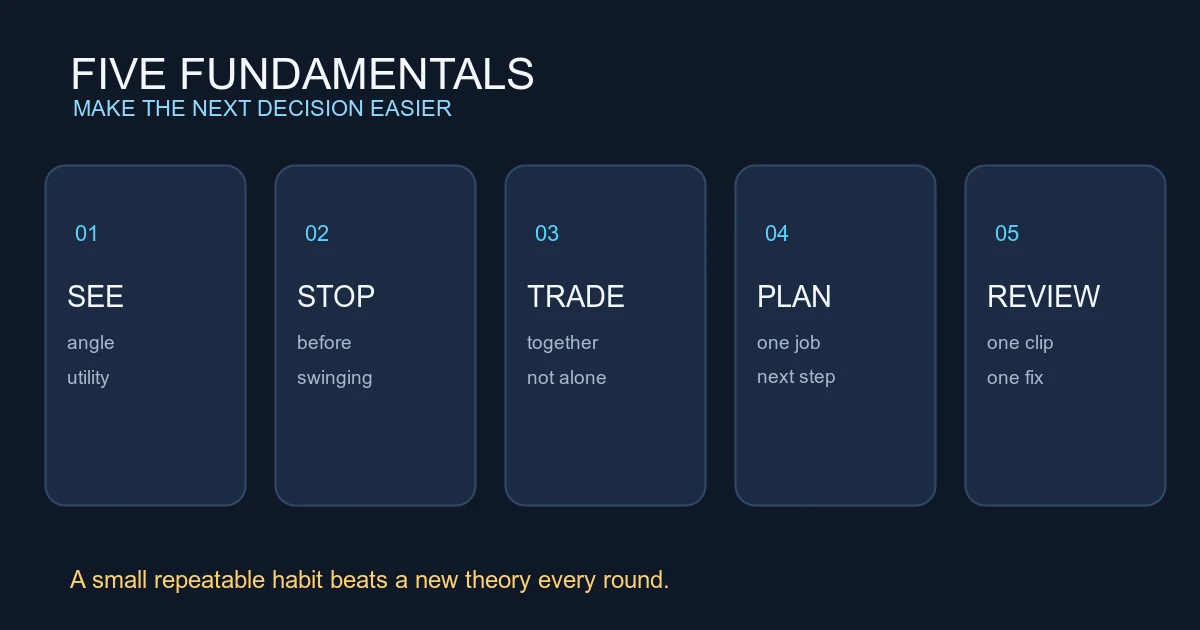
Riot’s Beginner’s Guide says Agents are grouped into four roles based on functionality. It also says each Agent brings distinct skills for teamwork, while a team does not have to include every role. Riot’s example is practical: a Controller who smokes watched sightlines can make getting onto a site easier. The same guide says map and playstyle can influence Agent choice, asks players to consider whether an ability helps the next goal, and recommends communication plus stopping before shooting for better accuracy.
Riot’s live pages label Omen as a Controller, Sova as an Initiator, Jett as a Duelist and Cypher as a Sentinel. Those are official labels and kit examples. The job descriptions and experiment below are Valorant Village coaching, not a Riot test or rank promise.
Pick the round job you enjoy
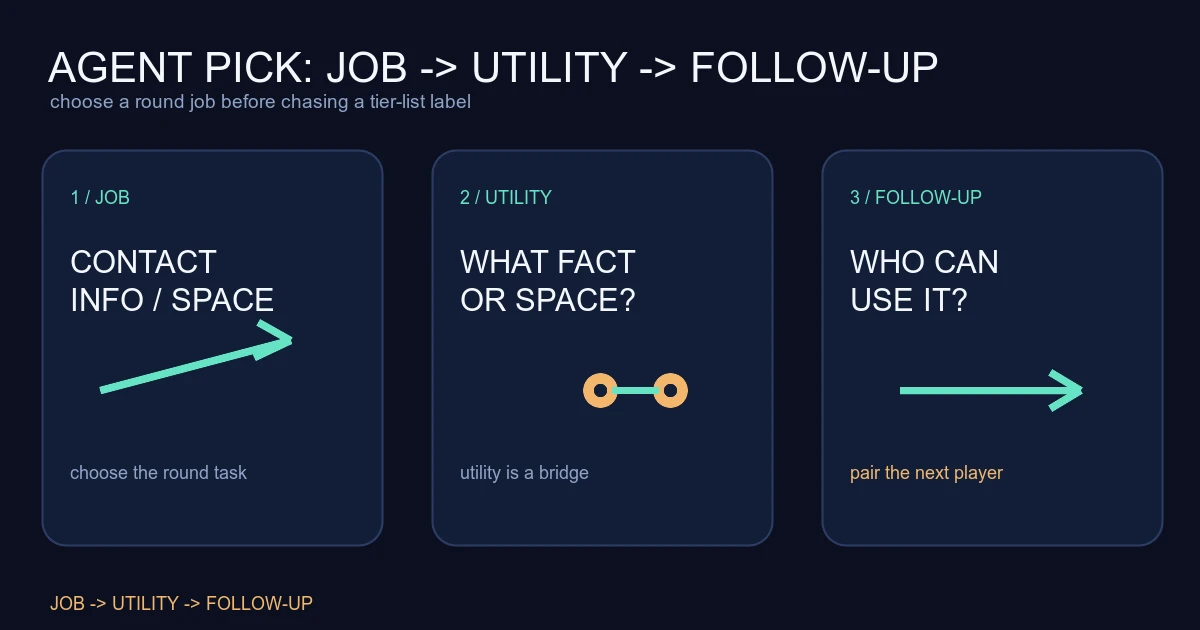
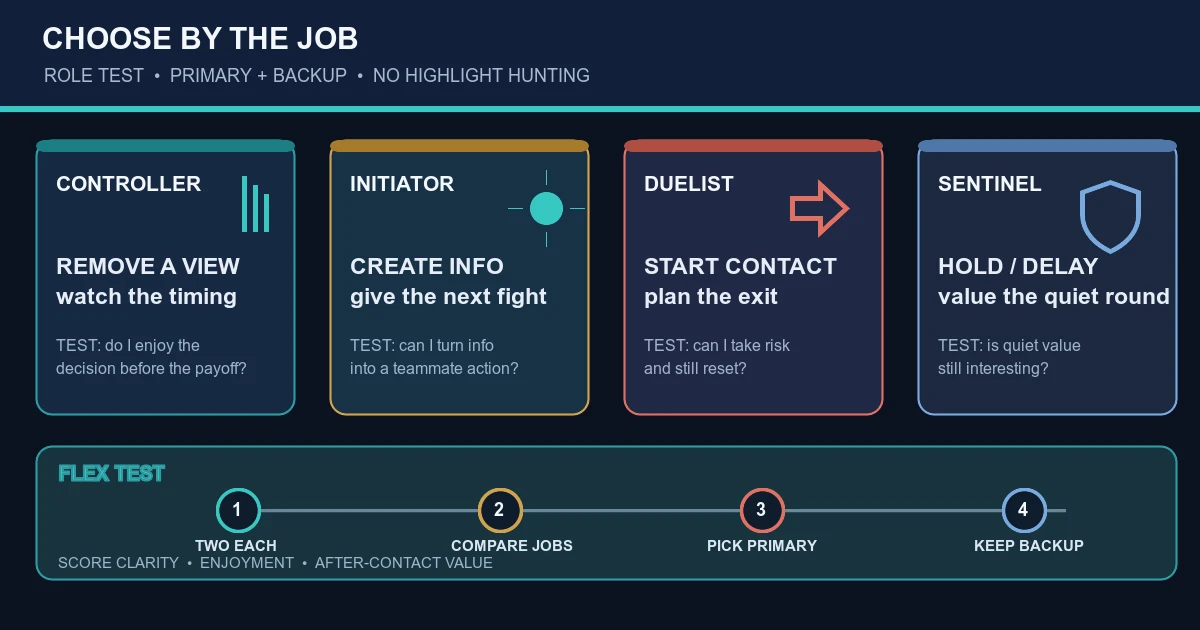
Controller: remove a view at the right time. Try Controller if you like deciding which sightline the team can stop worrying about, when a smoke or screen should appear, and what the team can do with that changed space. Your coaching question is: “Do I enjoy planning the timing, then adjusting when the enemy waits or pushes?” A Controller test is not a search for the prettiest smoke. Before using utility, name the next action: cross, plant, hold, or retake. The smokes guide has the longer version of that check.
Initiator: create information or a playable fight. Try Initiator if you like asking a question before the duel. Can you clear a likely corner, reveal a position, disrupt an angle, or give a teammate a timing to act on? Riot’s Sova page describes tracking and scouting, but that does not make every Initiator a remote utility player. The coaching test is whether you enjoy turning information into the next decision: swing, take space, wait, or rotate. If you use an ability and then stare at the result without a follow-up, the role may need a clearer plan, or it may not fit your current habits. The comms guide gives a compact way to turn that information into a teammate action.
Duelist: start the contact with a plan to leave. Try Duelist if the first fight interests you, including the parts before the kill. Your job is to choose a playable entry, create pressure, and know what happens if the defender gives ground. Riot describes Jett’s style as agile and able to take risks. That is an official character example, not a command to sprint into every angle. The coaching question is: “Can I accept controlled first contact without turning every miss into a second fight?” A good test gives your teammate a trade or gives you a clear escape. A montage only shows the successful half-second.
Sentinel: prepare, watch, delay. Try Sentinel if you enjoy making a location harder to attack and keeping track of what changed. Your value may be information, a flank warning, a delayed push, or the decision to leave before an isolated hold becomes impossible. Riot describes Cypher as an information broker and surveillance network. The coaching question is whether patient value still feels satisfying when no enemy walks into your setup. If you only enjoy the role when a trap produces a kill, you are choosing the payoff, not necessarily the job.
Flexible play: keep coverage, not chaos. Flexing is a useful backup skill, not a fifth official role. Choose one primary role and one secondary role whose basic responsibilities you can remember. A contrasting backup is often better than a duplicate: pair a Controller who wants to play close to the team with another that helps you think about longer sightlines, or pair an information-heavy Sentinel with a more delay-focused option.
Run a small role experiment
First, write one sentence for each role: “I want to remove a view,” “I want to create information,” “I want to start contact,” or “I want to hold and delay.” Add a fifth note for flexing: “I want a second role I can play when my primary is unavailable.” These sentences are your hypotheses, not identities.
Next, play two matches on each of the four roles in the same mode if possible. Use an Agent whose basic kit you can understand. After each match, score three things from 0 to 2:
- Job clarity: did you know what the round asked you to do?
- Decision enjoyment: did the useful decisions hold your attention?
- After-contact value: after the first fight, could you still help with information, space, delay, a trade, or a reset?
Write one sentence beside the scores. “I liked the timing, but I had no plan after the smoke” tells you more than “we lost 13–8.” Ignore a single great game or awful game. Highlight clips hide the missed entries, the patient holds, the setup that earned no kill, and the teammates who made the moment possible.
Choose the two highest-scoring roles, then validate them for three more matches each. Play the primary when it is available. Use the secondary when the primary is taken, the map makes the other job more attractive, or the team already has your first job covered. That is a flex test with a trigger, not random filling.
After five matches, review the short notes. Keep the role whose bad rounds still leave you with a useful question, and keep the other as your backup. For a deeper review, use How to Review One VALORANT VOD Without Getting Lost, but inspect only the decisions connected to your chosen job. Your next queue rule can be simple: primary by default, secondary when the trigger appears, and one sentence of evidence after the match.