VALORANT Callouts: How to Learn a Map Without Memorising a Poster
Written by Valorant Village
Source-backed coverage ●
You do not need to memorise every label on a map poster before you can communicate. You need a small shared vocabulary for the next decision. A callout is useful when it helps a teammate look, move, hold, or stop. A perfect name that arrives after the fight is only trivia.
What Riot actually asks you to learn
Riot's Beginner's Guide says to learn the maps, remember where enemies can come from, watch angles, and check corners. It also recommends communicating with voice, pings, or Agent voice lines. Those are official basics. Riot does not turn the public map descriptions into a complete ranked callout dictionary.
That distinction matters because players often learn a map as a picture. They remember a food truck, a tower, or a long corridor, then struggle when a teammate gives a name they have not heard. Learn a route and its problem first. The exact label can follow.
Build a callout from five pieces
This is Valorant Village coaching interpretation, not a Riot rule. For each important piece of a map, learn five things:
- Location: what space are we talking about?
- Route: how did a player get there, and where can they go next?
- Threat: which angle, cross, or objective is affected?
- Unknown: what does the call not prove?
- Action: what should the teammate do with the information?
“One near the plant lane, crossing to the back angle, hold my trade” is a complete call even if the first part is not the server's preferred name. It gives a location, movement, danger, and action. “They are everywhere” gives none of those.
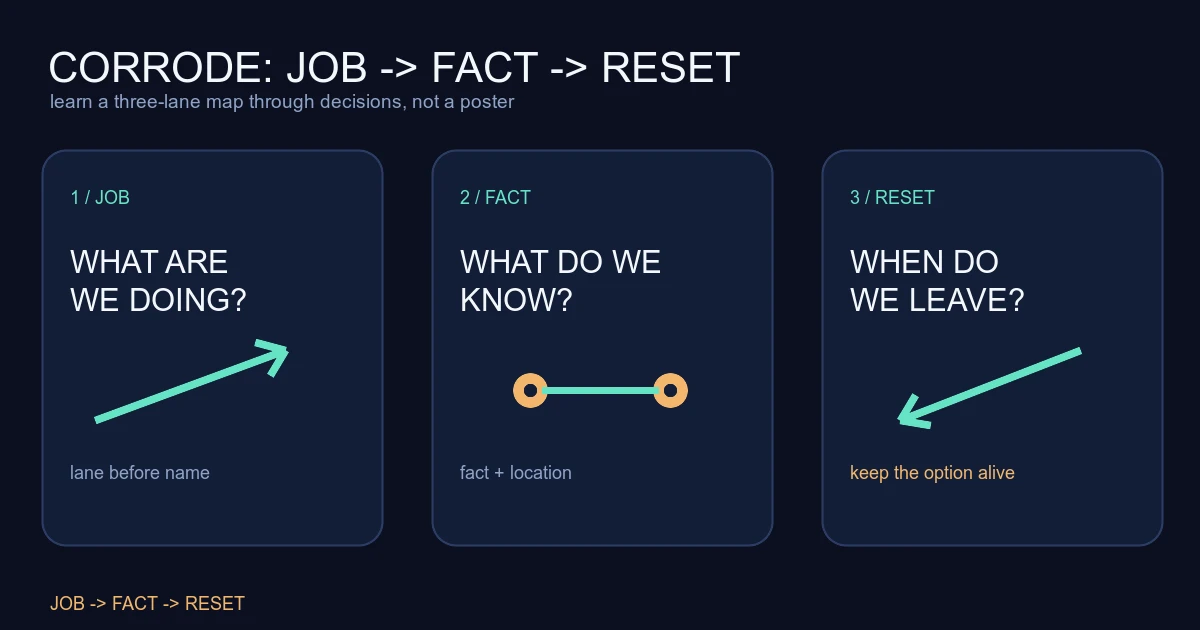
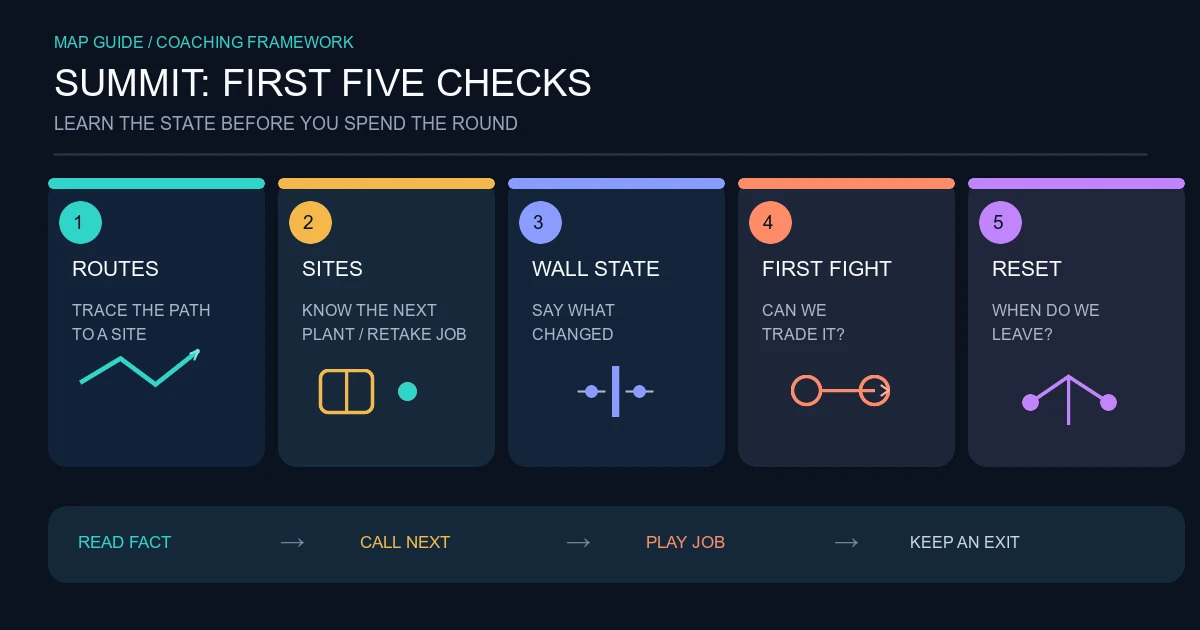
Start with only three spaces on a map: the first contact lane, the route to the objective, and the place a defender can retake from. Walk those routes in a custom game. At each turn, stop and describe what a player can see, what remains hidden, and what a teammate needs to cover. Write the short version in your own words.
After that, compare your words with the names teammates use. Keep the official or common label when you learn it. The comparison is easier because you already understand the space behind the name.
Learn the callout at the moment it matters
Do not study a page of names in isolation. Tie each label to a decision. On attack, ask: “Where must the Spike carrier cross?” On defense, ask: “Which lane gives the attacker a way around our hold?” In a retake, ask: “Which angle can stop the defuse?”
The Ascent attack defaults guide uses this kind of route thinking. A default is easier to remember when it has a job, a teammate, and a trigger. Apply the same idea to any map. Learn “the place we pause before contact” before you learn ten decorative landmarks.
Use one custom-game walk for geography and one live block for pressure. In the custom game, stand at each junction and name the routes. In the live block, record only calls that changed your view or movement. If a name never helped a decision, it is not a priority yet.
Say fact, location, action
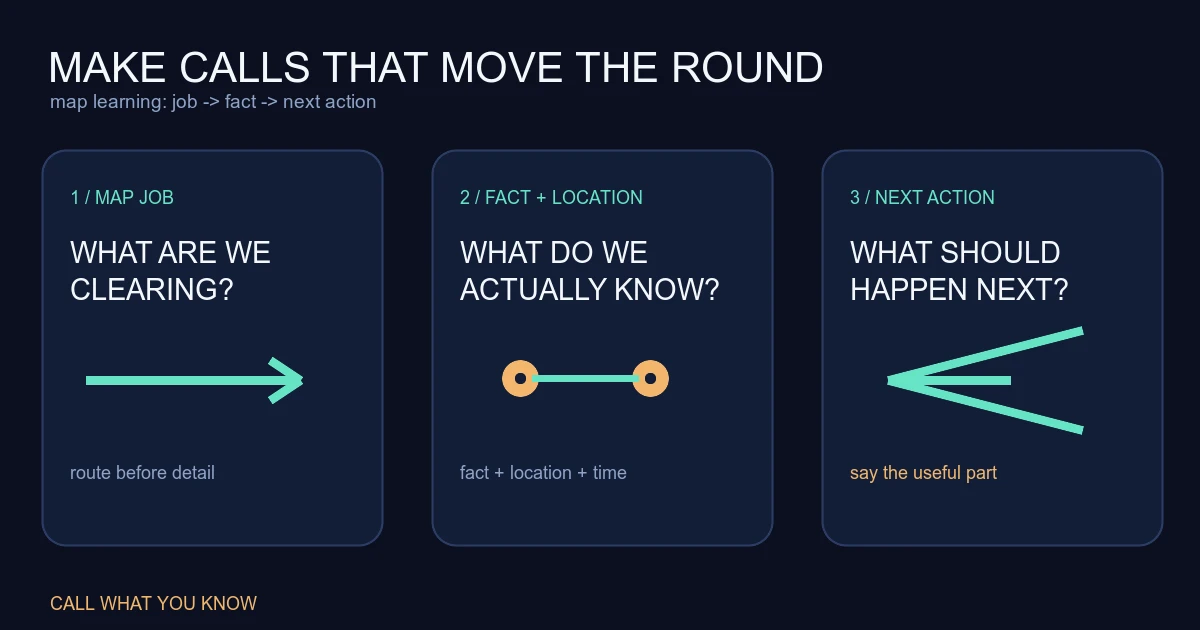
A practical call has three layers. State the confirmed fact first. Add the location or direction. Finish with the next action if one is clear.
- “One heard behind us, back route, hold the turn.”
- “One seen on the entry lane, close side unknown, wait for my flash.”
- “Spike dropped at the entrance, I am holding the recovery angle.”
Keep uncertainty in the call. A sound can tell you that something happened without proving the exact player count or position. The VALORANT sound-cue practice list is useful because it separates what the ear caught from what the player assumes.
If the action is not obvious, stop after the fact and location. “One in mid, no visual” is better than adding a confident swing that nobody can support. A teammate can then choose the next move without having to untangle your guess.
What to do when a teammate uses an unfamiliar name
Ask for a direction or a landmark, not a lecture. “Which side of mid?” “Near the plant box or the back lane?” “Is that the route to our spawn or theirs?” Once you can orient yourself, repeat the call in the words you know. This gives the team a shared reference without turning the round into an argument over vocabulary.
Do not answer an unfamiliar call by pretending you understood it. A false “yeah” can send two players to different angles. Ping the location when voice is too slow, then ask for the action. Communication is a tool for the current round, not a test of who studied the poster.
A ten-minute map drill
Pick one map and three decision spaces. Walk from spawn to a site, then back through the likely retake route. At each junction, say the location, the danger, the unknown, and the action. Repeat the route from the other side. In a live match, write down one call that helped and one call you misunderstood.
Next session, fix only the misunderstanding. Keep the map small until the route feels automatic, then add another branch. You are building a usable callout system one decision at a time.
Sources checked
- Riot Games Beginner's Guide, published 2024-08-02, checked in a live browser 2026-08-15 UTC. Used for map learning, angle and corner checks, communication, and next-goal utility.
- Riot Games VALORANT Maps, checked in a live browser 2026-08-15 UTC. Used for current map descriptions and the distinction between official map facts and this site's callout-learning method.
The five-part callout model, drills, examples, and fact-location-action structure are Valorant Village coaching interpretation, not Riot rules.