VALORANT Retake Mode: Rules, Cards and a Practice Plan
Written by Valorant Village
Source-backed coverage ●
Retake starts after the part of a normal round that usually takes the most time. The Spike is already down, the site is the whole map, and both teams have a reason to move now.
Riot introduced it as a limited-time 3v3 Spike mode, not as a small version of Competitive. There is no normal economy or full-map default to manage, so use it for quick repetitions of post-plant decisions. The rules below come from Riot. The practice plan is Valorant Village coaching advice.
How Retake works
Riot’s Patch Notes 13.00 define the mode like this:
| Part of the round | Riot-confirmed detail |
|---|---|
| Teams | 3v3 on a single site |
| Sides | Sides swap every round; the planters hold the Spike and the other team retakes |
| Spike | It auto-plants a few seconds into the round at a visible location chosen from curated spots for that site |
| Loadouts | There is no economy. Players choose from two cards covering weapons, armour and ability charges; each card has two randomized options that escalate round over round |
| Round result | Elimination, defuse or Spike detonation ends the round |
| Match result | The first team to five rounds wins |
The point is repetition. You are not saving for a rifle or walking a default for a minute; you are reading the site, the Spike and the first fight in front of you.
The launch notes list sites from Ascent, Bind, Haven, Summit and Sunset, with one site selected at random per match. Riot’s Patch Notes 13.02 later added Split, Corrode and Lotus. Treat the list as patch-sensitive and check the client before calling it permanent.
What the cards are for
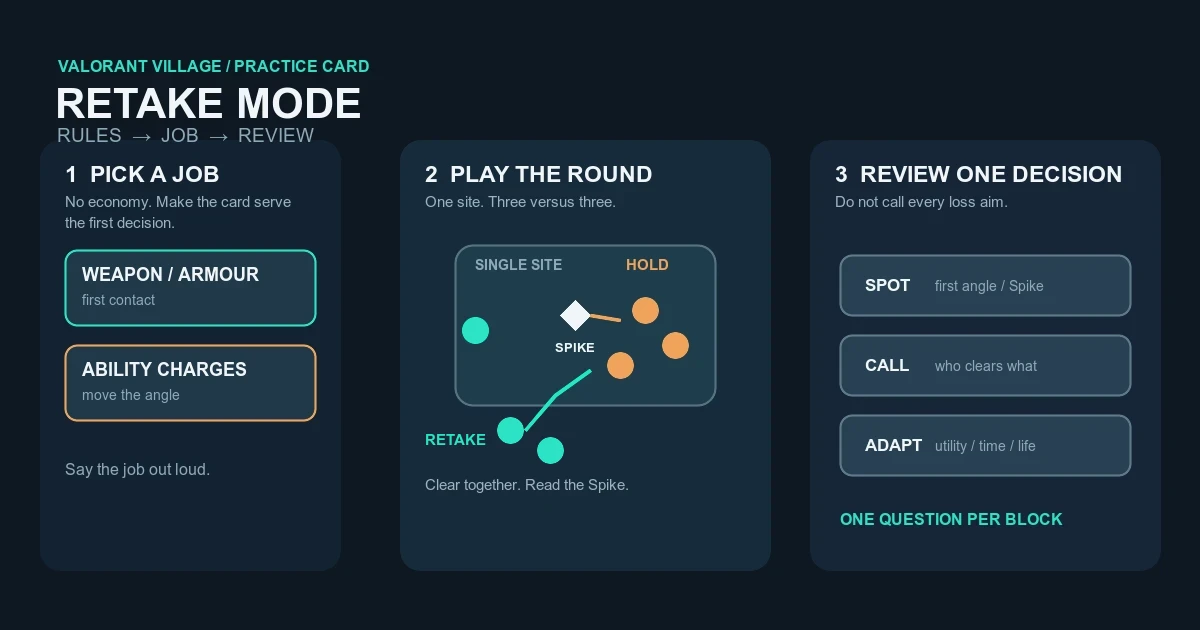
The card screen is not an economy puzzle. Riot gives you randomized options for weapons, armour and ability charges, with the options escalating round over round. Choose the card that helps your first job.
That last sentence is coaching advice, not a hidden rule.
If you are retaking, ask what must happen before the defuse is safe: clear a tight angle, break a hold with utility, or survive the first swing for a teammate. If you are holding, ask where you can spend time and what you need for the defuse fight.
Do not judge a card only by its biggest gun. A weapon that wins one duel but leaves your team unable to take the next space may be wrong. A utility-heavy option is not clever if nobody has a clear moment to use it. Name the first action before you lock in.
A simple Retake round flow
1. Pick a job
During card selection, make one sentence: “I clear the close angle,” “I hold the defuse space,” or “I move the holder before we swing.” A card is easier to evaluate when it has a job attached to it.
2. Read the Spike and the approach
The Spike is visible and its plant spot comes from the site’s curated spots. Look at your route, the angles that see the Spike, and the cover available once the fight starts. A retaker who only looks at the defuse prompt is already late to the site.
The holding team should make the Spike expensive to reach. The retaking team should make defenders answer more than one angle. Those are coaching principles, not Riot requirements; the mode does not require a clear order or agent composition.
3. Make the first action together
The first player through the door is not a plan. A useful retake gives first contact a reason to exist: a teammate can trade it, an ability changes the angle, or the fight creates a path to the Spike. On the holding side, do not give away a fight just because the retakers arrive; spend the space, utility or time you chose to buy.
If the first action fails, call what changed. “Two alive, Spike exposed, regroup left” is useful. “Go go go” is noise when the round is already split.
Turn the mode into deliberate practice
Retake is good practice when you measure one decision. It becomes background noise when every loss gets filed under “bad aim.” Try this loop:
- Choose one question. Did I clear the first angle before looking at the Spike? Did I use utility before the swing? Did I arrive with a teammate?
- Play three rounds with that question. Sides swap every round, so keep the question and change the action. On defence, watch when you spend time. On attack, watch when you spend lives.
- Write down the first failure. The round may end in a missed shot, but the useful mistake could be an isolated entry, a poor card fit, or a late retake.
After three rounds, change one thing: a route, one saved ability, or the timing of your first call. Do not change four variables at once.
For a longer session, use the 20-minute VALORANT warm-up plan and replace one aim block with Retake when your decision-making feels rusty. The post-plant practice guide is a better fit when you want to isolate plant location and defuse decisions. The callout guide helps if the real problem is not knowing what to name while the site is being cleared.
What Retake does not teach
No economy means no buy discipline. A single site means no defaulting or rotating across the whole map. Three players per side changes the spacing and utility in every fight, while randomized plant spots can make last round’s route a poor answer this time.
That is the reason to use the mode for a narrow job. Retake gives fast reps on first contact, angle clearing, utility timing and the decision to fight or make the Spike problem harder. It cannot prove a setup will work in a 5v5 ranked round or replace full rounds.
Play it with one question. Keep the answer that survives three rounds, then take it into a normal match.
Sources checked
- Riot Games, “VALORANT Patch Notes 13.00”, page timestamp
2026-06-23T13:00:00.000Z; checked 2026-08-14 UTC / 2026-08-15 NZST. Claims used: Retake’s 3v3 single-site structure, side swap, pre-planted Spike, round endings, first-to-five win condition, no-economy card loadouts, and launch site list. - Riot Games, “VALORANT Patch Notes 13.02”, page timestamp
2026-07-28T13:00:00.000Z; checked 2026-08-14 UTC / 2026-08-15 NZST. Claim used: Split, Corrode and Lotus were added to the Retake map pool.
Header image: an original explanatory diagram made for Valorant Village. It shows the mode’s rules-to-practice flow; it is not Riot artwork, a client screenshot or a live-match image.