VALORANT Store Rotation and Skin Ownership: What Riot Exposes
Written by Valorant Village
Source-backed coverage ●
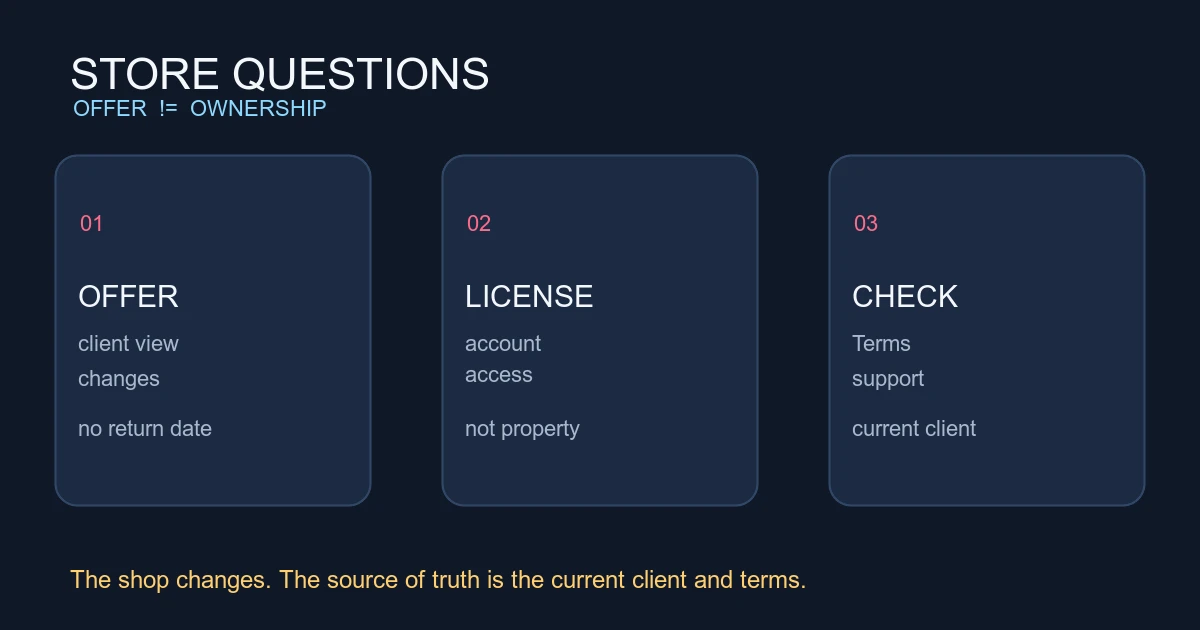
The VALORANT store creates two different questions that often get answered as if they were one. The first is availability: which cosmetic offers are visible to your account today? The second is ownership: what does buying a cosmetic actually give you under Riot's terms?
The client answers the first question at the time you open it. Riot's Terms of Service answer the second in legal language: Virtual Content is a limited licence to access content associated with your account, not property that you own outright. This article is an explanation of those boundaries, not a promise about a future shop offer or a legal opinion.
Rotation is an availability system
The Riot VALORANT Store Guide describes the shop's rotating offers and notes that support agents cannot manually restore an expired offer. Because support pages and product systems can change, use the current client and support page as the authority for the exact refresh behaviour.
The useful practical conclusion is modest: seeing a skin in a third-party rotation tracker does not place it in your account's store, and missing an offer does not create a guaranteed return date. A tracker can help you remember what you saw. It cannot change the catalogue or promise when Riot will show the item again.
Do not publish a daily “shop” page by copying screenshots from players. An account's offer is personal, the screenshot may include identifiers and the image may not be yours to republish. If you cover rotation, explain the system and send readers to the client for their own current offers.
Purchase is a licence, not a tradeable asset
Riot's Terms say players have no ownership or other property interest in Virtual Content. They describe a personal, non-exclusive, non-transferable and revocable right to use that content with the applicable Riot Services. The same document says Virtual Content has no real-world monetary value and cannot be transferred or redeemed for cash except where Riot allows functionality or applicable law requires otherwise.
That explains why a skin is not the same thing as a physical product. Buying it does not create a separate object that can be sold on a marketplace, moved to another account or treated as an investment. The Terms also address account access and prohibit sharing, selling or transferring login credentials.
Use the word “owns” carefully in an article. “The player owns the skin” is common shorthand, but “the player has access to the purchased Virtual Content under Riot's terms” is more accurate. The distinction matters when readers ask about account resale, gifting, refunds or a discontinued feature.
Availability and access can change
The Terms say Riot may change, remove, repackage, reprice or transfer Game Content and Virtual Content, subject to the limits described there and applicable law. That does not mean a particular skin will disappear tomorrow. It means a guide should not promise that the store, bundle, price or feature will remain unchanged forever.
The same caution applies to old screenshots. A store image may be a historical record of an offer, not proof that the item is available now. Date every screenshot or source page. If the article includes a current price or rotation rule, add a checked date and revisit it after major updates.
The gun-model reference is a safer evergreen use of cosmetic information because it teaches recognition without pretending to expose a player's store. For image work, the media asset guide explains why an official file still needs a source and rights record.
Separate purchases from refunds
A store question is not automatically a refund question. Eligibility depends on the current support policy, how the content was used and the region or payment situation. Do not copy a refund window from an old support article and present it as a guarantee.
Instead, direct readers to their purchase history and current Riot support flow. Tell them to avoid using the content in a match while they investigate if the support policy makes that distinction. Valorant Village should not ask readers for account credentials, payment screenshots with personal details or a login token.
A safe way to publish store coverage
For an evergreen guide, use this structure:
- Explain rotation as a client availability question.
- Link the current Riot Store Guide and Terms.
- State that offers and rules can change.
- Avoid guaranteed return dates and resale language.
- Use an original diagram or rights-cleared asset instead of a player's private shop screenshot.
- Add a checked date to any current claim.
For a news post, archive the original official announcement and clearly label the date. Do not turn an old limited-time event into a current store promise. Readers deserve the difference between an explanation and a live offer.
Sources checked
- Riot Games Terms of Service, last modified 2024-12-01 and checked 2026-08-14 UTC. Used for Virtual Content licensing, account access and possible changes to Game Content.
- VALORANT Store Guide, checked 2026-08-14 UTC. Used for the support boundary around rotating offers and expired store items; the current support page and client remain authoritative.
This is a plain-English editorial summary, not legal or financial advice. Check Riot's current Terms, support policy and applicable consumer law for an account-specific question.