A Weekly VALORANT Improvement Loop for Bronze Through Ascendant Players
Written by Valorant Village
Source-backed coverage ●
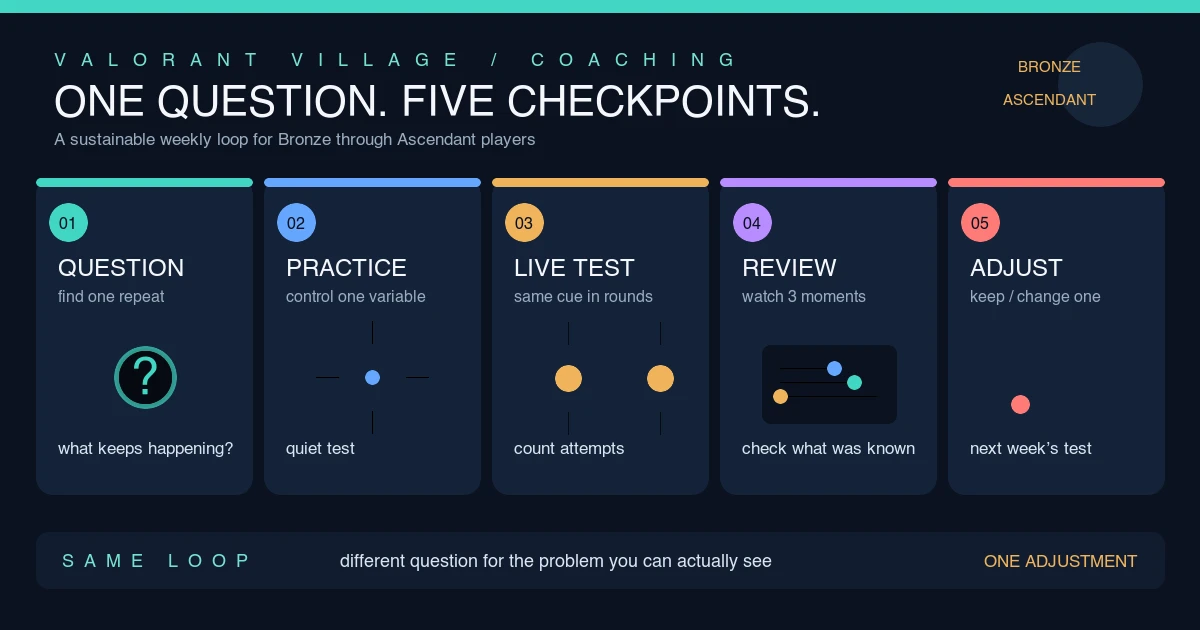
Improvement gets noisy when every session has a new mission. One day it is aim, then a new Agent, then a different sensitivity, then a queue of games played while tired. Use a week with five jobs instead: choose one question, practise it in a controlled setting, test it in live rounds, review a few attempts, and make one adjustment.
This is a process for Bronze through Ascendant, not a rank promise. Those ranks cover different problems. The loop stays the same; the question changes with the evidence in your rounds.
What Riot gives you
Official fact: Riot’s Beginner’s Guide, published August 3, 2024, frames the round around planting or defusing the Spike and recommends learning where enemies can come from, watching angles and corners, asking whether an ability helps the next goal, stopping before shooting, and communicating through voice, pings, or Agent voice lines.
Official fact: Riot Support’s Welcome to VALORANT, published April 17, 2024, describes a five-versus-five tactical shooter with one life per round, abilities, strategy, a Spike objective, and teamwork. That makes a practice plan that only measures aim incomplete.
Official fact: Riot’s Replays: Everything You Need to Know, published September 17, 2025, says Replays are meant to show a complete view of recent matches. Riot lists player perspectives, a third-person observer camera, playback speed controls, round and time jumps, timeline markers, minimap and HUD toggles, and the combat report.
Those pages document the game and its tools. They do not prescribe this weekly schedule. The loop below is coaching advice.
Monday: choose one question
Start with recent rounds, not a new guide. Pick one repeatable question you can answer from a clip or a short note:
- Did I fire before I stopped moving?
- Did I take a second fight after my first shot gave away my position?
- Did I use an ability with a named next goal?
- Did I begin a fight before a teammate could help or trade?
Write the question as a trigger and a replacement: “When I miss first contact, do I reset behind cover instead of re-peeking?” Avoid “How do I climb?” or “Why am I bad?” They cannot tell you what to practise.
Do not choose the question because of your rank label. A Bronze player may have the clearest evidence in stopping or angle discipline. An Ascendant player may find that mechanics are stable while timing, information, or utility purpose keeps repeating. That is coaching inference, not a Riot rule about what each rank should drill.
Tuesday: practise one variable
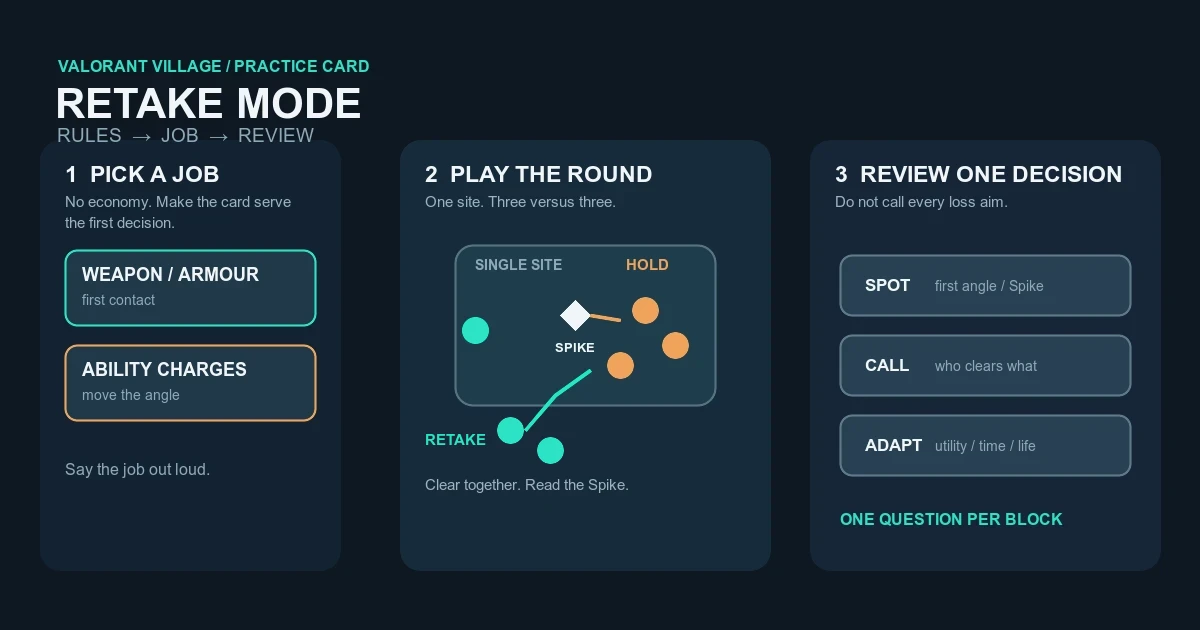
Make the first session quiet enough to see the action. If the question is mechanical, use a short Range block with one rifle: move, stop, fire, reset. If the question is a live duel habit, use a mode that supplies repeated fights. If the question is a decision, rehearse it in a Custom Game, Unrated, or a real round where the Spike and teammates still matter.
The tool must match the question. Range, Deathmatch or Aimlabs: Choosing the Right VALORANT Drill is a useful comparison when you are unsure. Keep the block short enough that fatigue does not become a second variable. The controlled session can show whether you can perform one action. It cannot prove that you will choose it under pressure.
Wednesday and Thursday: run the live test
Take the same cue into a small block of games. Ranked is appropriate when the question depends on real team and objective pressure, but the score is not the measurement. Unrated or Swiftplay can be a lower-cost place to test a basic cue, especially if you are already tilted. Riot’s Beginner’s Guide names those modes as options when Competitive is not the right context.
Before the first round, write the cue in seven words or fewer: “stop before the first rifle shot,” “wait for contact before re-peeking,” or “name the ability’s next goal.” During the block, tally attempts and whether you followed the cue. Do not replace it after one ugly death. You are testing a behaviour, not trying to force a particular result.
The test should also fit the player’s problem. A player working on stopping needs enough gunfights to notice movement and firing. A player working on rotations needs information and round context. A player working on trade timing needs a teammate’s position. No single drill is equally useful for all three.
Friday: review three attempts
If your client provides Replays, start with your own perspective at normal speed. Mark three moments related to Monday’s question. Then use the available context to answer four things:
- What did I know before I acted?
- What was my intended job in that moment?
- Did I follow the cue?
- Was the main issue mechanics, information, timing, or fight choice?
Riot’s Replay controls can show more than you knew live, especially from another player’s perspective or the minimap. Treat that as explanation, not hindsight evidence against yourself. If Replays are unavailable, use a recording or a short round log and keep the same questions. How to Review One VALORANT VOD Without Getting Lost has a longer version of this bounded review method.
Do not review every missed bullet. Look for the first decision that repeats. A reasonable fight can lose. A good cue can be followed in a losing round. The useful finding is a behaviour you can change, not a verdict on the scoreboard.
Weekend: make one adjustment
Choose one response to the review. If the cue was too broad, shorten it. If you followed it and the problem stayed mechanical, change the controlled drill. If the problem was information, move the cue earlier: gather or communicate before exposing yourself. If the problem was fight choice, define the exit or teammate condition that makes the fight acceptable.
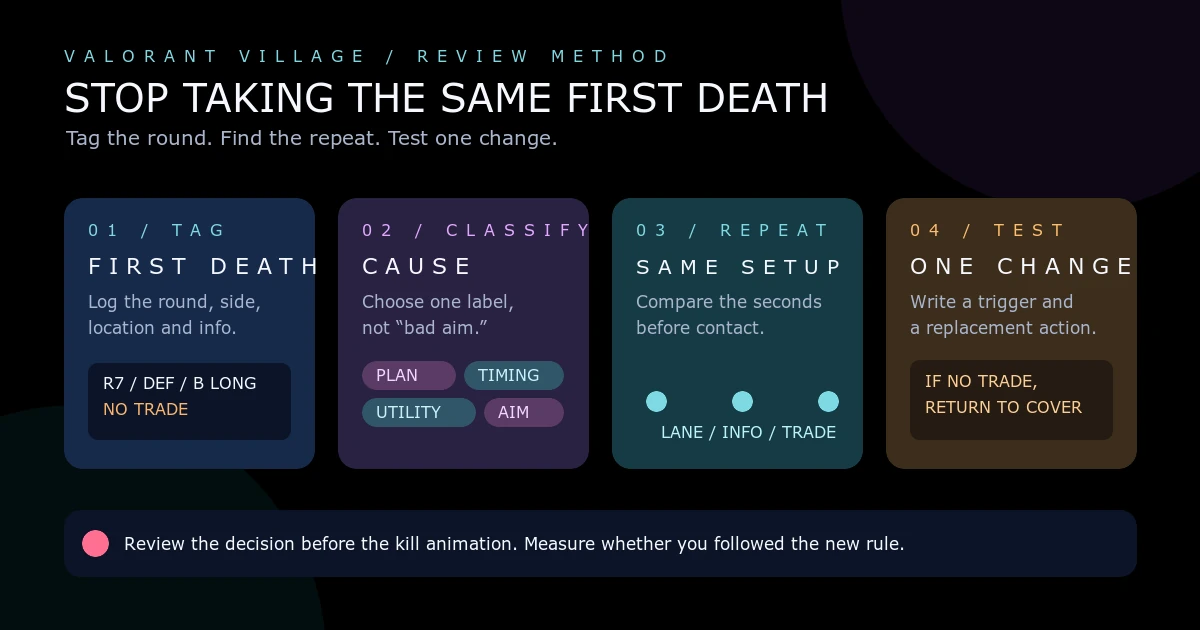
Keep the adjustment conditional. “After first contact, I leave unless a teammate can help” is testable. “I will never die first” is not, and it can turn useful space-taking into hiding. Stop Taking the Same First Death: A Round-by-Round VALORANT Review shows how to study a repeated first death without treating every first death as a mistake.
Next Monday, keep the question if it still repeats, raise the difficulty if the cue is stable, or retire it for the next largest problem. The week is complete when you can name one question, three observed attempts, and one adjustment. The rank result is context, not the experiment.