Stop Taking the Same First Death: A Round-by-Round VALORANT Review
Written by Valorant Village
Source-backed coverage ●
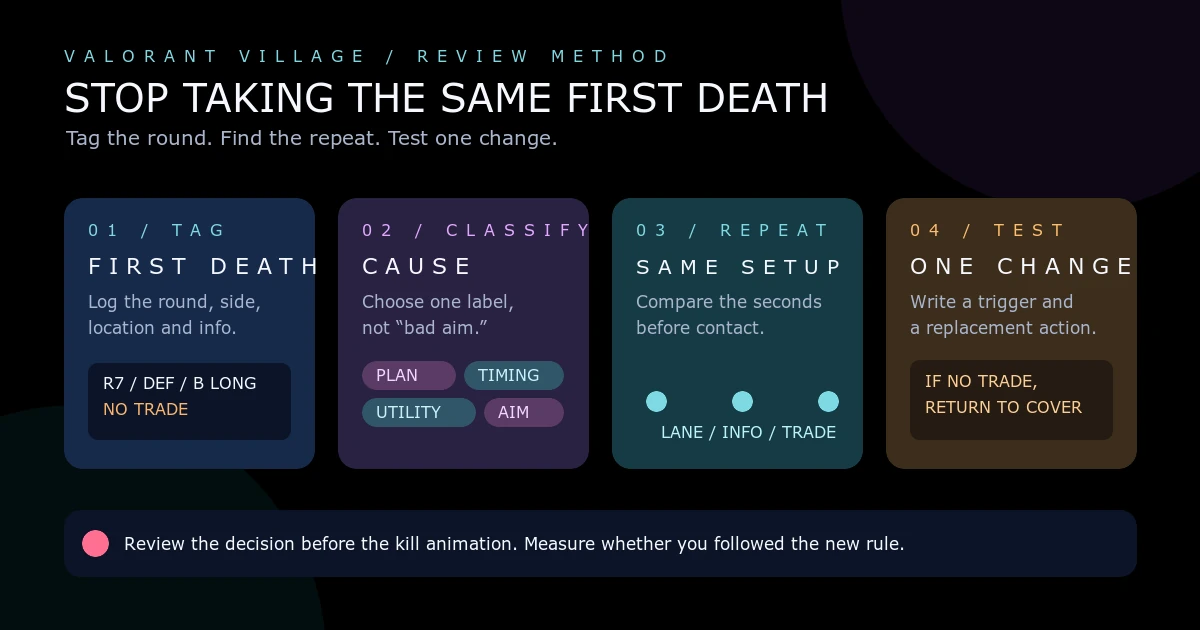
Taking first contact can be correct. Taking the same first death without changing anything is a review problem. The useful question is not “How do I never die first?” It is “What condition keeps making this death available?”
Source facts: what the replay can show
Source fact: Riot Support describes VALORANT as a five-versus-five tactical shooter where each player has one life per round, with abilities, strategy, a Spike objective and essential teamwork. That means losing the first player changes the team’s options for the rest of the round. The consequence is editorial analysis, not a promise that every first death loses the round. Welcome to VALORANT was published April 17, 2024.
Source fact: Riot’s “Replays: Everything You Need to Know”, published September 17, 2025, says Replays are meant to show a complete view of recent matches. The feature list includes all ten first-person perspectives, a third-person free camera, speed controls, round and time jumps, timeline icons for kills and deaths, minimap and HUD controls, and the combat report.
Editorial method: use those controls to inspect one question, not to prosecute every missed bullet. Start with your own perspective at normal speed. Then revisit only the rounds where your team lost first contact. The replay gives you information you did not have live, so enemy perspective explains the outcome but does not rewrite your decision-making at the time.
1. Tag the first death by round
Review one match and make a row for every round in which you were the first player on your team to die. Record the round, side, location, phase of the round, information you had, teammate distance, and what happened immediately before the fight. Add a value note: traded, space created, information gained, or nothing useful.
These are invented sample notes, not match data:
| Round | Sample note | First tag |
|---|---|---|
| R4 attack | A Main, 0:34. I swung before the flash; our second player was still clearing spawn. No trade. | timing / trade |
| R7 defense | B Long, 0:51. They saw my first shot, then I held the same edge again with no new information. | repeated angle |
| R10 attack | Site entry, 0:28. I went first, made the defender turn, and was traded while the team took site. | deliberate contact |
Keep the language observable. “No teammate could see me” is useful. “I have terrible instincts” is not. If a teammate died first, you can still note the round’s opening, but keep this exercise focused on your own first deaths.
2. Classify the cause before blaming aim
Editorial method: give each row one primary tag. Use these labels:
- Plan: you chose a fight that did not serve the round’s next goal, such as taking an isolated duel while the team was still setting up.
- Information: you ignored a sound, minimap cue, revealed angle or earlier contact, or entered without asking what the peek needed to answer.
- Timing or trade: you exposed yourself before a teammate could see the fight or after the useful contact had already ended.
- Utility: an ability could have helped the next goal, but you held it until after exposure or used it without a clear purpose.
- Mechanics: the decision was supported, but movement, crosshair placement or the shot itself failed.
- Reasonable risk: you intentionally made first contact, created space, forced attention or were traded. A zero on the scoreboard does not turn that into an automatic mistake.
Source fact: Riot’s Beginner’s Guide tells players to ask whether an ability helps achieve the next goal and to stop moving before shooting for better accuracy. Use those as checks inside the labels, not as a claim that every fight needs an ability. The same guide tells players to learn enemy routes, watch angles and communicate information with voice, pings or Agent voice lines.
3. Find the repeated conditions
For each tagged death, rewind to roughly eight seconds before contact. Compare the lane, round phase, teammate line, known enemy information, available utility, movement state and escape route. Ask one blunt question: what stayed the same?
Two similar deaths are a clue. Three are a repeat worth testing. That threshold is my editorial rule, not a Riot statistic. A pattern might be “first peek on defense, no teammate in line, re-peek after the first shot.” It might be “entry begins before the flash,” or “I hold the same angle after the enemy has seen it.” Those conditions are more actionable than “I lost the duel.”
If the replay reveals an unseen off-angle, do not pretend you should have known it was there. Record the information gap. Your next change might be a slower clear or a call for utility, but hindsight should not become blame.
4. Test one change
Pick the smallest replacement that matches the repeated condition, then test it for the next three to five first-contact situations:
- no trade: call the swing and wait until a teammate can see the fight;
- repeated angle: change the hold after contact or leave and re-clear it;
- late utility: use it before exposure only when it helps the next goal;
- mechanics: stop before firing and keep the same supported fight;
- no escape: take the contact from cover and set a retreat point first.
Do not change all five variables. If the repeated note is “B Long, no trade,” your test rule could be: “On defense, after my first shot, I return to cover and re-peek only when a teammate calls contact.” Success means you followed that rule. Whether the round was won is a separate result.
For a wider match-review routine, read How to Review One VALORANT VOD Without Getting Lost. If the repeated tag is trade distance, use How to Trade a Teammate in VALORANT. If it is the exposure itself, compare the decision behind a wide, jiggle, shoulder or late peek.