Bind Teleporters: Predictable Uses and Punishable Habits
Written by Valorant Village
Source-backed coverage ●
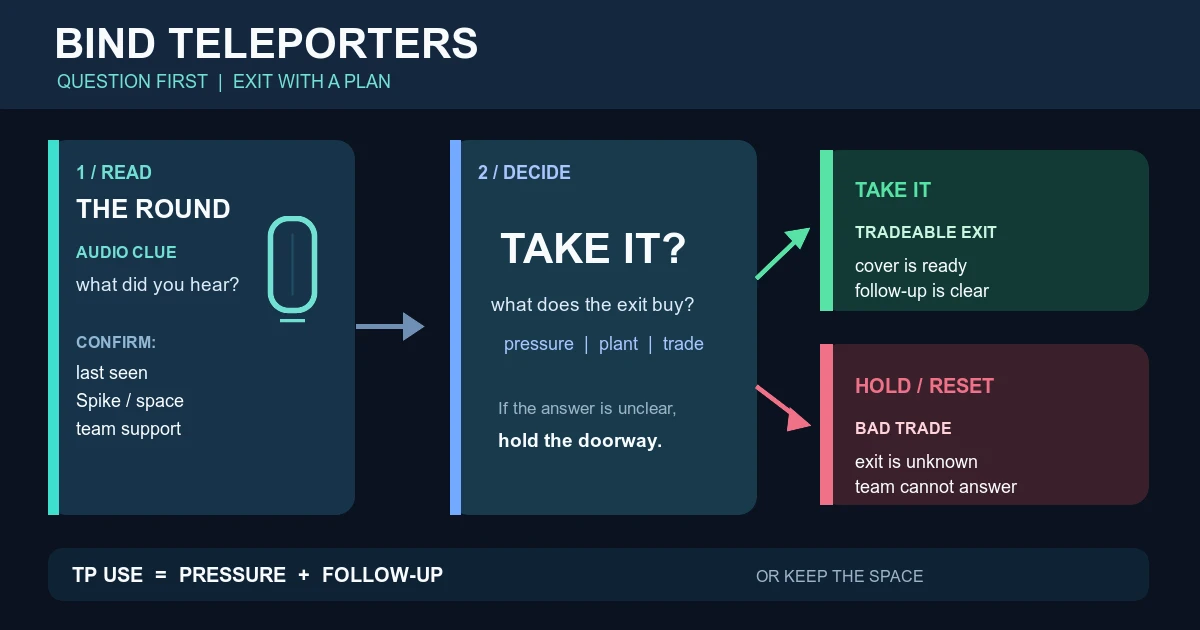
A Bind teleporter is most useful when it makes the other team solve two possible problems. It is least useful when it becomes your team’s automatic first move. Riot’s current Maps page describes Bind as two sites with no middle, direct paths for attackers, and a pair of one-way teleporters that make flanking easier. That is the map fact. The rest of this guide is Valorant Village strategy interpretation: use the teleporters to change the opponent’s read, not to replace a plan.
What the teleporter tells the enemy
Riot’s current Beginner’s Guide asks players whether they want enemies to hear them run or walk, whether an ability helps the next goal, and tells them to learn where enemies can come from. A teleporter belongs inside those decisions.
Riot’s Patch Notes 7.02 refer to a “teleport audio sound” while fixing a Bind B-side issue involving a controlled ability such as Sova’s Owl Drone. That confirms the official notes treat the teleporter event as audio-relevant. They do not publish a universal audible range, volume, or exact timing in that note, so this guide will not invent one. Treat a sound as a clue, then check it against the minimap, last positions, Spike, and the round plan. A teleporter sound is not automatically a player count.
Patch Notes 6.07 also moved the exit room for the B Long to A Lobby teleporter outside A Bath. The official change is old, but it is a useful reminder that the exit location matters. Do not think only “I crossed the map.” Ask what space your team owns when you arrive.
Make the teleport answer a question
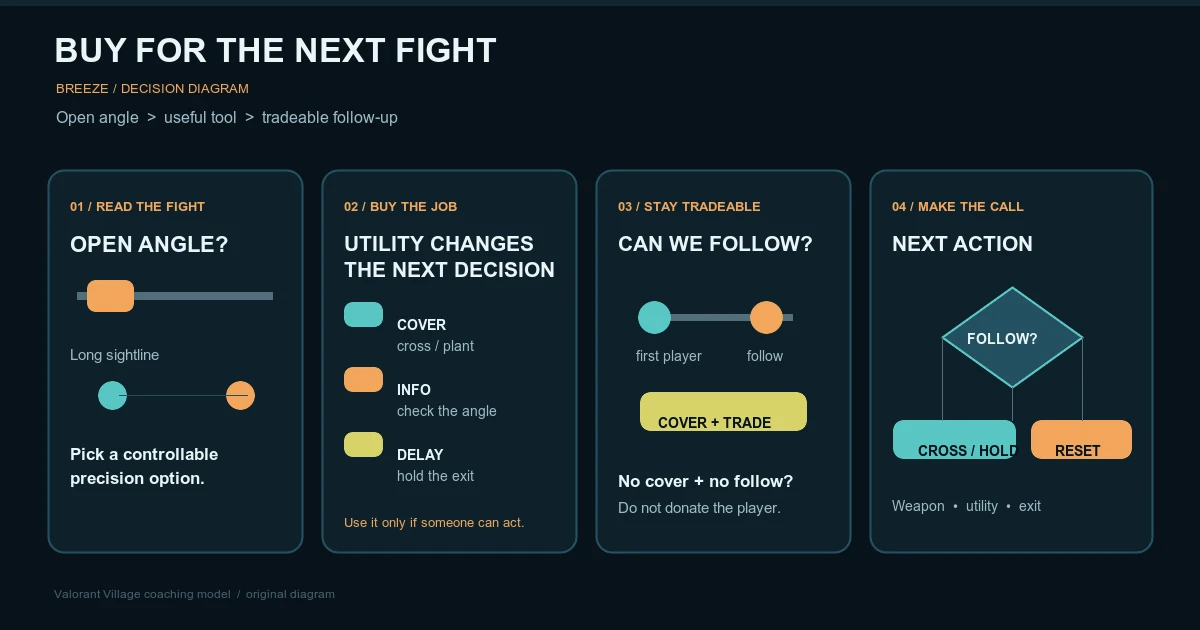
Riot describes the tactical cycle as Intel -> Plan -> Execute -> Repeat in How we balance VALORANT. Its execution notes call out timing, coordination, abilities, and shooting. Use that as an editorial lens for Bind. Before taking a teleporter, answer four questions:
- What do we actually know? Separate a confirmed enemy position from a guess based on one sound. Note the Spike, the last seen player, and the space your team can still hold.
- What pressure does the move create? A useful teleport gives the opponents a second credible problem. If everyone knows your team has abandoned the first lane, it may only announce the rotation.
- Who covers the exit? A teammate, smoke, flash, or already-confirmed enemy location can change the risk. None of those is a guarantee that the landing spot is safe.
- What happens next? Name the plant, trade, flank pressure, hold, or regroup that follows. If the answer is “we will see,” keep the entrance and gather more information.
Predictable habits opponents punish
The ritual first teleport
Taking the same teleporter at the same early-round moment teaches the defense your opening shape. They do not need an exact frame count. A repeated route is enough for them to hold the exit, keep a player home, or stop respecting your pressure elsewhere.
The editorial fix is to vary the trigger, not to force a random delay. Hold the entrance while a teammate makes contact, take it after a confirmed push, or leave the route unused while your team keeps the first lane credible. A changed timing only matters if it changes what the opponent has to answer.
The sound becomes the call
Hearing the teleporter and immediately rotating can be as predictable as using it. Patch 7.02’s controlled-ability example is a useful warning: a teleporter audio event does not by itself prove that a player has arrived. Call what you heard, identify what is confirmed, and make the next move from the full picture. Our VALORANT sound-cues practice list uses the same rule: sound gives you a clue, not a complete round state.
This is also where a fake rotation can work. Show enough pressure at one side to make the defense consider moving, but keep a real second threat on the other side. That could be the Spike group holding its route while one player threatens the teleporter, or a pair delaying a rotate until contact. A lone player who disappears through the portal with no follow-up is not creating a fake. They are creating an isolated fight.
The exit before the team
The most punishable teleport is the one that turns a supported position into a solo arrival. If the exit is watched, your teammates cannot see the fight, and the Spike or next action is still behind, the move has traded known control for uncertain contact.
This is a bad trade when you cannot answer three simple questions: who fights with me, what do we do if nobody is there, and where does the Spike go? The teleporter can still be the right choice after you have forced attention away, confirmed the exit is playable, or arranged a clear swing. Without that preparation, holding the doorway is often more valuable than arriving first.
For the spacing and timing part of that decision, use our guide to how to trade a teammate. The teleporter does not remove the trade requirement. It only changes where the fight happens.
Practise the decision, not a script
In a custom Bind game, repeat one teleporter five times with a different question each round: gather information, support a confirmed contact, create pressure for a fake rotation, hold the route, then regroup. Before each attempt, say the exit plan out loud. After it, record what the opponent could know, whether a teammate could answer the first fight, and whether the Spike had a clear next job.
Do not count frames or memorise an invented audio range. Test the route on your own current setup and compare the decision, not the clip. A call such as “one through B TP, Spike stays B, hold A pressure” is more useful than “TP now.” For more examples of turning information into an action, see How to Make Useful Comms in VALORANT.
Riot’s map, gameplay, audio, and patch facts are linked above. The pressure model, fake-rotation examples, timing tests, and bad-trade checklist are Valorant Village editorial interpretation.