Breeze Space and Long Sightlines: Weapon and Utility Choices
Written by Valorant Village
Source-backed coverage ●
Breeze punishes a buy made on autopilot. Riot’s current Maps page describes the map as having wide open spaces and long-range engagements, then gives two blunt reminders: bring cover and watch your flanks. A close-range weapon has to create its own close fight. Utility should change the next angle, cross, or plant.
This guide separates Riot facts from Valorant Village coaching. There is no official Breeze loadout chart or guaranteed weapon choice, so pick for the next job.
What Riot documents
Riot’s Beginner’s Guide, dated August 3, 2024, says VALORANT has a gun for every situation. It tells players to consider weapon type, credits, expertise, and team strategy, and to experiment when the preferred weapon is unaffordable. The guide also says a Controller smoke can make getting onto a site easier by blocking sightlines, asks whether an ability helps the next goal, advises stopping before shooting, and points to voice, pings, or Agent voice lines for communication.
The choices below are our interpretation. Riot’s August 30, 2023 Patch 7.04 gives dated context: it calls Breeze’s scale and size core to its design, says the changes simplified rotation threats, and records adjustments to Mid, B Site, A Hall, and A Cave. Treat that as patch history, not proof that every current detail is unchanged.
Choose the weapon for the first honest fight
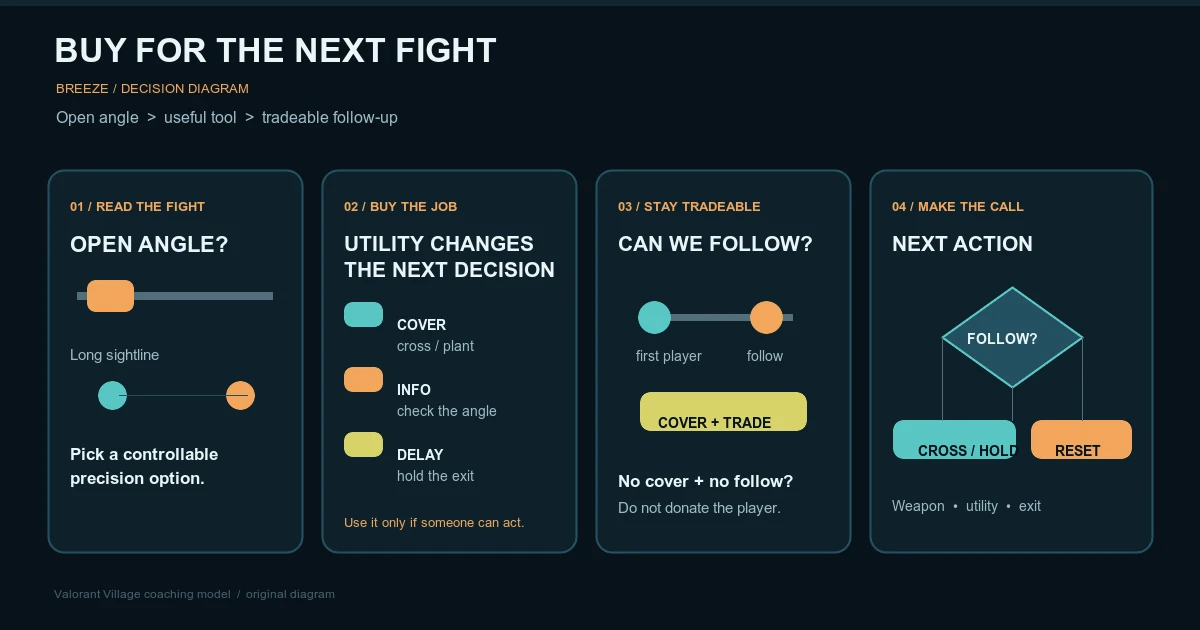
Start with the distance your plan expects. If the first contact is an open angle, my default is a controllable rifle or another precision option you already know how to stop and fire with. That is coaching, not a Riot tier list. Do not buy a long-range weapon just because the map is open. If your team has no cover for the cross and no player close enough to trade, the weapon is decoration.
A close-range weapon makes more sense when the plan creates a close fight: behind cover, around a tight entrance, or in an anti-push hold. It becomes a bad bargain when you carry it into an exposed lane and ask it to solve a distance problem. A cheaper weapon can still be correct if the team is deliberately setting a trap or holding a protected space. It is not automatically correct because it saves credits.
When credits are awkward, keep whatever lets the next player act. A controllable weapon plus crossing utility may be more useful than a stronger gun with no cover. Riot ties buying to credits and team strategy, so say it before shopping: “long fight,” “cover the cross,” or “close hold.”
Spend utility on the next decision
Cover is the obvious first question. Use a smoke or wall to remove the sightline you actually need to cross, plant behind, or hold after contact. A smoke thrown somewhere dramatic but irrelevant has not created space. Say what happens after it lands: cross, plant, fight, or fall back. If nobody can use the blocked lane, save the ability or change the route.
Information utility asks whether a long angle is occupied, a flank is active, or the team can take one more step without guessing. Do not spend every recon tool on a lane nobody plans to use. The answer should change a call, or it is noise.
Delay and displacement matter when the enemy must move through them. A slow, damaging zone, forced movement effect, or other denial tool helps only if a teammate can act on the change. Riot’s guide asks whether an ability helps the next goal. Name that goal before the throw: take first contact, escort the Spike, plant, or hold the exit.
Once cover or a teammate makes a lane safer, treat the gained room as a decision, not a victory lap. The guide to playing for space is useful here because the point of space is the option it gives your team. On Breeze, that option may be a safer cross, a regroup, or pressure that pulls attention away from the Spike.
Use the map’s width without donating a player
Start with three questions: which open angle are we testing, who owns the flank, and who follows the first player? If nobody follows, the first peek is information only, not an invitation to duel.
If there is no contact, do not let the team drift farther apart. A slow spread is useful when it keeps choices open and gives you a clear next check. It becomes wasted space when nobody knows what fact would trigger the commit. The defaulting guide gives a broader version of that handoff.
If a teammate dies on the long angle, do not repeat the fight with a better gun by reflex. Ask whether the problem was cover, information, or trade support. Reset, change the angle, or spend utility that lets two players challenge it.
Riot’s map description tells players to watch flanks, so assign a player, sound check, or information tool to that job. Do not call the back route clear because you heard nothing. Sound is a clue, not a full map read. The VALORANT sound-cue practice list separates what you heard from what you guessed.
A short practice drill
In a custom game, test an open cross with cover, a long hold with your precision weapon, and a protected close hold. Before each, say the weapon job, utility job, and teammate who follows. Record what changed and whether the team had an exit.
Change one variable at a time. The useful result is a rule such as: “If we cannot trade the open angle, we smoke it or give it up.”
Sources checked
- VALORANT Maps | Riot Games, accessed 2026-08-14 UTC. Breeze: cover, wide-open spaces, long-range engagements, and flanks.
- Beginner’s Guide | Riot Games, published 2024-08-03, accessed 2026-08-14 UTC. Weapon type, credits, team strategy, next-goal utility, movement, and communication.
- VALORANT Patch Notes 7.04 | Riot Games, published 2023-08-30, accessed 2026-08-14 UTC. Historical Breeze design goals and map adjustments.