Fracture Ropes and Pivots: A Beginner's Round Plan
Written by Valorant Village
Source-backed coverage ●
Fracture can make every sound feel urgent. A rope cue arrives, a teammate calls a pivot, and suddenly three players are moving without anyone saying what the movement is meant to solve. The map rewards a plan for information and trade support. It does not reward rotating on a single noise.
What Riot documents
Riot's current VALORANT Maps page describes Fracture as a top-secret research facility split apart by a failed radianite experiment. Riot also says defender options are divided across the map. Those are the official map facts. The rope checklist, pivot conditions, and reset advice below are Valorant Village coaching interpretation.
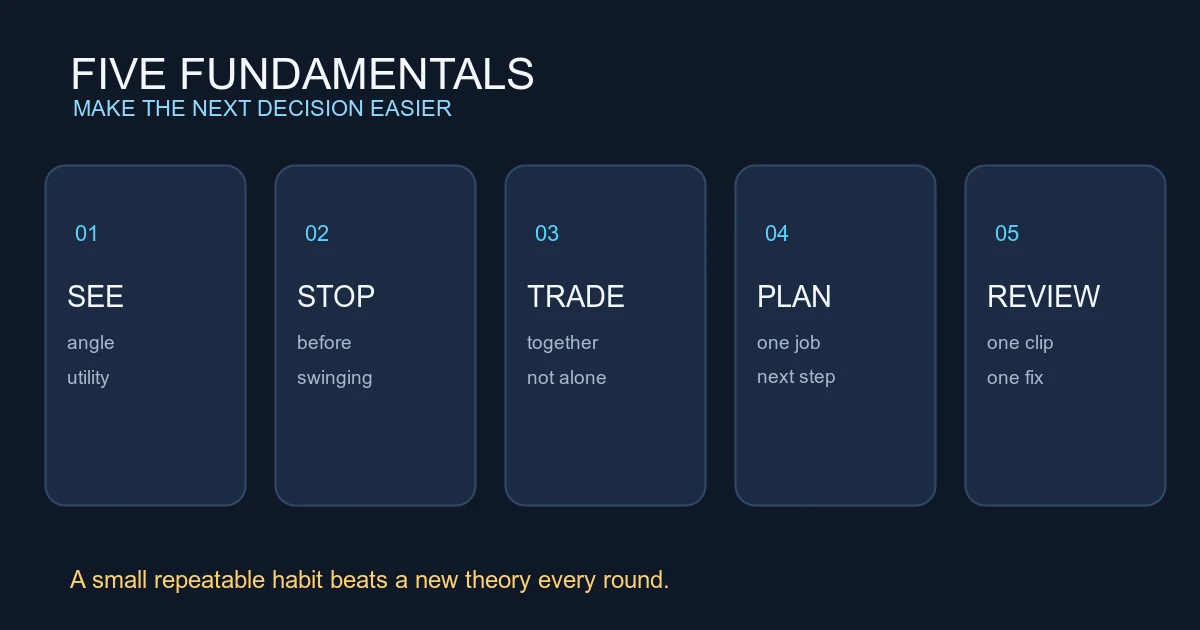
Riot's Beginner's Guide recommends learning where enemies can come from, watching angles and corners, deciding whether to run or walk, asking whether an ability helps the next goal, and communicating through voice or pings. Use those as the round frame instead of treating a rope as a guaranteed enemy location.
Read the cue in four parts
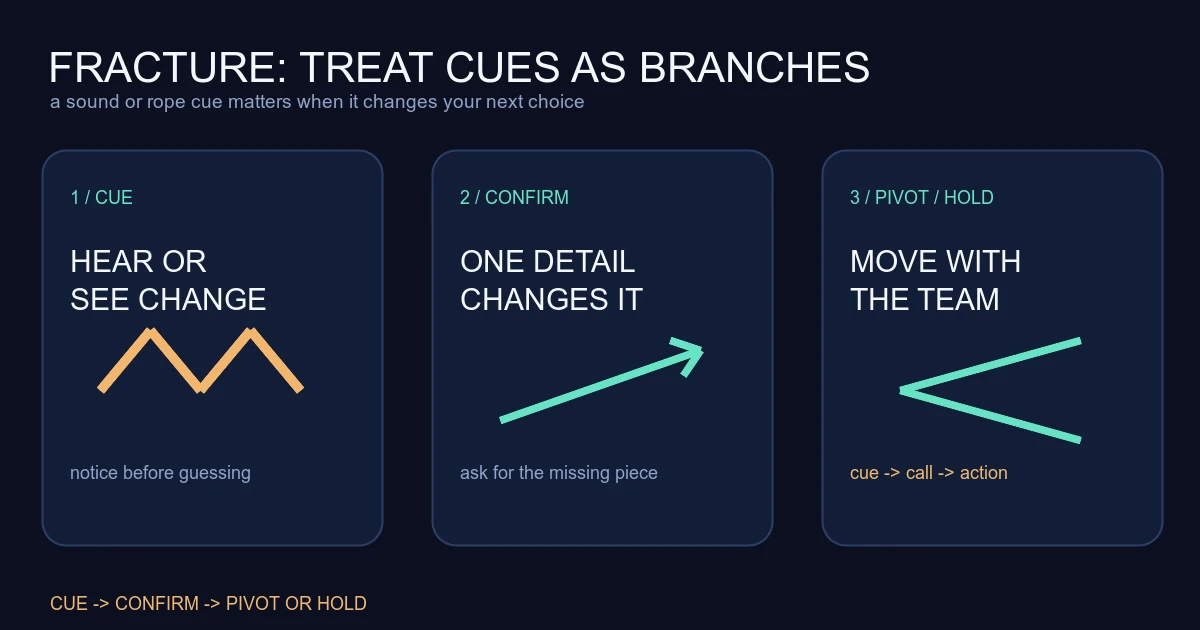
When you hear or see movement around a rope, ask four questions:
- What is confirmed? You may know that a movement cue happened, not who made it.
- Which lane does it affect? Point to the route or angle that now deserves attention.
- Who can answer? Name the player who can hold, trade, or gather the next fact.
- What action changes? Hold, rotate, take space, or keep the original plan.
The sound-cue practice list is useful for learning the first distinction. A sound is a clue. It becomes a call when the team knows what it can do with the clue.
Do not say “they are rotating” when all you have is one sound. Say “movement heard on the rope route, site count unknown, I am holding this angle.” That call keeps the team from giving up a site or walking into a second fight based on a guess.
Attack: pivot with a job
On attack, a pivot should preserve an option. You might have learned that the first site is heavily contested, pulled a defender away, or opened a route for the Spike. Decide which fact justifies the change before the Spike carrier moves.
Give the new route a contact player and a trader. A rope route can create a fast arrival without creating a safe arrival. If the first player reaches the next angle alone, the pivot has converted information into a donation. The trade guide explains the test: can the second player see the shooter and fight immediately?
If the answer is no, hold the pressure or wait for utility that changes the line. Do not ask the first player to prove that the pivot was correct by taking a second solo fight. A slower move with a trade can be stronger than a fast move that arrives as one player.
Defense: do not abandon the useful lane
Defenders often overreact to the first rope cue. A divided map can produce threats on more than one route, but an unconfirmed sound does not tell you to give the site away. Keep one player on the original job while another gathers the next fact, unless the available evidence truly requires a full rotation.
Use an action call with a condition: “I heard the rope, I hold until contact,” or “one confirmed crossing, rotate one and keep the close lane.” This makes the pivot reversible. If the next fact contradicts the first read, the team can return without arguing about who called it.
The defaulting guide explains the value of preserving choices. A Fracture pivot is good when it keeps a better response alive. A pivot that leaves every important lane empty is only movement.
Practise the pivot without a script
In a custom game, walk one rope route from each side. Stop at the arrival point and name the first angle, the teammate who answers it, and the route back. Repeat with a sound cue from a teammate. Your goal is not to record an exact audio range or a perfect rotation time. Your goal is to practise asking what the cue changes.
After three live rounds, write down the cue, the fact you confirmed, the action you took, and the lane you left. If the same mistake appears, shorten the call. “Rope heard, hold close” is easier to follow than a speech about every possible rotation.
That review also tells you whether the problem was recognition or discipline. If the cue was real but the team still moved too far, practise the hold condition. If the cue was misread, practise naming what was confirmed before choosing a lane. Those are different errors, and they need different repetitions.
Sources checked
- Riot Games VALORANT Maps, checked in a live browser 2026-08-15 UTC. Used for Fracture's current split-facility description and divided defender options.
- Riot Games Beginner's Guide, published 2024-08-02, checked 2026-08-15 UTC. Used for map learning, angle checks, movement choices, next-goal utility, and communication.
The four-part cue check, pivot conditions, trade test, and practice drill are Valorant Village coaching interpretation, not Riot rules or exact audio guidance.