Haven’s Three-Site Decisions: How to Stop Rotating on Autopilot
Written by Valorant Village
Source-backed coverage ●
Haven feels like three emergencies when defenders lack a shared information plan. One sound pulls someone from A, contact appears at B, and C is left unattended. The issue is not movement. It is movement without a shared question.
Riot’s current VALORANT Maps page describes Haven as a monastery where rival Agents fight to control three sites. It also says defenders can use the extra territory for aggressive pushes. Those are the map facts. Riot does not publish a Haven default or universal rotation trigger there. The framework below is Valorant Village coaching: make the next decision visible and proportionate.
Start with three questions, not three emergencies
Riot’s How we balance VALORANT describes a cycle of Intel, Plan, Execute and Repeat. Its Intel questions include opponent location, owned territory, abilities, weapons and previous actions.
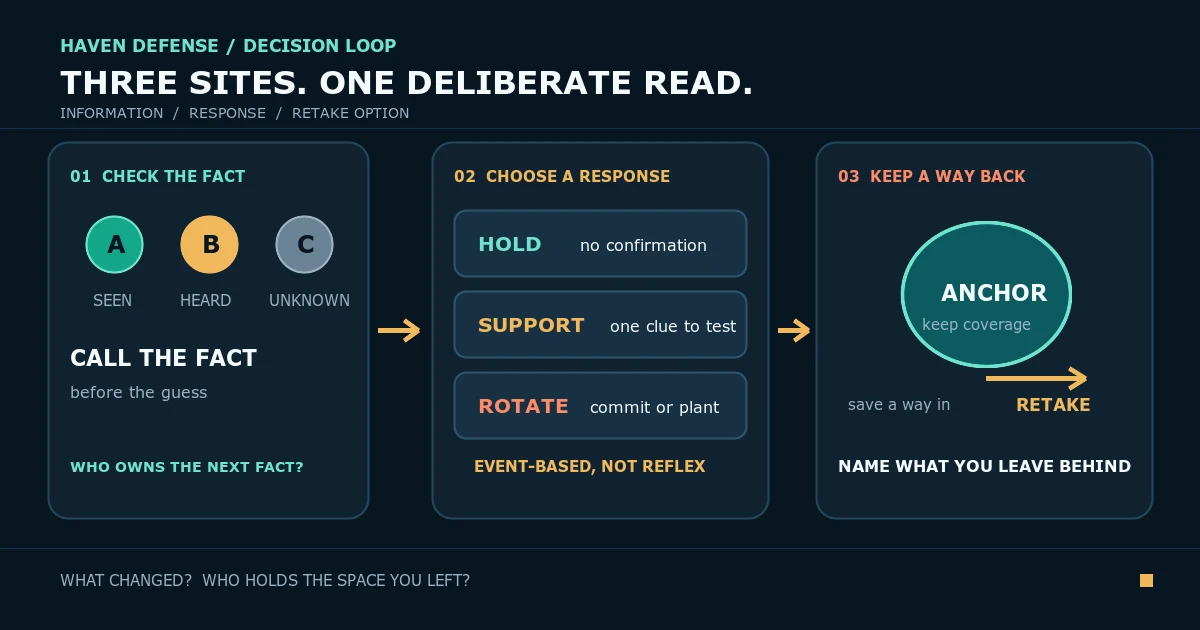
On Haven, turn that into three short questions: what do we know about A, B and C? Each defender should have a first job, even if it is only listening for contact. One may watch for a fight, another may hold a different site, and another may support. That is editorial structure, not a Riot-required setup. Everyone should know who owns the next fact.
Label the evidence as you call it. “Saw one A” is different from “heard one near A.” “Teammate saw two B” is different from “they are all B.” Add “unknown” when a player is unaccounted for. A missing fact is not permission for a confident guess.
Use a response ladder for A/B/C rotations
Do not let one clue create a full-team rotation. Use a simple ladder:
- No confirmed contact: Keep the initial responsibilities. Quiet does not prove that a site is empty or that an attack is coming elsewhere.
- One clue: Call it and ask for confirmation. A small reinforcement, cautious check or saved utility can test the idea while anchors protect the other sites.
- Confirmed commitment: When several attackers are confirmed at one site, or the Spike makes it the active problem, say what changes. “Support B, C stays held” is a decision. “Rotate” is only a direction.
- Plant: The objective changes from equal coverage to a defuse. Riot’s Beginner’s Guide says defenders defuse after the Spike is planted and that eliminating enemies makes the job easier. It does not say to chase every kill. Group the retake around the information and resources you have.
The call should name the destination and the coverage left behind. That stops five players moving toward one sound while an unconfirmed site disappears.
Treat noise as a clue, not a verdict
Riot’s Beginner’s Guide asks whether players want enemies to hear them run up or walk. Sound is part of a round decision, but the page gives no universal range, player count or exact rotation timing.
Use a sound call with three parts: cue, location and confidence. “Heard movement near A, no visual, holding for confirmation” tells teammates what you know and what you are doing. “They are all A” turns one cue into a conclusion. Check the minimap, teammate reports, visible utility and the Spike before a bigger move.
Your own movement creates the same problem. A silent rotate can be useful, but it can leave teammates believing the old coverage still exists. If the move supports a site, denies a plant or starts a retake, say so. Hearing the move is a cost to weigh, not a reason to panic. For an audio drill, use VALORANT Sound Cues: A Practice List for New Players.
Anchor until the job changes
An anchor is not a player glued to a site. Here, it means a defender close enough to contest useful information while preserving a fallback and a way for teammates to help. The anchor’s value is keeping one more decision available.
Make anchor timing event-based rather than a stopwatch. Before contact, hold enough to learn whether the site is tested. After a fight, decide whether staying buys another fact or only offers a second free duel. After a confirmed commitment, leave only when the call accounts for the coverage you give up. After a plant, decide whether your position helps a coordinated retake or strands you in a solo fight.
The moving player should say why they are leaving and who owns the space behind them. “One heard A, no visual, I am holding” is a hold call. “C confirmed, I am supporting, B stays covered” is a rotation call. These are examples, not scripts. If nobody can state the change, hold for one more piece of information. Riot’s Beginner’s Guide recommends voice, pings or Agent voice lines for sharing enemy locations; How to Make Useful Comms in VALORANT shows a compact call format.
Preserve the retake before you need it
A retake option is more than being alive. It needs a player who can arrive, a useful resource or timing, and enough information to choose the first fight. Protect those things while the round is uncertain.
First, do not abandon the last unconfirmed site without naming who covers it or what event pulls them back. Second, do not spend every defensive resource on first pressure if the round may become a post-plant. An ability is valuable when it helps the next goal, the question Riot puts to players in the Beginner’s Guide. Third, announce the retake before everyone peeks. Grouping turns Intel and Plan into a coordinated Execute; solo re-peeks turn them into separate guesses.
If the team is already down a player, be stricter. Read How to Play a Man-Disadvantage Round in VALORANT for the broader rule: protect the next life unless a fight has a clear reason and an answer. On Haven, giving up an aggressive push to keep a retake timing may be better than hunting one extra sound.
After five Haven rounds, write down four things: the first confirmed fact, the rotation call, the anchor’s job and the resource saved for the next fight. If a round has no clear answer, the fix is not faster movement. Before you move, say what changed and who holds the site you left. If neither answer exists, gather the next fact, then rotate.