Lotus Doors, Rotates and the Cost of Making Noise
Written by Valorant Village
Source-backed coverage ●
Lotus makes movement a visible choice. Riot’s current VALORANT Maps page describes great stone doors that create movement opportunities and unlock three sites. The useful question is what the new route lets your team do before the opponents answer it.
Riot’s Lotus design article describes a three-site map with corridors connecting the sites, two rotating doors near A and C, and a breakable door that opens an A/B connector. The rotating doors can be activated from either side by attackers or defenders. Riot also describes their audio and minimap cues as part of the map’s mind games. Those are documented features. The recommendations below are Valorant Village coaching, not a fixed Lotus meta.
Riot’s Beginner’s Guide asks whether enemies should hear a run or walk, recommends learning map angles, checking the next goal for utility, and communicating with voice, pings, or Agent voice lines. Riot’s tac-cycle explanation frames a round as Intel, Plan, Execute, Repeat. Use that frame to decide what the door buys.
Coaching: Give the door a job
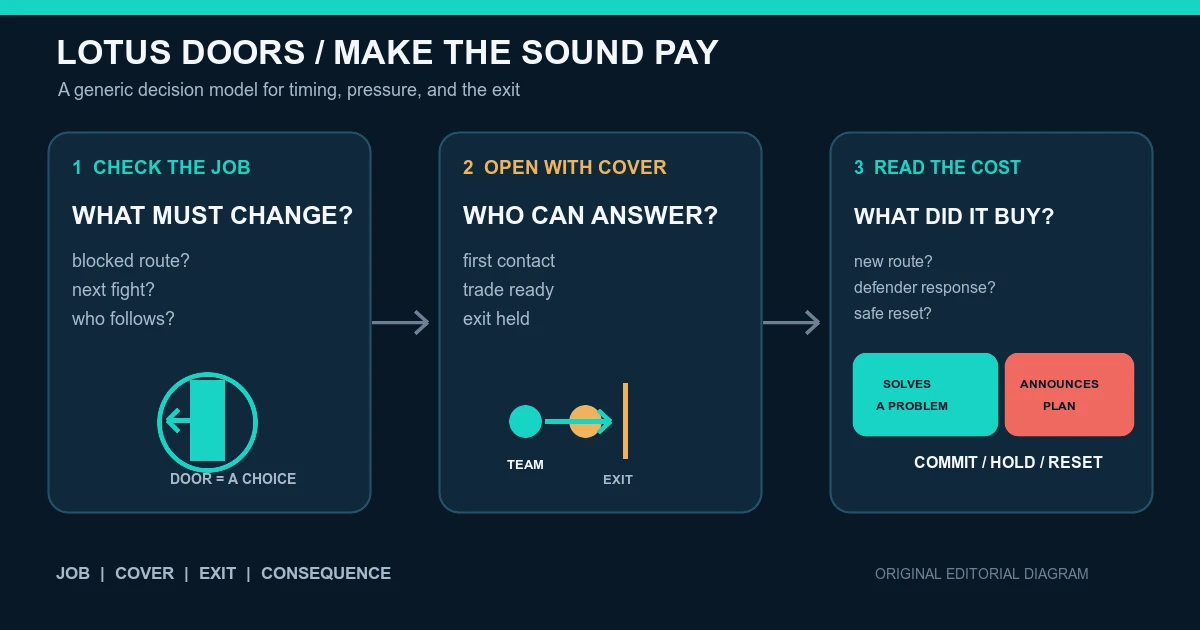
Before activating a door, finish this sentence: “We are opening it so we can…” The answer might be to give the Spike a supportable route, change the next contact, create a way out, or make the defense respect a second direction. If the answer is only “because we can,” the sound announces movement without creating a decision.
Door timing should be event-based, not a memorised stopwatch. Open when a teammate can support the first exposure, the route changes the next fight, or pressure elsewhere gives the activation a purpose. Hold when nobody can follow, the Spike cannot use the route, or the exit is uncovered. Riot documents the door’s movement and cues, but not one timing for every round.
On attack, name the first player, the answer to that contact, and the destination before the door moves. On defense, name what the activation checks and who keeps the original space covered. A route is useful only if its beneficiary is ready.
Coaching: Treat rotate noise as a cost, not a verdict
Rotate noise is information opponents may use, not automatic failure. Riot’s run-or-walk prompt reminds players to weigh movement noise against the job. The Lotus article says audio and minimap cues support mind games. Neither source gives a hearing range, volume, or player count, so do not turn a cue into “they heard everything” or “the site is empty.”
Call the cue and action separately: “Door active near C, no visual, I am holding the old exit.” This keeps sound from becoming a story. The VALORANT Sound Cues: A Practice List for New Players has the broader habit: describe what you heard, then check what you can confirm.
Noise becomes pressure when the team makes two possibilities credible. If everyone funnels through the door, it advertises the route. If another lane stays playable while one group uses the opening, the activation may force a defensive choice. That is a test, not a guaranteed reaction.
Coaching: Use pressure to change the call
After the door moves, ask what changed. Did the defense reveal a player, spend utility, give up an angle, or leave the original route less protected? If nothing changed, gather another fact instead of activating again for the feeling of pressure.
Use three coaching outcomes:
- Commit: The route has a supportable first fight, the Spike can move, and the exit is covered. Stop collecting information and make the site action clear.
- Hold: The activation drew a response, but entry is not ready. Keep the threat credible while a teammate checks the next fact. Do not send isolated players through because the door is open.
- Reset: The route is unsupported, contact is isolated, or information is thin. Fall back together and make the next attempt answer a different question.
This applies Riot’s Intel, Plan, Execute, Repeat lens as Valorant Village coaching, not as a Lotus rule. The Defaulting Explained: When a Slow VALORANT Round Creates More Options covers the same principle: keep options alive until information earns a commitment.
Coaching: Cover the exit before opening
Exit coverage is decided before the door moves. On attack, name the first contact, trader, Spike carrier, and fallback. The trader does not need to stand inside the first player, but must be ready to answer the fight. Use How to Trade a Teammate in VALORANT for the spacing test behind that call.
On defense, a door can help a contest, retake route, or movement check. It does not excuse abandoning the space behind the mover. Say who owns the old angle and whether the next fight is a contest or a wait. If nobody can name that coverage, the rotation creates an empty answer.
When opening solves a problem versus announces a plan
Opening solves a problem when:
- the current route is blocked or unsafe and the new route changes who can support the fight;
- a teammate is ready to trade or cover the exit;
- the Spike, utility, and destination share one clear call;
- the activation creates a second choice the team can actually use.
Opening announces a plan when:
- the team activates before choosing a destination;
- the player who needs the route is too far away to help;
- one sound cue causes a full rotate without confirmation;
- the old exit is uncovered and the new route has no trade.
Practise this in a custom game from both sides of one rotating door. Activate it alone and note the cue and route change. Repeat with a teammate holding the first exposure, then with a third player watching the exit you give up. Make the job-plus-action call before moving. Record the intended job, support, information gained, and whether the opening solved a problem or announced the plan.
Before pressing the door, check four words: job, cover, exit, consequence. If one is missing, keep the route quiet and collect the next fact.