Jett Guide: Dash Discipline, Space, and Blade Storm
Written by Valorant Village
Source-backed coverage ●
Jett is easy to play badly in a way that still looks exciting. You dash, take a fight, and sometimes the round opens up. Other times the dash only moves you into a different bad fight. The difference is usually decided before the ability is pressed.
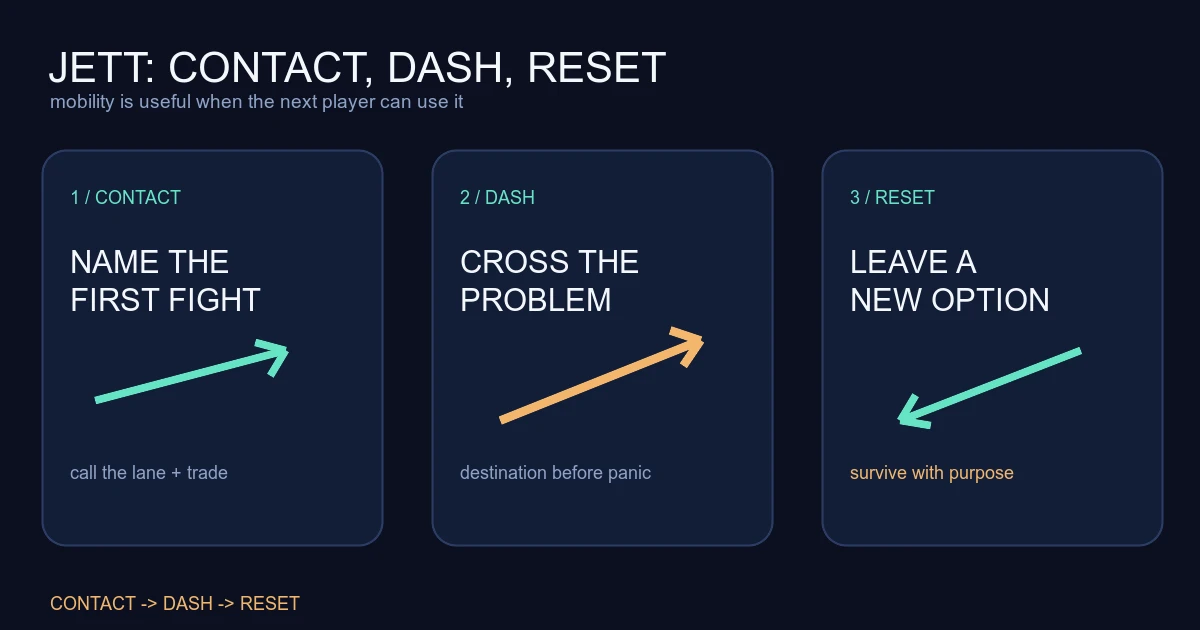
The useful Jett question is not “can I get out?” It is “what does getting out allow my team to do?” A Dash that saves you while your teammates are still trapped has limited value. A Dash that crosses a dangerous lane, creates a trade window, or lets you keep a planted Spike alive can change the round.
What Riot actually documents
Riot lists Jett as a Duelist and describes her as an Agent built around agile, evasive fighting. Its current Jett page documents Updraft and Tailwind. Tailwind can be reused to propel Jett in the direction she is moving, and its charge resets every two kills. Those are the ability facts. The route planning and decision rules below are Valorant Village coaching interpretation.
That distinction matters because a mobility ability can feel like a second life. It is not. It changes your position, but it does not remove every angle, clear a corner, or guarantee that a teammate can follow.
Choose the job before you choose the fight
Before the round starts, name one job for Dash. Keep it simple:
- cross the first dangerous lane and arrive where a teammate can trade;
- escape after taking first contact while keeping the Spike or a key rifle alive;
- change the angle after utility has forced a defender to look elsewhere;
- hold a defensive off-angle and leave when the first piece of information arrives.
If you cannot name the job, save the ability for a later decision. “I will dash when I see someone” is not a plan. It makes the enemy's first bullet decide where you go.
Your destination also needs a sentence. Say “dash behind the box,” “dash past the choke,” or “dash back to the player holding the trade.” The exact landmark depends on the map, but the habit is universal. A destination gives the movement a purpose and gives teammates a chance to understand what happens after you leave.
This is the same principle as playing for space. Space is not the distance you travelled. It is the useful option your movement leaves for the next player.
Attack: make first contact playable
Jett's strongest attacking rounds usually have a second player close enough to exploit the first contact. Tell that player what you are doing before the barrier drops: “I will show first, dash through if they fight, follow on my contact.” That is more useful than promising an entry without describing the follow-up.
When you meet the defender, look for the first change in the fight. A flashed angle, a smoke edge, a defender forced off cover, or a teammate's contact can be the signal. Dash through the change if the destination gives the team a new angle. Do not dash simply because the opponent saw you.
If you take damage and retreat to the same exposed lane, the ability did not solve the problem. If you take the fight, create a safe exit, and leave the defender unable to hold the original angle, you have bought something even without a kill.
The trade still has to exist. The teammate trade guide explains the core test: can the second player see the shooter and fight immediately? If not, your dash may be creating separation instead of creating an entry. Sometimes the right call is to hold the first contact and let the teammate close the distance before you commit.
Defense: first contact is information, not a contract
On defense, Jett can hold an aggressive angle because the escape is available. That does not mean every early peek deserves a fight. Decide what information the angle is meant to collect and where you will go if the attackers use utility.
If you see one attacker and hear the rest behind them, a dash back to a teammate can preserve the site. If you see no one but lose the angle to a smoke, keep the ability rather than sprinting into a new line. A quiet round can be a successful defensive round when the enemy spent time and utility without forcing you to give up a life.
The most common mistake is using Dash after the fight has already become unwinnable. By then the player is moving late, the destination is predictable, and the enemy is holding the exit. Move on the first useful signal, not after three bullets have made the decision for you.
Blade Storm still needs a round plan
Blade Storm can tempt Jett into a string of solo fights because the weapon feels flexible. Treat it like a normal rifle round with one extra resource. Decide whether the ultimate is helping the first contact, saving credits for the next buy, or giving the team a strong close-range conversion after utility lands.
Do not turn a good first kill into a bad second duel just because the ultimate is active. Ask where the next opponent must stand, whether a teammate can trade you, and what happens if the fight is missed. The best Blade Storm round may be one kill followed by a safe rifle pickup and a planted Spike.
A ten-minute Jett practice loop
In a custom game, walk the first-contact route without enemies. Mark the place where you will start, the place where you will dash, and the place where the teammate should arrive. Repeat it from defense with one exit route.
Then play three short rounds with one rule: call the Dash job before using it. After each round, write down four things: the trigger you saw, the destination you chose, whether a teammate could trade, and whether the new position gave the team another option.
If you died while moving, read the gunfight-after-utility guide and check whether you were still trying to solve a movement problem with aim. Jett's movement is strongest when it simplifies the next fight. It cannot rescue a plan that never named the next fight.
Sources checked
- Riot Games Jett, checked in a live browser 2026-08-15 UTC. Used for Jett's Duelist role, Updraft, Tailwind's directional reuse, and the documented two-kill reset.
The Dash jobs, destination rule, trade test, defensive conditions, Blade Storm advice and practice loop are Valorant Village coaching interpretation, not Riot rules or guaranteed outcomes.