Yoru Guide: Gatecrash, Fakeout, and Honest Timing
Written by Valorant Village
Source-backed coverage ●
Yoru can make a round look solved before anyone has actually checked the result. A Fakeout draws attention, a Gatecrash threatens a route, and the team starts rotating because the play felt convincing. The danger is not that the deception failed. It is that your team treated the enemy's reaction as a fact without checking what changed.
Good Yoru rounds create a choice for the defender and keep a real option for the attackers. The fake can pull a crosshair, the teleport threat can hold a player in place, and the actual hit can arrive somewhere else. The value comes from the decision the enemy has to make, not from making a loud animation.
What Riot actually documents
Riot lists Yoru as a Duelist and describes him as an Agent who combines deception and aggression. On the current Yoru page, Riot documents Blindside as a dimensional fragment that activates a flash after colliding with a hard surface. It also describes Fakeout as a mirror image that can be sent forward and explodes in a blinding flash when enemies destroy it.
Those are the source-backed ability facts. Gatecrash routes, timing rules and communication are Valorant Village coaching interpretation. Do not assume a fake proves that a defender moved, or that an old teleport route is safe on the current client.
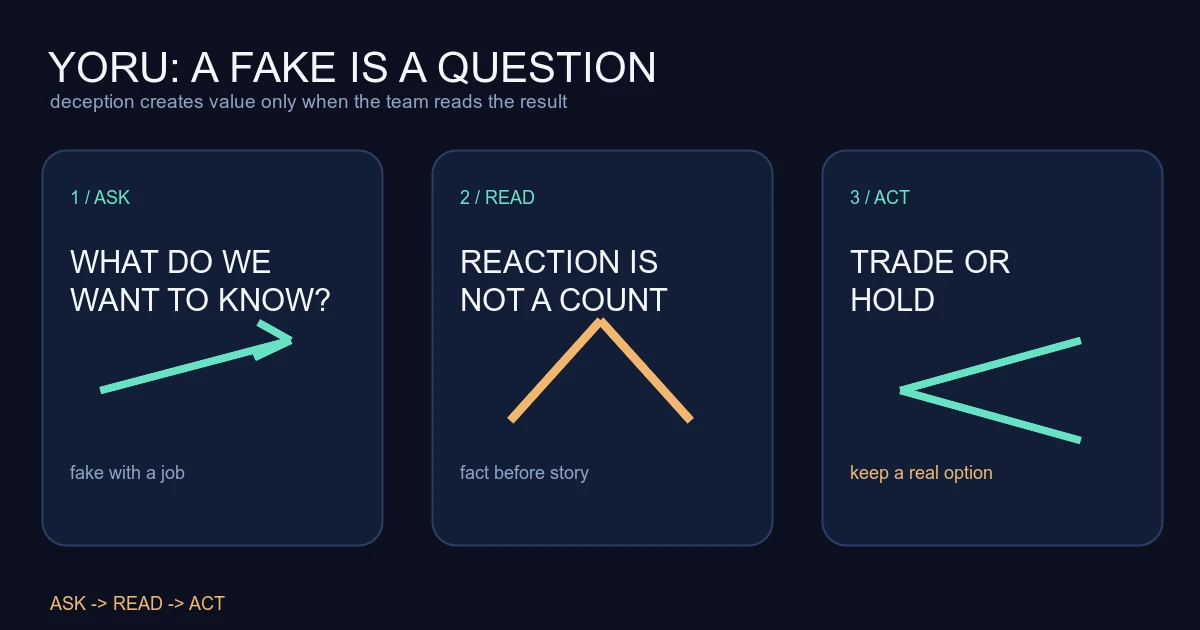
A fake is a question, not an answer
Before sending Fakeout, decide what you want to learn. Are you testing whether a close angle is occupied? Asking a defender to turn away from the real entry? Buying time for a teammate to cross? One fake should have one primary job.
Call the question out loud: “fake checks close,” “fake pulls site eyes,” or “fake now, we hold.” That makes the result easier to read. If the fake is destroyed, you know someone saw it or reacted to it. You do not automatically know how many players were there, where they are now, or whether the site is clear.
The useful comms guide gives the right structure: say what happened, where it happened, and what the team should do next. “They panicked” is an interpretation. “Fake destroyed close, no player count” is information.
Gatecrash needs an exit before it needs a destination
When you set up Gatecrash, start with the return condition. If the entry creates a fight, where can you leave? If the enemy ignores the threat, what does the team gain by keeping it available? If your teammate dies elsewhere, can you still use the route without arriving alone?
The destination matters, but a route that only works when nobody is watching is not a reliable plan. Test the first angle at the arrival point in a custom game. Walk the route with a teammate and check whether the player following you can take the same fight. Then add utility and repeat. A route that looks clever by itself may be impossible to trade.
Do not announce the teleport as an automatic call. Say what the team should expect: “Gatecrash threatens back site, we hit front,” or “I take the route only if contact starts.” This keeps the threat tied to a round decision instead of turning it into a solo side quest.
Deception still needs a real entry
Yoru's fake can make a defender look the wrong way, but somebody still has to take the useful space. Keep a teammate close enough to use the opening. The space guide is a good test here: what option did the deception leave for the next player?
If the fake pulls a defender off a common angle, take that angle with a trade. If it does not pull anyone, stop repeating the same idea. Use the information to slow down, change the lane, or keep the resource for the post-plant. Deception is strongest when the team can accept a quiet result.
Blindside also works best when it has a destination and a follow-up. Throwing a flash into a general area can create noise without a fight. Name the first player who will look at the result and the lane they will clear. A flash that no one plays is not an entry plan.
When not to force the trick
Avoid a complicated Yoru play when the team has no time to understand it. A late-round teleport threat with no Spike control, a fake while the team is already in a five-player fight, or a flash that blinds the only player holding the exit can make the round worse.
The trade guide is still the final check. Can the second player see the shooter and fight immediately? If not, simplify the play. Yoru's identity does not require every round to contain a fake. Sometimes the best use of the Agent is a normal flash, a held route and a clear call.
Practise the information loop
In a custom game, run one drill with a friend. Send Fakeout into a close angle while the friend chooses whether to destroy it or hold. You call only what you know, then decide whether the route remains useful. Repeat with a different starting position. The goal is to stop treating every reaction as a full map read.
After three live rounds, record the fake, the reaction, the fact confirmed, and the action that followed. If the reaction was loud but your team gained no space, the next practice is not a more complex trick. It is a better follow-up.
Sources checked
- Riot Games Yoru, checked in a live browser 2026-08-15 UTC. Used for Yoru's Duelist role, Blindside's hard-surface flash description and Fakeout's mirror-image flash behaviour.
The question rule, Gatecrash return planning, team calls, trade test and practice loop are Valorant Village coaching interpretation, not Riot rules or guaranteed outcomes.