Sunset B Site: How to Plan an Execute Around the Choke Points
Written by Valorant Village
Source-backed coverage ●
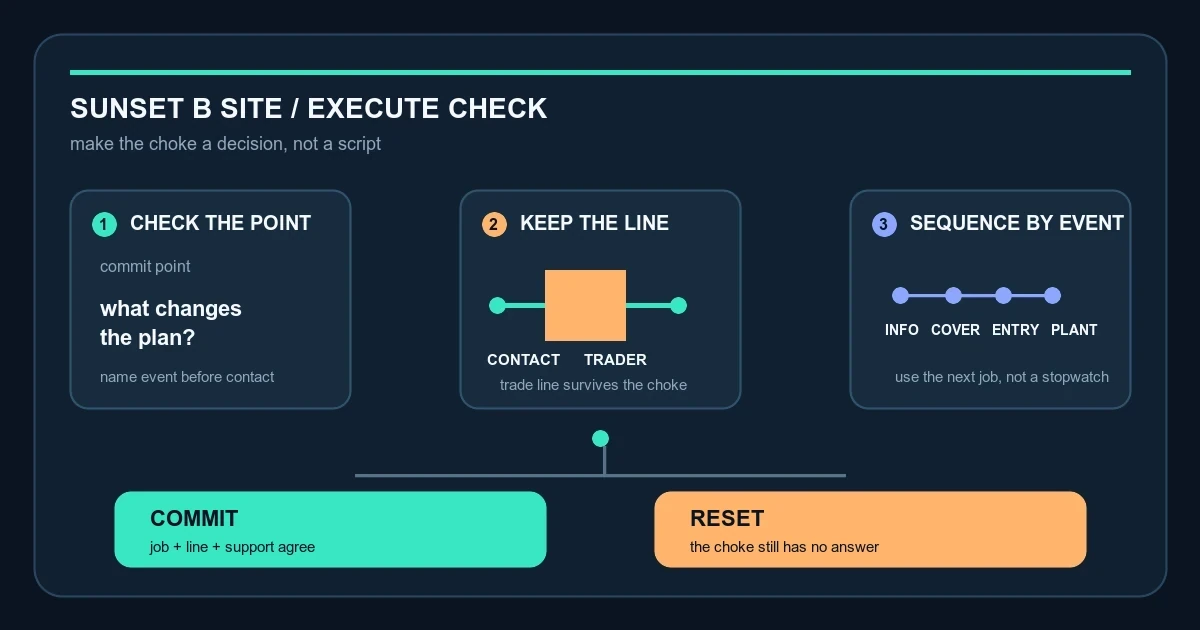
Sunset B Site is easy to reduce to “call B execute and throw everything at the first corner.” Riot’s current VALORANT Maps page describes Sunset as a traditional three lane map, while the Patch Notes 7.04 introduction describes three lanes and two sites. A useful B plan answers three questions before utility starts: where the approach stops being reversible, who can answer first contact, and what evidence cancels the push.
What Riot documents
Riot’s Patch Notes 9.08 names B Main, B Main Exterior, B Site, B Site Back, B Boba, and Mid Courtyard in its Sunset update. Riot says the B Site changes addressed defensibility, post-plant play, and more ways to play on site. It also says the B Main pivot box was adding pressure during post-plant, so the cover there was simplified to make it easier for retakers to manage. It is not a promise that one cover setup, trap, or post-plant position is always current or correct.
Riot’s Beginner’s Guide tells players to learn maps and enemy angles, consider whether enemies should hear a run or walk, check whether an ability helps the next goal, and communicate with voice, pings, or Agent voice lines. Riot’s tactical-cycle explanation gives the broader loop: Intel, Plan, Execute, Repeat. The practical sections below are Valorant Village coaching. Riot does not publish a universal Sunset timing, audio range, or B Site execute order.
Coaching: Find the commitment point
The commitment point is the event after which your team gives up a reversible choice. It is not a line on the floor that every team must cross at the same moment. It might be a confirmed defender contact, a cleared angle that makes the next step supportable, a teammate’s first move with a trader ready, or the Spike entering the route you have chosen. These are examples, not official Sunset triggers.
Choose the event before the choke becomes noisy. A clear call sounds like: “We hold B pressure until we confirm the contact. On that contact, Spike follows. If the contact is not tradeable, we reset.” Another round might use a utility result as the trigger. Everyone must know which fact changes the plan. Without that sentence, one player commits, another waits for a flash, and the Spike carrier is left deciding in the choke.
Coaching: Keep a trade line
A trade line is not an exact distance. It is the route and sightline that let a second player answer the first fight. Before entry, ask whether the trader can see the same contact, move without crossing the first player, and continue if the first player falls. Check whether your own smoke or denial utility blocks both players. Check whether the Spike carrier can arrive without becoming the first isolated fight. If any answer is no, the player at the front may still be gathering information, but the team is not ready to call that contact an execute.
Give each job a name: contact, trader, utility, Spike, and exit. On a narrow approach, a close stack can lose several players to one piece of utility. Spread too far and the first fight becomes unanswerable. Use How to Trade a Teammate in VALORANT for the broader spacing test, then apply it to the line your team is using today.
Coaching: Sequence utility by event
Use utility to solve the next problem, not to make the execute look complete. A flexible sequence is: gather or confirm information, cover the sightline that blocks the next step, support the first entry, then secure the plant and the exit. Not every round needs every category, and no agent order is mandatory.
Use events instead of a stopwatch. After information resolves, call what it actually showed. When cover is present, the contact player moves only if the trader is ready. When entry support creates a usable route, the Spike advances. After the plant, surviving players choose the exits they can hold. Riot’s “next goal” question is a good filter: if an ability does not help the next action, keep it or assign it to a later problem.
Sound is part of the decision, not a verdict. If a movement or ability cue gives the defenders a clue, say what was heard and what you are checking next. Do not turn one cue into an exact enemy count or assume the site is empty. The VALORANT Sound Cues: A Practice List for New Players has the same useful habit: describe the cue, then combine it with what the team can confirm.
Coaching: Know when to reset
Reset when the first contact is no longer tradeable, the Spike route has no support, or utility was spent without changing the problem. Reset when the information that justified the push is contradicted and nobody can state a new commitment point. A defender holding the choke is not automatically a reason to fight harder. If your team has lost the line that made the fight answerable, following one isolated player through only converts a bad read into more deaths.
A reset is a deliberate return to options. Preserve the Spike and ask a different question on the next approach. The Defaulting Explained: When a Slow VALORANT Round Creates More Options explains the larger principle: information is valuable when it keeps a better next move alive. On Sunset B, that may mean holding pressure, changing the approach, or returning later with a new support line. It does not mean forcing the choke because a smoke or flash has already been used.
Practise the decision, not a script
In a custom game, make three reps. First, walk the B approach and name the event that would make you commit. Second, add a teammate as contact and trader, then check whether both players can answer the same fight. Third, add one utility job at a time and say what changed. If the trade line disappears, reset instead of improvising a rescue. Review the fact you saw, commitment point, protected line, and reset trigger. That is a plan you can adapt when the choke behaves differently.